




































by Felicia Lindberg,Karolinska Institutet
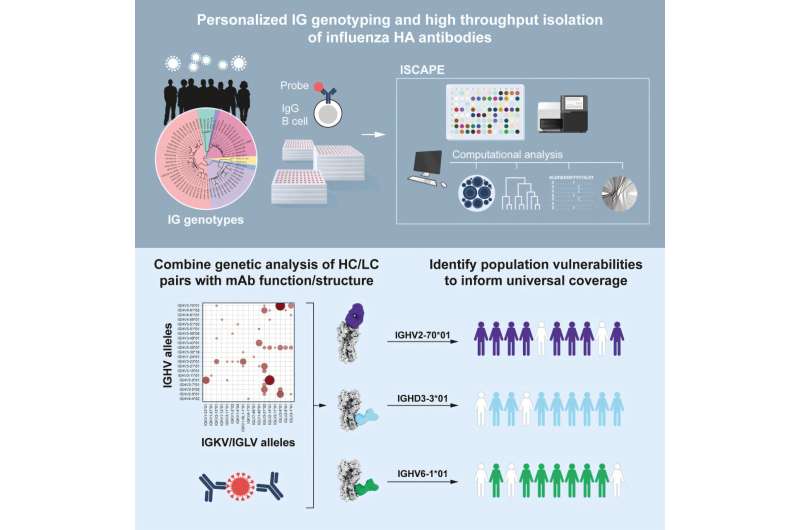
Credit:Immunity(2026). DOI: 10.1016/j.immuni.2026.03.002
Inherited variations in antibody genes can affect how we respond to infections and vaccines, show two new studies from Karolinska Institutet published in the journalImmunity. The researchers have mapped immune gene variation across multiple global populations and shown how these variations affect the ability to form neutralizing antibodies, for example against the influenza virus.
"We show that the genes that enable the body to form antibodies vary far more than previously thought, and this variation is seen in both coding and gene copy number differences," says Gunilla Karlsson Hedestam, professor at the Department of Microbiology, Tumor and Cell Biology, Karolinska Institutet, who led the research.
Antibodies, or immunoglobulins (IG), are produced by the immune system's B cells and are central to detecting and neutralizing foreign substances. In thefirst study, the researchers describe the development of a new targeted sequencing method, ImmuneDiscover, and used it to map antibody genes in 2,486 people from 25 population groups worldwide. The method makes it possible to analyze genetically difficult-to-reach regions of the genome in numbers of cases much higher than previously possible.
May contribute to susceptibility to infection
The most notable discovery was a common gene deletion of six consecutive IGHD genes, which differed in frequency between the population groups. IGHD genes encode the part of antibodies that recognize and bind to the foreign substance. The IGHD deletion occurred in all populations but was particularly common in people of East Asian origin, where up to 30% of some populations had deletions on both chromosomes, influencing the type of antibodies that are produced. The study also identified over 300 previously unknown gene variants, which were shown to be present in different frequencies in different population groups.
The human immune system has evolved over many thousands of years in populations living in widely differing environments, resulting inlocalized adaptationof the antibody genes to the predominant diseases, explains Martin Corcoran, researcher at the Department of Microbiology, Tumor and Cell Biology, Karolinska Institutet.
"The ability to map these genes in large groups of individuals will provide new knowledge about how immune gene differences affect our physiology in a range of conditions, ranging from infections and autoimmune diseases to cancer and, critically, provide a mechanism to read the immunological history of our species encoded within our DNA," he says.
Some antibody responses may not occur
In thesecond study, the researchers, in collaboration with the Scripps Research Institute in the U.S., investigated how genetic differences affect the immune response to the influenza virus. Using a new technique called ISCAPE, also developed at the Karlsson Hedestam laboratory, they were able to analyze individual B cells from four healthy adults and identify which antibody genes are used to produce neutralizing antibodies against the surface hemagglutinin (HA) protein.
The analysis again showed large differences between individuals and identified a common genetic variant that was found to affect the ability to form a certain class of neutralizing antibodies against the part of HA that the virus uses to bind to our cells. Importantly, the researchers showed that many of the neutralizing antibodies required the use of IGHD genes that are absent in many individuals, especially antibodies that bind to the more stable stem region of HA—a structure that is important in the development of broad influenza vaccines.
"We see that certain types of antibody responses are possible only in people with specific gene variants. This shows how important it is to take genetic diversity into account when designing vaccines that will work globally," says Karlsson Hedestam.
Publication details Martin Corcoran et al, Ultra-high-throughput IGH genotyping of 25 global populations reveals population-biased allelic diversity and homozygous V and D gene deletions, Immunity (2026). DOI: 10.1016/j.immuni.2026.01.026 Alexandra Fischer et al, Genetically diverse influenza antibodies highlight the role of IG germline gene variation and informs population-comprehensive vaccine strategies, Immunity (2026). DOI: 10.1016/j.immuni.2026.03.002 Journal information: Immunity










Post comments