




































byDelthia Ricks, Medical Xpress
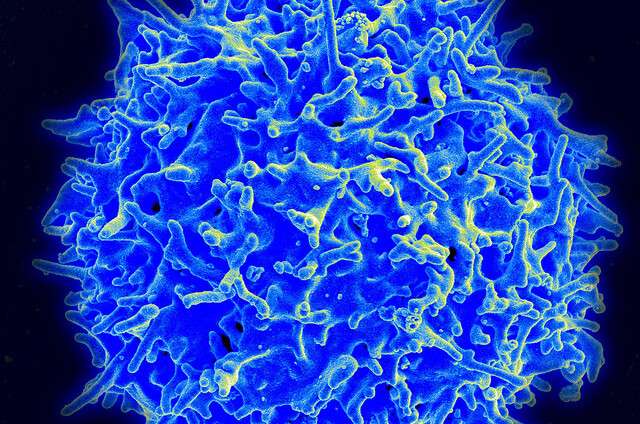
Scanning electron micrograph of a human T lymphocyte (also called a T cell) from the immune system of a healthy donor. Credit: NIAID
Signaling is fundamental to how cells sense and respond to their environment—but in immune cells, those signals must be precisely amplified to mount an effective defense against invasive threats. New research by immunologists in Germany is shedding light on how that amplification occurs in T cells, revealing a key molecular mechanism that helps trigger immune responses—and may also contribute to inflammatory conditions.
WritinginScience Signaling, researchers at the University Medical Center Hamburg-Eppendorf identified a crucial step in the production of a "second messenger," an internal signal that relays and amplifies messages received at the cell surface. Because external signaling molecules cannot enter the cell, second messengers translate those cues into powerful intracellular responses.
In T cells, that process depends on NAADP (nicotinic acid adenine dinucleotide phosphate), a molecule that drives calcium (Ca²⁺) signaling—an essential step in T cell activation. Without it, T cells cannot become the effector cells needed to fight serious threats, such as infections or cancer.
"T cell activation critically depends on the calcium ion (Ca²⁺)–mobilizing second messenger NAADP," wrote Dr. Kai Winterberg, the study's lead author. "NAADP induces localized Ca²⁺ signals that expand into global cellular responses."
Winterberg and colleagues identified critical signaling events that induce the generation of a calcium-mobilizing second messenger in a study involving a human T cell line and another line of mouse T cells.
The new study adds to the already vast—and still growing—catalog of data on T cell biological processes. And it also sharpens scientific understanding about second messenger activity in cells and its role in inflammation.
How NAADP is generated at synapses
The team found that NAADP is produced at the immunological synapse—the contact point between T cells and other cells, such as antigen-presenting dendritic cells, by the enzyme DUOX2. But fully activating DUOX2 requires more than a simple trigger.
Instead, the researchers discovered that multiple signaling pathways converge to switch the enzyme on. One pathway involves PKCθ, activated downstream of the T cell receptor at the synapse. Another involves protein kinase A (PKA), activated through adenosine A2A receptors at sites away from the synapse.
Together, these pathways modify DUOX2 through phosphorylation, enabling it to generate sufficient NAADP to drive calcium signaling.
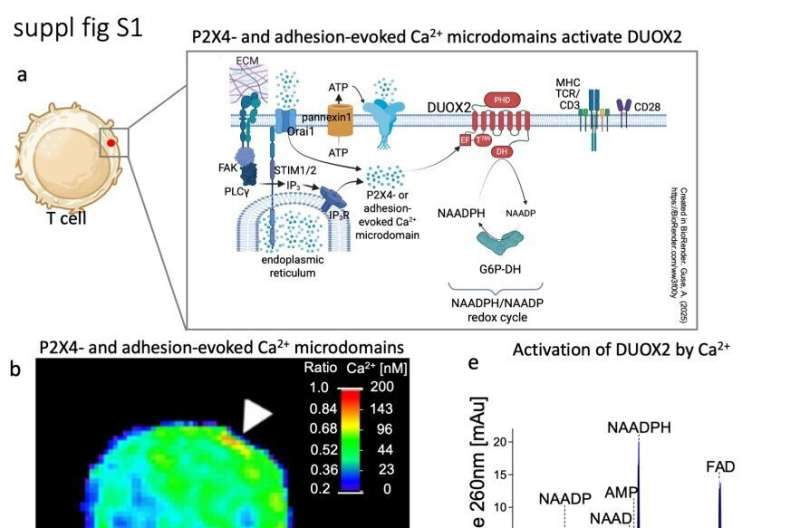
Ca2+increases NAADP formation by DUOX2. Credit:Science Signaling(2026). DOI: 10.1126/scisignal.adp4326
Integrating signals to fine-tune activation
The findings suggest that T cells rely on a coordinated integration of signals—both dependent on and independent of the T cell receptor—to fine-tune their activation.
As Wei Wong noted in an accompanying editorial commentary, this process leads to the formation of Ca²⁺ "hotspots" that ultimately trigger full T cell activation.
"These results suggest that NAADP production by DUOX2 is regulated by the integration of signals from the T cell receptor and other pathways during T cell activation," Wong added.
Implications for inflammation and therapy
The study has powerful implications for inflammatory conditions. When the researchers blocked either PKCθ or A2A receptors, T cells produced less of the inflammatory cytokine interleukin-17. Because inhibitors targeting these pathways are already in clinical trials, the work points to a potential strategy for modulating immune responses in inflammatory disorders.
Winterberg and colleagues concluded that "full stimulation of NAADP signaling that is critical for T cell activation requires integration of multiple T cell receptor-independent and dependent signals with different spatiotemporal characteristics by DUOX2, a fine-tuning mechanism that could be relevant for inflammation."
The researchers concluded that this signal integration mechanism may represent a critical control point in T cell biology—one that could be exploited to dial immune activity up or down in inflammatory disorders.
© 2026 Science X Network
Publication details Kai J. Winterberg et al, Multiple signaling events are required for NAADP synthesis by DUOX2 and formation of Ca 2+ microdomains to initiate T cell activation, Science Signaling (2026). DOI: 10.1126/scisignal.adp4326 Journal information: Science Signaling








Post comments