




































byKing's College London
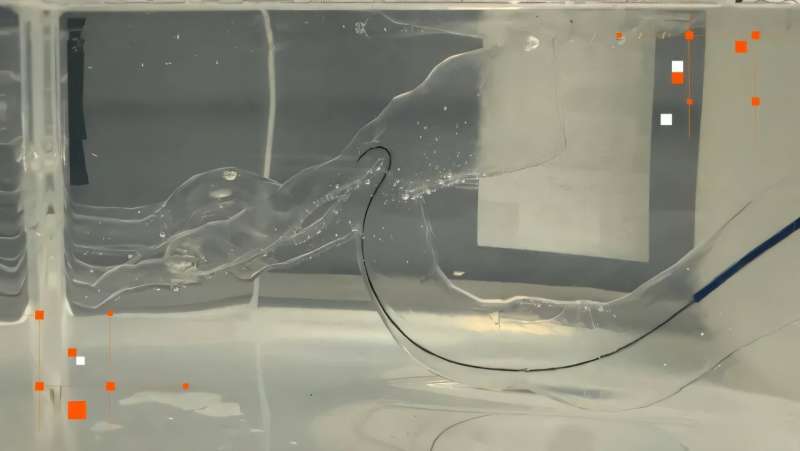
The AI-controlled guidewire being guided through a transparent 3D-printed blood vessel model. Credit: King's College London
Researchers at King's College London have shown for the first time that AI can autonomously perform thrombectomy navigation in a physical lab setting, a step toward expanding access to life-saving stroke treatment. For their study, nowpublishedinIEEE Robotics and Automation Letters, the team developed a robotic system that uses AI to navigate the complex pathway through blood vessels from the leg to the brain during mechanical thrombectomy (MT).
Stroke is the second-leading cause of death worldwide, and its incidence is rising. MT is a life-saving procedure that removes blood clots from large arteries in the brain during stroke. For some types of stroke, it is the most effective treatment, improving recovery and lowering the risk of death compared with medication alone.
However, MT is a complex procedure that requires highly specialized expertise. As a result, access remains limited, with many hospitals unable to offer the treatment.Robotic systemscould help expand access to MT by enabling specialists to perform procedures remotely.
"Autonomous robotics could allow equal access to life-saving stroke treatment no matter where you live in the world," said first author Harry Robertshaw, a Ph.D. student at King's School of Biomedical Engineering & Imaging Sciences.
In the study, the team developed asurgical robotic systemthat uses AI to help guide the catheters and guidewires safely through the body's complex blood vessels during MT.
Navigating from the entry point in the leg all the way up to the brain is long and complex. To address this, the researchers used a machine learning approach in which multiple AI "agents" are responsible for different parts of the pathway, rather than relying on a single AI for the entire procedure.
The team tested the system using bothcomputer modelsand 3D-printed models of human blood vessels. They found that overall, it could successfully navigate the complex vascular pathways.
"This work provides the first demonstration that thrombectomy can be done solely by AI in a lab setting, outside of simulations," explained Robertshaw.
"Translating these advances into real-world environments means that we are one step closer towards the goal of improving outcomes for patients by introducing autonomous endovascular procedures into the clinic," said senior author Dr. Thomas Booth, Reader in Neuroimaging at King's College London and Consultant Diagnostic and Interventional Neuroradiologist at King's College Hospital.
Publication details H. Robertshaw et al, Toward AI Autonomous Navigation for Mechanical Thrombectomy Using Hierarchical Modular Multi-Agent Reinforcement Learning (HM-MARL), IEEE Robotics and Automation Letters (2026). DOI: 10.1109/lra.2026.3664661 Journal information: IEEE Robotics and Automation Letters










Post comments