




































by Jill Adams,Thomas Jefferson University
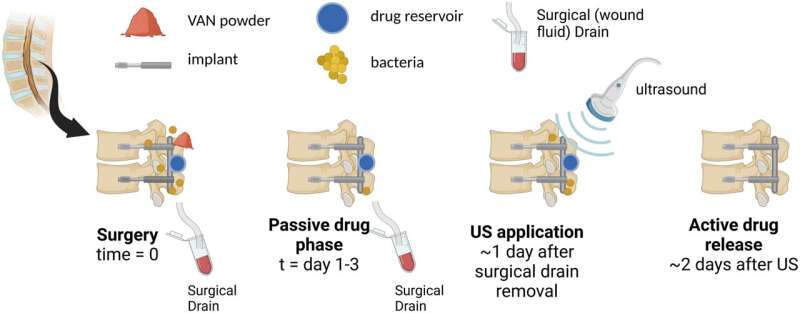
The timeline of proposed local drug delivery method. Credit:PLOS One(2025). DOI: 10.1371/journal.pone.0337717
Nearly one in 10 people who are implanted with a surgical fix to their spine will develop a serious bacterial infection, despite prophylactic antibiotic treatment. In a recent studypublishedin the journalPLOS One, researchers at Thomas Jefferson University have engineered a device they hope will help prevent this devastating complication.
Current practice includes applying antibiotics on wounded areas at the end of an orthopedic surgery, says Flemming Forsberg, Ph.D., professor of radiology and expert in ultrasound physics. The problem is that the protection wanes over hours, and any surviving bacteria can still ravage the area.
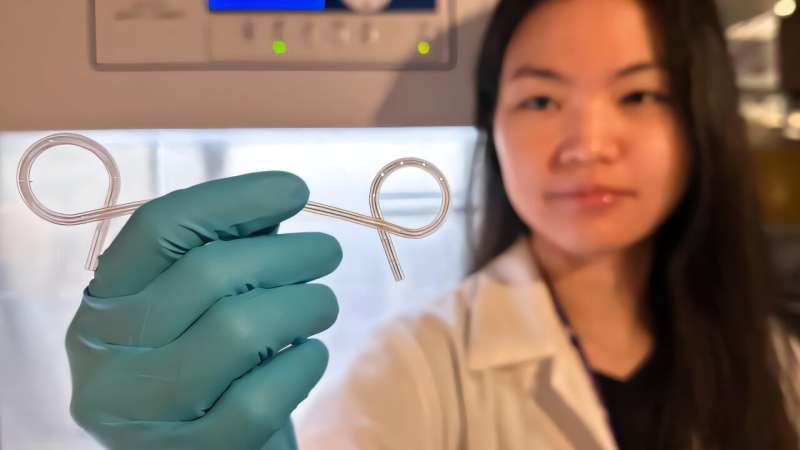
Dr. Forsberg, Dr. Noreen Hickok from orthopedic surgery and their team have been developing a tinyrepository of antibioticsthat could be put in the surgical site and activated with ultrasound two to three days later—when the prophylactic drugs have petered out. Such a device would help doctors deliver a one-two punch against troublesome bacteria.
The team first explored materials that would be stable enough to hold a reservoir of drugs for several days and also weak enough to break open with ultrasound. MD-Ph.D. student Selin Isguven Billmyer, first author of the study, spent years testing materials and shapes of receptacles. However, when tested in freely moving laboratory animals, the reservoir broke open too soon. She went back to the figurative drawing board to find a shape that would perform better. The design holds promise for clinical use in spinal surgeries.
A related antibiotic reservoir has been tested in knee surgery, and one of the Sidney Kimmel Medical College team members, radiology researcher Lauren Delaney, Ph.D., plans to conduct a multicenter clinical trial.
This iterative testing cycle is common practice in the Forsberg laboratory, which includes engineers, scientists, and physicians. "We test new engineering ideas, we get clinicians' feedback, and then we try to implement," he says. Getting his team's good ideas into the clinic is always the goal, in the vein of translational science. Dr. Forsberg says, "I can get the two sides to talk to each other, so we focus on moving solutions to real problems into clinical practice."
Publication details Selin Isguven Billmyer et al, Delayed delivery of antibiotics by ultrasound-mediated rupture of polylactic acid pockets: In vitro and in vivo studies, PLOS One (2025). DOI: 10.1371/journal.pone.0337717 Journal information: PLoS ONE









Post comments