




































byUniversity of Minnesota
Credit: Pixabay/CC0 Public Domain
Treatments for serious illnesses like cancer can be enormously time-consuming. Yet most research on cancer-related time burdens has relied on hospital administrative data and medical records—information that captures appointment lengths but overlooks the many additional hours patients spend traveling to appointments, managing care at home and handling the paperwork that accompanies their treatment.
A new study from the University of Minnesota School of Public Health, University of Minnesota Medical School and the University of Alabama at Birmingham sheds light on this often-overlooked cost of cancer care and examines the full scope of time patients devote to managing their treatment, both inside and outside the clinic.
To conduct the study, researchers tracked 60 adults receiving systemic therapy treatments for metastatic breast cancer or advanced stage ovarian cancer. Participants used a smartphone app that automatically detected location and activity through GPS and phone sensors to track their time use over 28 days. Participants reviewed and corrected the app's activity logs each day and reported additional out-of-clinic cancer-related tasks through short in-app surveys.
The study,publishedinJAMA Network Open, found:
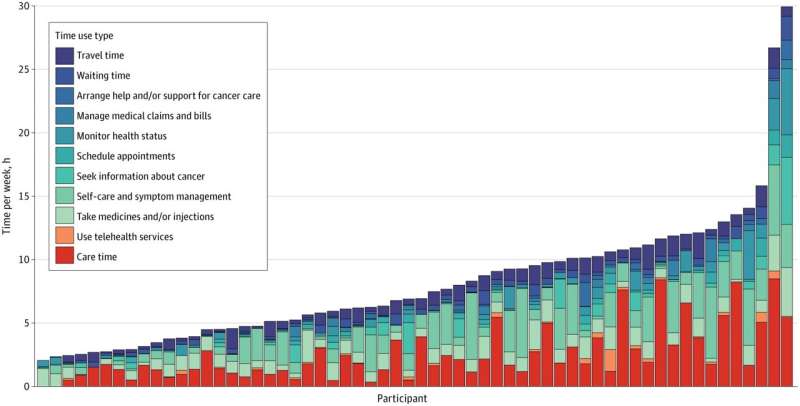
Weekly Total Time Spent on Each Health Care, Travel Waiting, and Home Cancer-Related Task by Participant. Credit:JAMA Network Open(2025). DOI: 10.1001/jamanetworkopen.2025.49957
"For years, patients have been telling us that managing cancer is like a part-time job—now we have the objective data to support that. Treatment for a disease like cancer can take over a patient's life in countless ways, yet past studies haven't captured the full range of demands it creates," said Rachel Vogel, an associate professor in the University of Minnesota Medical School and lead author.
"For many patients, the hours spent traveling, waiting or managing care at home far exceed the time spent in actual treatment," said Helen Parsons, a professor in the School of Public Health and co-author. "Recognizing these hidden burdens on patients, as well as their families and caregivers, is essential if we want to design cancer care that truly meets patients' needs."
Future research should refine howtime burdenis measured, examine which demographic or clinical factors predict higher burdens and explore how these demands affect quality of life, employment and financial well-being.
More information Rachel I. Vogel et al, Time Burden in Patients With Metastatic Breast and Ovarian Cancer from Clinic and Home Demands, JAMA Network Open (2025). DOI: 10.1001/jamanetworkopen.2025.49957 Journal information: JAMA Network Open
Provided by University of Minnesota










Post comments