




































by Darien Sutton,The Wistar Institute
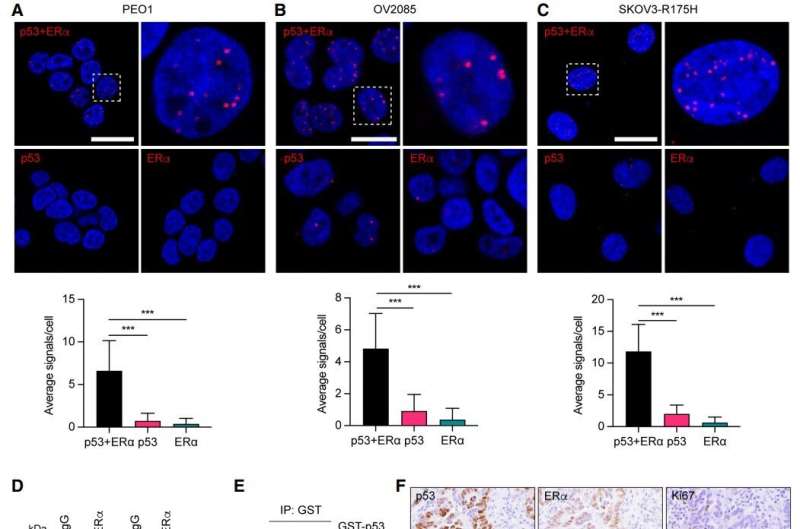
Mutant p53 interacts with ERα in ovarian cancer. Credit:Genes & Development(2025). DOI: 10.1101/gad.352953.125
Scientists at The Wistar Institute have solved a longstanding puzzle in ovarian cancer treatment: why anti-estrogen therapy often fails even when tumors express the hormone receptor that should make them responsive. The study reveals that mutant p53, which occurs in 96% of high-grade serous ovarian cancers, blocks estrogen signaling, which drives treatment resistance. The researchers also identified a potential therapeutic strategy that relies on a drug already being explored in clinical trials.
"This discovery fundamentally changes how we think about hormone therapy resistance inovarian cancer," said Maureen Murphy, Ph.D., deputy director of the Ellen and Ronald Caplan Cancer Center, Ira Brind Professor, program leader of the Molecular and Cellular Oncogenesis Program at The Wistar Institute, and senior author of the study.
"We've not only uncovered why these treatments fail but also identified a clear path to making them work. For patients with specific p53 variants, we can potentially combine FDA-approved drugs to overcome resistance."
High-grade serous ovarian cancer is particularly deadly, with an 80% relapse rate after initial chemotherapy and a predicted death toll of 13,000 women per year in the United States alone. While nearly three quarters of these tumors express estrogen receptors—suggesting they should respond to hormone-blocking drugs—clinical trialsof these therapies have shown a clinical benefit rate of only 41%.
Murphy's investigation into this discrepancy began with an unexpected discovery during her previous work on genetic variants of p53 found in people of African descent. When her team analyzedblood samplesfrom carriers of these variants, they found that estrogen-responsive genes showed dampened activity—a clue that led her team to explore the p53-estrogen receptor connection.
In the lab's most recent study,publishedinGenes & Development, the team discovered that the mutant p53 protein binds to estrogen receptors, disrupting an important hormone signaling pathway. When this happens, the tumor becomes resistant to hormone treatments.
Thanks to collaborations with key consortium partners such as the Helen F. Graham Cancer Center & Research Institute, Murphy's team was able to obtain human ovarian cancer cells and patient tissue samples to test whether silencing mutant p53 restored hormone therapy sensitivity. Their hypothesis proved correct: When mutated p53 was silenced, previously resistant tumors responded totreatment. Together with Ronny Drapkin at the University of Pennsylvania, they confirmed these findings in even the earliest stages of ovarian cancer.
"The most exciting part came when we tested a compound called rezatapopt," Murphy said. "This drug can refold a specific variant form of p53—called Y220C—back into its normal shape. When we combined rezatapopt with hormone therapy, tumors with this mutation became much more sensitive to treatment."
Rezatapopt is already being tested in clinical trials at Penn and other institutions, meaning this combination approach could be trialed in patients relatively quickly. Furthermore, the findings may have broader implications for other hormone-driven cancers. For instance, the work provides a potential explanation for why endocrine therapy sometimes fails in breast cancer patients with p53 mutations, opening new research directions for improving treatment of that disease, as well.
Murphy's team is now working to expand their findings to other variant forms of p53. They're also developing more precise methods to identify which patients would benefit most from p53-targeted combination treatments.
"Our ultimate goal is to transform this from a laboratory discovery into a clinical tool that helps patients," Murphy said. "We've shown the scientific principle works—now we need to translate that into treatment protocols that oncologists can use to help their patients."
More information: Chunlei Shao et al, Mutant p53 binds and controls estrogen receptor activity to drive endocrine resistance in ovarian cancer, Genes & Development (2025). DOI: 10.1101/gad.352953.125 Journal information: Genes & Development
Provided by The Wistar Institute








Post comments