




































byJapan Advanced Institute of Science and Technology
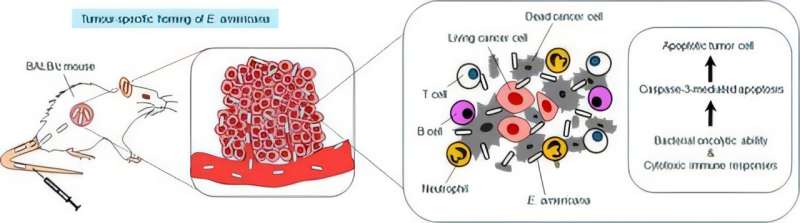
Mechanisms underlying Ewingella americana antitumor effects. Credit: Eijiro Miyako from JAIST.
A research team of Prof. Eijiro Miyako at the Japan Advanced Institute of Science and Technology (JAIST) has discovered that the bacterium Ewingella americana, isolated from the intestines of Japanese tree frogs (Dryophytes japonicus), possesses remarkably potent anticancer activity. This research has been published in the international journalGut Microbes.
While the relationship between gut microbiota and cancer has attracted considerable attention in recent years, most approaches have focused on indirect methods such as microbiome modulation or fecal microbiota transplantation. In contrast, this study takes a completely different approach: isolating, culturing, and directlyadministering individual bacterial strainsintravenously to attack tumors—representing an innovative therapeutic strategy.
The research team isolated a total of 45 bacterial strains from the intestines of Japanese tree frogs, Japanese fire belly newts (Cynops pyrrhogaster), and Japanese grass lizards (Takydromus tachydromoides). Through systematic screening, nine strains demonstrated antitumor effects, with E. americana exhibiting the most exceptional therapeutic efficacy.
In a mouse colorectal cancer model, a single intravenous administration of E. americana achieved complete tumor elimination with a 100% complete response (CR) rate. This dramatically surpasses the therapeutic efficacy of current standard treatments, including immune checkpoint inhibitors (anti-PD-L1 antibody) and liposomal doxorubicin (chemotherapy agent).
E. americana attacks cancer through two complementary mechanisms:
E. americana selectively accumulates in tumor tissues with zero colonization in normal organs. This remarkable tumor specificity arises from multiple synergistic mechanisms:
Comprehensive safety evaluation revealed that E. americana demonstrates:
This research has established proof-of-concept for a novel cancer therapy using natural bacteria. Future research and development will focus on:
This research demonstrates that unexplored biodiversity represents a treasure trove for novel medical technology development and holds promise for providing new therapeutic options for patients with refractory cancers.
More information Seigo Iwata et al, Discovery and characterization of antitumor gut microbiota from amphibians and reptiles:Ewingella americana as a novel therapeutic agent with dual cytotoxic and immunomodulatory properties, Gut Microbes (2025). DOI: 10.1080/19490976.2025.2599562







Post comments