



































byIngrid Fadelli, Medical Xpress
Credit: AI-generated image
Neuroscientists have been trying to understand how the human brain supports numerous advanced capabilities for centuries. The cerebral cortex, the outer layer of the brain, is now known to be responsible for many of these capabilities, including reasoning, decision-making, the processing of sensory information and voluntary movement.
Neurons in the cerebral cortex often become active consecutively or simultaneously for brief periods of time, following recurrent patterns of activity. These recurring neuron firing patterns have been linked to sensorimotor coordination, the brain's ability to link sensory inputs (i.e., the information collected via the senses) to movements.
For decades, repeating neuronal activity has been described in the context of attractor dynamics theory, a physics-based framework that frames recurring neuron firing patterns as so-called attractors. Attractors are stable states or activity patterns toward which a system naturally returns to.
The return to the same firing patterns was so far assumed to arise from strong connections between the same neurons, with groups of neurons acting as "pattern-completion" units. Neurons in these groups were theorized to elicit the same recurring activity patterns when only part of the neurons were activated.
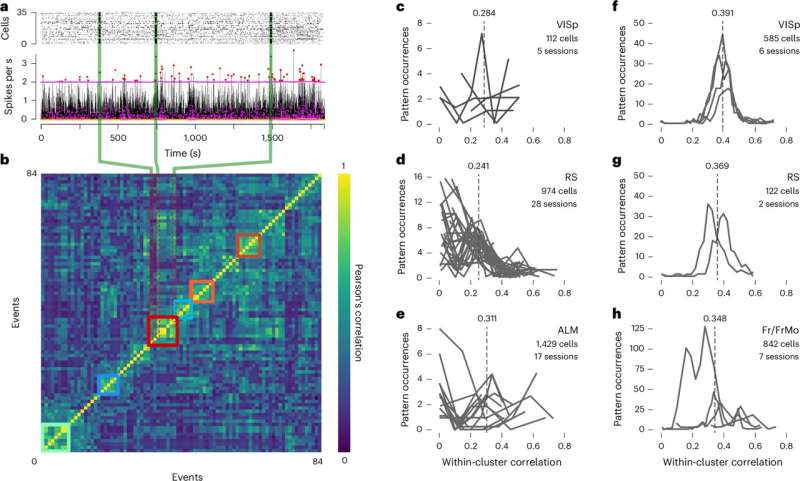
Reproducible activity patterns occur throughout cortex. Credit:Nature Neuroscience(2025). DOI: 10.1038/s41593-025-02128-5
Researchers at Paris-Saclay Institute of Neuroscience (NeuroPSI) recently gathered new evidence that challenges this assumption, proposing an alternative explanation for the repeating firing patterns of neurons in the cerebral cortex. Their paper,publishedinNature Neuroscience, suggests that rather than being organized into pattern-completing units, cortical neurons are arranged into modules that are connected to core neurons, which in turn guide the flow of activity in the brain.
As part of their study, the researchers at NeuroPSI analyzed several publicly availablebrain-related datasets, which were collected using various imaging techniques, microscopy tools and electrical activity detection methods. These included data released by theMICrONS project,the Allen Brain Observatory,Goard lab,Svoboda labandCortexLab.
By analyzing this data, the team first identified repeating activity patterns in the cortex. They then mapped connections between neurons and looked at how strongly neurons that repeatedly fired together were connected.
"Using multimodal datasets—including two-photon imaging, electrophysiology and electron microscopy—we show that these reproducible patterns do not involve strongly interconnected neurons," Domenico Guarino, Anton Flipchuk, and Alain Destexhe wrote in their paper.
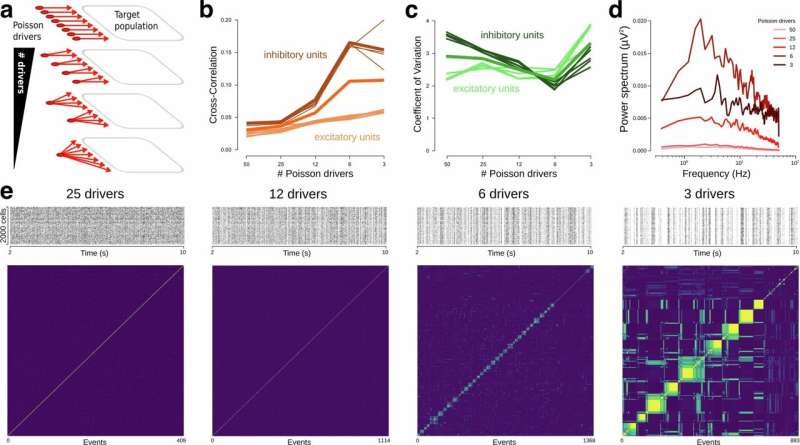
Increasing input correlations rescues population event reproducibility but introduces network-wide oscillations. Credit:Nature Neuroscience(2025). DOI: 10.1038/s41593-025-02128-5
"Instead, we show that cortical networks exhibithierarchical modularity, with core neurons serving as high-information-flow nodes at module interfaces. These cores funnel activity but lack the structural signatures of pattern-completion units that are typically found in attractor networks."
Guarino, Flipchuk and Destexhe also used computational models and computational tools to simulate neural networks and better understand the underpinnings of widely observed recurrent patterns of activity in the cerebral cortex. They found that these patterns are more likely to emerge from the activity of "core" neurons that act as "hubs," funneling information between different 'modules' of neurons that are more strongly connected to each other.
"Using computational models, we find thatdistance-dependent connectivityis necessary and sufficient to produce the modularity and transient reproducible events observed in the cortex," wrote the authors.
"Our findings suggest that cortical networks are preconfigured to support sensorimotor coordination. This work redefines the structural and dynamical basis of cortical activity, with a focus on the relationship between modular structure and function."
The results of this recent study appear to challenge a long-standing interpretation of recurring cortical activity, offering an alternative explanation. Future experiments and analyses could validate the team's hypothesis, potentially deepening the current understanding of the brain and how it coordinates sensory information with movement.
If validated, the team's new explanation could have important implications for the study of brain development or of disorders characterized by poor sensorimotor coordination. In addition, it could potentially inform the development of new types of artificial neural networks, computational models inspired by the brain's organization and functioning.
© 2025 Science X Network
More information Domenico Guarino et al, Convergent information flows explain recurring firing patterns in cerebral cortex, Nature Neuroscience (2025). DOI: 10.1038/s41593-025-02128-5 . Journal information: Nature Neuroscience











Post comments