




































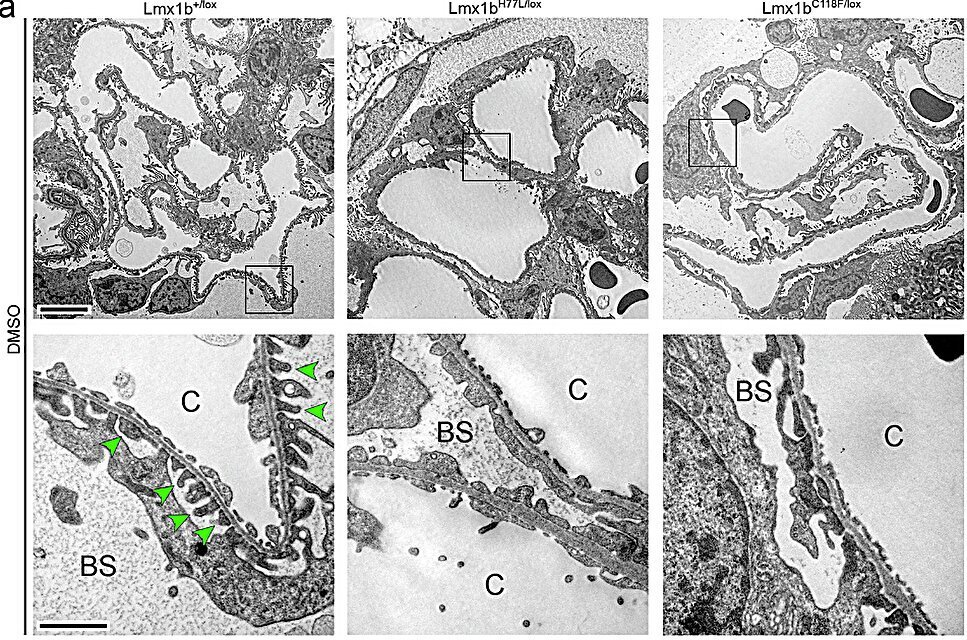
Treatment with bortezomib maintains the glomerular filtration barrier. Transmission electron micrographs demonstrate the drastically reduced number of foot processes (arrow heads) after 7 days of Cre induction (top panels), which was prevented to a large degree by the administration of bortezomib (bottom panels). Credit: Nature Communications (2026). DOI: 10.1038/s41467-026-77485-1
Researchers led by Dr. Ralph Witzgall, a professor at the Chair of Molecular and Cellular Anatomy at the University of Regensburg, have deciphered a key disease mechanism underlying the hereditary kidney disorder nail-patella syndrome and identified a potential therapeutic strategy. Their findings demonstrate that an already approved drug can significantly reduce disease-causing changes. The study, which also involved researchers from the Technical University of Munich (TUM), was recently published in the journal Nature Communications.
Nail-patella syndrome is a rare inherited disorder named after its characteristic abnormalities of the fingernails and kneecaps (the medical term for the kneecap is patella). However, the determining factor for patients' prognosis is impaired kidney function, which can in some cases progress to complete kidney failure. Although mutations in the LMX1B gene were identified as the cause of nail-patella syndrome as early as 1998, the molecular mechanisms underlying the disease have remained poorly understood, and no therapeutic approach currently exists to help affected patients.
Mutated proteins are degraded prematurely
The research team has now elucidated how certain disease-causing mutations in LMX1B contribute to kidney damage.
The kidneys, together with the liver, are the body's most important excretory organs and are responsible for filtering the blood. Essential substances such as proteins are normally retained in the bloodstream by the kidney's filtration apparatus and are not excreted in the urine. LMX1B regulates a genetic program that is indispensable for the function of specialized kidney cells known as podocytes.
LMX1B can perform its function only when it is bound to the trace element zinc. The researchers discovered that mutations preventing zinc binding destroy the structure of LMX1B. As a result, the body's quality-control system recognizes the mutated LMX1B as defective, causing the protein to become unstable and to be prematurely degraded by the proteasome. Consequently, LMX1B levels in podocytes fall below a critical threshold, the kidney's filtration barrier is no longer formed correctly, and protein leaks into the urine, a hallmark of kidney damage.
Therapeutic potential of a proteasome inhibitor
"Our results show for the first time that the disease-causing mutations do not alter the function of LMX1B itself, but rather impair its stability, thereby identifying an important molecular mechanism of the disease," explains Witzgall, corresponding author of the study. "The discovery of this disease-causing mechanism made it possible to test a novel therapeutic approach."
The team investigated bortezomib, a drug already used in cancer therapy that can inhibit the degradation of certain proteins by the proteasome. The researchers found that treatment with bortezomib stabilizes mutated LMX1B, leading to a significant reduction in proteinuria and consequently to stabilization of kidney function.
"Although these findings do not yet represent an immediately available therapy for affected patients, they constitute an important first step," says Witzgall. "They demonstrate that stabilizing the mutated LMX1B protein could, in principle, prevent or at least mitigate kidney damage."
More information: Joshua Hermens et al, Proteasome inhibition alleviates proteinuria in Lmx1b knock-in mice with dysfunctional LIM domains, Nature Communications (2026). DOI: 10.1038/s41467-026-77485-1
Provided by University of Regensburg
Source: MedicalXpress
Original article: https://medicalxpress.com/news/2026-10-cancer-drug-kidney-linked-patella.html










Post comments