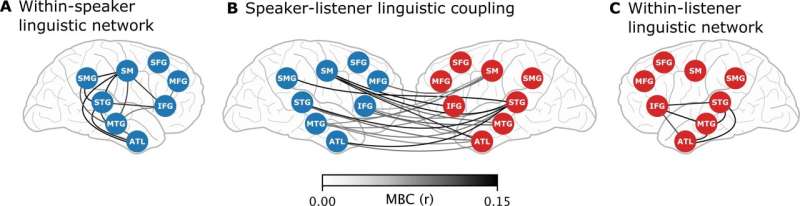




















byCell PressCoupling between speaker and listener brains. Credit:Neuron/ Zada et al.When two people interact, their brain activity becomes synchronized, but it was unclear until now
by Alzheimer's Research UKResearchers in Denmark have released findings from a small clinical trial of the diabetes drug liraglutide in people living with Alzheimer's disease.Thepil
by Medical University of ViennaAlzheimer's disease: patients exhibit changes in certain blood lipids that are typical of premature ageing. Credit: Medical University of ViennaThe neurodegener
by European Molecular Biology OrganizationResearchers at the Ludwig-Maximilians-University, the German Center for Neurodegenerative Diseases (DZNE), and the Institute for Stroke and Dementia Rese
by Perelman School of Medicine at the University of PennsylvaniaCredit: Unsplash/CC0 Public DomainAlzheimer's disease and related diseases can still only be confirmed in deceased patients'
by Kate Wighton,Imperial College LondonCredit: CC0 Public DomainNew research may help explain why people with type 2 diabetes are more likely to develop dementia.The findings, from scientists at
by American Academy of NeurologyDiagram of the brain of a person with Alzheimer's Disease. Credit: Wikipedia/public domain.An estrogen-like drug, raloxifene, has no demonstrated benefit on me
by McGill UniversityCredit: McGill UniversityFor years, neuroscientists have puzzled over how two abnormal proteins, called amyloid and tau, accumulate in the brain and damage it to cause Alzheim
by Australian Institute for Bioengineering and Nanotechnology (AIBN)SOX10 driven genetic switch is activated in SCOs and enables lineage tracing. SOX10 driven genetic switch is activated in SCOs and e
byOsaka Metropolitan UniversityAnti-Parkinson’s seaweed: Ecklonia cava is a seaweed that may hold the key to Parkinson’s disease prevention. Credit: Osaka Metropolitan UniversityParkinson's
by Ingrid Fadelli , Medical XpressColor-coded responses to different visual stimuli. a, Activations to achromatic high-SF gratings (in cycles per degree). Yellow, SF11; purple, SF15; orange, SF18. b,