




































bySociety for Neuroscience
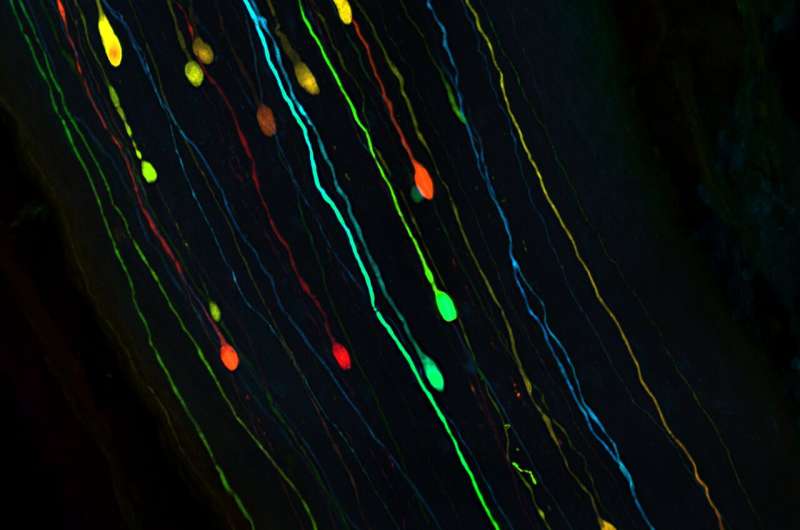
Microscopy image showing sparsely labeled axons in a mouse optic nerve shortly after traumatic brain injury. Axons are the long projections of neurons that carry electrical signals between brain regions. Traumatic brain injury causes diffuse and often irreversible disconnection and degeneration of these fibers, disrupting communication within neural circuits—in this case, between the eye and visual centers of the brain. Credit: Athanasios Alexandris
The brain shows a capacity to recover from traumatic injury, which somewhat contradicts the widely accepted idea that neurons do not regenerate. So how is recovery possible?
In a newJNeuroscipaper, Athanasios Alexandris and colleagues, from Johns Hopkins University, used mice to explore how the visual brain system recovers following traumatic injury.
The researchers monitored connections from cells in the eye to the brain after injury. They discovered thatsurviving cellscompensated for cell death by sprouting extra branches to make connections with more neurons in the brain. Thissproutingoccurred to such an extent that connections between the eye and brain matched preinjury levels.
Activity measures showed that these connections were functional. Notably, there were sex differences: Female mice had delayed or incomplete repair.
According to the authors, this work points to a compensatory mechanism following brain injury that differs between sexes.
Alexandris said, "We didn't expect to see sex differences, but this aligns with clinical observations in humans. Women experience more lingering symptoms from concussion or brain injury than men.
"Understanding the mechanism behind the branch sprouting we observed—and what delays or prevents this mechanism in females—could eventually point toward strategies to promote recovery from traumatic or other forms of neural injury."
The researchers plan to continue exploring underlying mechanisms and why they may be different in females and males.
More information Recovery of Retinal Terminal Fields After Traumatic Brain Injury: Evidence of Collateral Sprouting and Sexual Dimorphism, JNeurosci (2025). DOI: 10.1523/JNEUROSCI.0792-25.2025 Journal information: Journal of Neuroscience






Post comments