




































by India Glyde,University of Wollongong
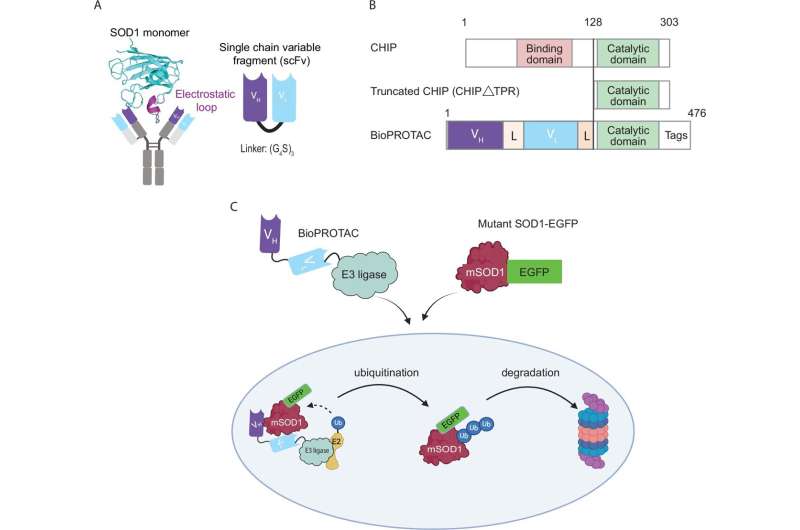
Design and proposed mechanistic action of the SOD1-targeting BioPROTACs. Credit:Nature Communications(2025). DOI: 10.1038/s41467-025-65481-w
University of Wollongong (UOW) scientists have developed a breakthrough therapy that clears toxic proteins from nerve cells—a discovery that advances the work of the late Professor Justin Yerbury and could transform the treatment of motor neuron disease (MND).
Theproof-of-concept study, published inNature Communicationsand led by Dr. Christen Chisholm from UOW's Molecular Horizons, unveils a therapeutic designer molecule, MisfoldUbL, that targets and removes toxic misfolded SOD1 (superoxide dismutase 1) proteins from cells. SOD1 is an antioxidant enzyme that plays a crucial role in protecting cells from damage caused by superoxide radicals. About 35% of people with inherited MND in Australia have SOD1 gene mutations that cause more frequent misfolding.
"In MND, proteins misfold more frequently and the cell's degradation systems become overwhelmed and stop working properly. The misfoldedproteincan then accumulate, forming clumps or 'aggregates' and over time, this accumulation damages and eventually kills motor neurons, leading to gradual muscle weakness, paralysis and death," Dr. Chisholm said.
"We wanted to design a therapy that could help the cells get rid of harmful misfolded SOD1 before it could accumulate into aggregates. To do this, we needed a way to identify the misfolded protein in the sea of cellular proteins. Once identified, we needed a way to feed misfolded SOD1 into the cell's degradation systems."
Developed with industry partner ProMIS Neurosciences, Misfold UbL acts like a protein recycling tag. It attaches to misfolded SOD1 proteins and directs the cell's waste-disposal system to break them down before they form clumps. In tests on mice, the treatment slowed symptom development, protectedmotor neuronsin thespinal cordand preserved muscle connections compared to untreated animals.
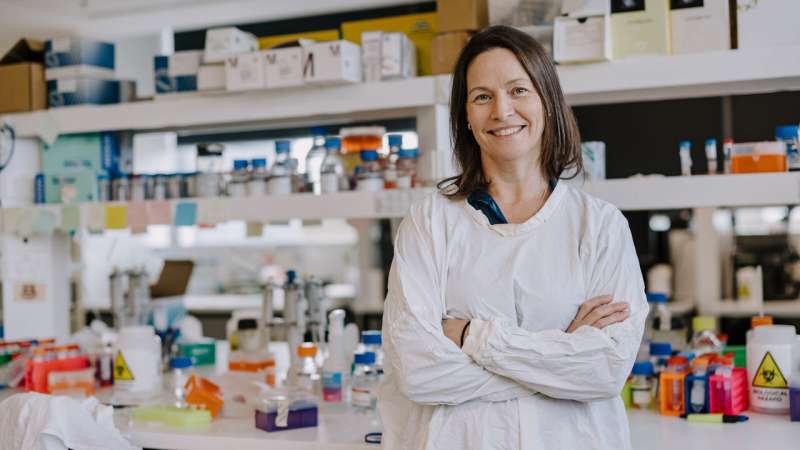
Credit: Michael Gray
The project was initially led by the late Professor Justin Yerbury. Professor Yerbury, who lost his own battle with MND in 2023, was a carrier of the SOD1 gene mutation and dedicated much of his career to understanding its role in the disease's development and progression. Early in her Ph.D., Dr. Chisholm took the helm of this project following Professor Yerbury's death.
Researchers from UOW's Yerbury Lab who were co-authors on the research included Dr. Jeremy Lum, lead author Dr. Christen Chisholm, Professor Heath Ecroyd and Dr. Luke McAlary.
Dr. Chisholm, a former high school science teacher, had been friends with Professor Yerbury for many years. A mother of three young children, she was inspired by Professor Yerbury to change careers and join his lab to help him continue his research following his MND diagnosis.
"This research is the result of years of dedicated effort by many amazing scientists, all inspired by Justin and driven to advancing our understanding of MND and how to treat it," Dr. Chisholm said. "I am especially honored that Justin entrusted his idea to me to develop and I'm so proud and grateful to all the people who helped me bring his idea to fruition."
The project was undertaken by researchers from UOW's Yerbury Lab in collaboration with MND researcher Professor Neil Cashman.
More information: Christen G. Chisholm et al, Development of a targeted BioPROTAC degrader selective for misfolded SOD1, Nature Communications (2025). DOI: 10.1038/s41467-025-65481-w Journal information: Nature Communications
Provided by University of Wollongong









Post comments