



































by UdeMNouvelles
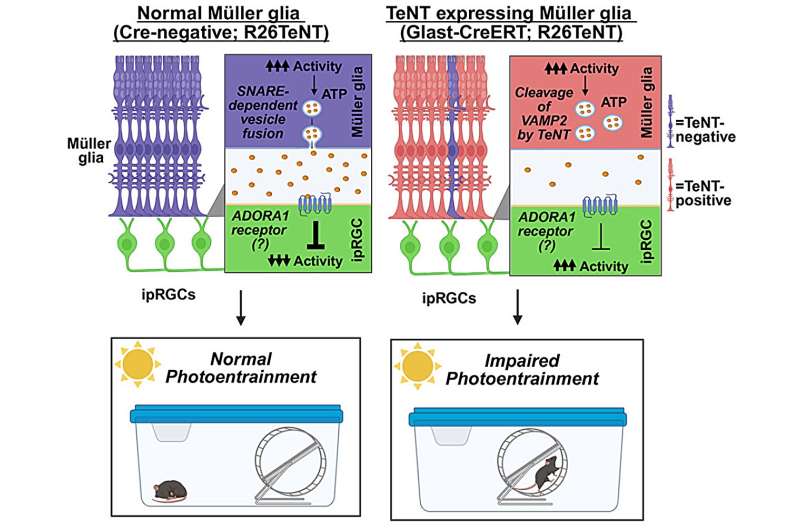
Credit:Cell Reports(2025). DOI: 10.1016/j.celrep.2025.116464
It's well-known that neural circuits help synchronize our biological clock with the day-night cycle. But just how exactly do those circuits develop, and can better understanding the process help, for example, in treating circadian rhythm disorders?
In a new study coinciding with the annual end of Daylight Saving Time, Université de Montréal medical professor Michel Cayouette and his research team at the UdeM-affiliated Montreal Clinical Research Institute provide some answers to those questions.
Published inCell Reportsjust days before the return last Sunday to regular time, thestudyreveals the unexpected role played by Müller glial cells in the retina, the layer at the back of the eyeball that converts light intonerve signals.
Typically considered as simple support cells in the retina, Müller glial cells actually play a key role in the assembly of neural circuitry, the UdeM researchers report.
Synchronization of our internal clock to the day-night cycle relies on specializedlight-sensitive cellsin the retina that send information about environmental light conditions to the brain, allowing it to adjust our daily rhythms.
However, the mechanisms controlling the formation of this critical neuronal circuit have until now remained poorly understood. Along with McGill University researchers Nicolas Cermakian and Arjun Krishnaswamy, Cayouette's team sought to learn more.
They discovered that by releasing specific chemical signals, Müllerglial cellsenable light-sensitive neurons to properly connect to the brain. In the absence of these signals, the neurons become overly reactive, interfering with our ability to adjust to changes in the day-night cycle.
"These findings show that the dialog between nerve cells and their glial partners is essential for building the system that regulates our circadian rhythms," said Cayouette, who wrote the study with co-first authors Thomas Brown and Noémie Vilallongue, members of his team.
Disruptions tocircadian rhythmsare linked to conditions such as insomnia, seasonal depression, metabolic imbalances, and even certain cancers.
Better understanding how this system develops could one day help prevent or correct these disorders, the researchers believe.
More information: Thomas W. Brown et al, Retinal glia regulate development of the circadian photoentrainment circuit, Cell Reports (2025). DOI: 10.1016/j.celrep.2025.116464 Journal information: Cell Reports
Provided by
UdeMNouvelles







Post comments