



































by Clara Turnage,University of Mississippi
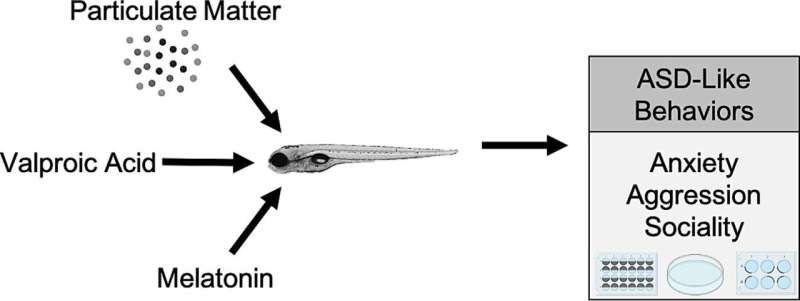
Graphical abstract. Credit:Neurotoxicology and Teratology(2025). DOI: 10.1016/j.ntt.2025.107548
University of Mississippi researchers have developed a new tool to help scientists study how environmental and genetic factors interact to influence autism spectrum disorder.
Courtney Roper, assistant professor of environmental toxicology, and Shayla Victoria, a 2025 graduate from thepharmaceutical sciencesdoctoral program, published their research on the impact of urban pollution on thebehaviorand development of zebrafish inNeurotoxicology and Teratology.
"The current status of scientific literature is thatautism spectrum disorderin humans is caused by a variety of factors that may involve a connection between genetics and the environment," Roper said. "While we didn't see a clear connection between particulate matter in every assay, it's still a model that we can use to start to look at gene-environment interactions.
"It gives us a new tool to study autism spectrum disorder."
About 1 in 31 children in the U.S. is diagnosed with autism spectrum disorder, according to the Centers for Disease Control and Prevention. Scientists havedocumented a connection between exposure to air pollution with an increased risk of autism in children,but its exact causes remain complex.
"There have been some studies that have linked exposure (to air particulate matter) during development—specifically in utero—to children being born and later being diagnosed with autism spectrum disorder," she said. "But in humans, that's very challenging to study."
By creating a model that allows scientists to test multiple environmental influences across genetic combinations, the researchers are opening a new path to study autism risk factors.
"ASD in humans is very complex, and our study aims to establish a model for investigating a part of this complexity, which is how environmental exposures can influence ASD-like behaviors," Victoria said.
"Our goal was to establish this model so that readers are encouraged to ask further questions that will drive important research about the environmental influences of ASD, and hopefully eventually lead to prevention measures."
Using azebrafish model, Roper and Victoria were able to control the genetics and exposure levels of particulate matter on developing fish embryos. Zebrafish are particularly well-suited for this type of study because they have defined behaviors at very early stages of development, Roper said.
"Because we are looking at autism spectrum disorder-like behaviors, we want to have a model where we can identify behaviors quickly and in large scale," she said. "With zebrafish, we can study a large number quickly and look for patterns and behavior."
Valproic acid, a medication that is widely prescribed for epilepsy and bipolar disorder, is aproven risk factor for autism spectrum disorder in children. TheU.S. Food and Drug Administration has warnedagainst its prescriptions for pregnant women.
By introducingvalproic acidto the fish, the researchers established a benchmark for autism-like behaviors to compare against pollution exposure.
While the air particulate matter tested did alter the neurological development and behavior of the fish, those changes were not always in line with autism spectrum disorder-like behavior.
"This model would be fairly simple to implement for the study of how other environmental contaminants impact neurodevelopment, which is partially why zebrafish are such a powerful model system in general," Victoria said.
"Just like we usedair pollutionparticles in our study, others could conduct similar exposure to otherenvironmental contaminantsthat are predicted to have neurodevelopmental impacts and measure those same behaviors.
"The results could prompt additional questions about those contaminants or even drive the research into a specific direction, based on which behaviors are impacted and how."
Future experiments can model differentparticulate matterand test longer periods of development.
"It's important to say that this is a model that helps us better understand the risk factors for autism spectrum disorder, not one that can immediately prove or disprove anything," Roper said.
"Now that we have this model, we can start expanding the types of behaviors we're looking at. We can look at long-term changes and see how this exposure might play out in adulthood. We can try other kinds of environmental exposures and combinations.
"It's a new tool we have that can help us understandautism."
More information: Shayla Victoria et al, Autism spectrum disorder-like behaviors in developing zebrafish exposed to particulate matter, Neurotoxicology and Teratology (2025). DOI: 10.1016/j.ntt.2025.107548
Provided by University of Mississippi










Post comments