




































By Ingrid Fadelli
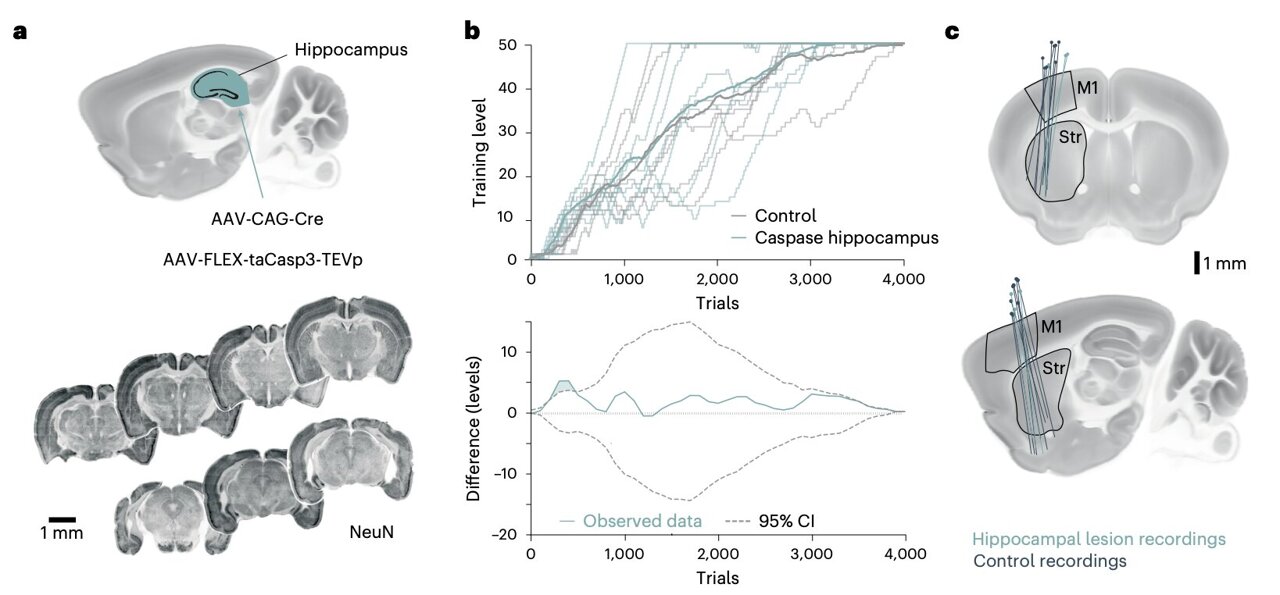
Procedural memory formation and replay are independent of the hippocampus. a, Top: schematic of the experimental approach for bilateral lesion of the hippocampus. Bottom: histology, example NeuN-stained coronal slices showing lesion extent across hippocampal volume for a mouse. b, Top: learning progression curves (training level versus trials) for control and lesioned animal groups (shaded area = s.d.). Bottom: differences in performance between the groups. The dotted lines indicate the 95% CI for the shuffled data (Methods; lesion n = 7 mice, control n = 6 mice). c, Schematic showing implanted Neuropixel probe locations projected onto a standard Allen coronal (top) and sagittal (bottom) atlas. Credit: Thompson et al. (Nature Neuroscience, 2026).
Sleep is a crucial physiological process that supports recovery, clears metabolic waste products from the brain, regulates metabolism and supports the functioning of the immune system. Sleep is also known to play a key role in consolidating different types of memories, ranging from memories of past events and memorized facts to newly acquired skills or habits (i.e., procedural memories).
A key neural process that supports memory consolidation during sleep is offline replay, the reactivation of the same brain activity patterns that occurred during earlier experiences while awake.
Past neuroscience research hypothesized that offline replay originates in the hippocampus, a brain region known to support the formation and organization of declarative memories, or memories of facts, events or experiences that can be consciously recalled. However, how the brain consolidates procedural memories (i.e., memories of learned skills and habits) remains unclear.
Researchers at University College London (UCL) recently carried out a study aimed at better delineating the brain regions involved in consolidating procedural memories during sleep. Their paper, published in Nature Neuroscience, suggests that different types of memories are consolidated via separate but parallel replay systems beyond the hippocampus.
Probing the brain regions supporting procedural memory consolidation
To shed more light on the neural circuits involved in replaying and consolidating procedural memories during sleep, the team at UCL carried out an experiment involving adult mice. The mice gradually learned a new motor skill through extensive practice.
The researchers recorded the activity of neuron populations in the mice's brains while they were learning this motor skill and during subsequent periods of sleep. This allowed them to determine whether similar activity patterns occurred during learning and sleep, a hallmark of offline replay.
"Current models propose that replay originates in the hippocampus and triggers reactivation across cortical and subcortical networks," wrote Scott J. Thompson and his colleagues in their paper. "However, conflicting evidence about the role of the hippocampus in offline consolidation of nondeclarative memories raises the question of whether hippocampal replay drives their consolidation. We show that replay occurs in the dorsal striatum during offline consolidation of a procedural memory in mice, independently of the hippocampus, and that its content predicts subsequent performance improvements."
Thompson and his colleagues observed similar patterns of activity in the dorsal striatum, a region implicated in motor learning and habit formation, while the mice were learning the new motor skill and during subsequent sleep. They also found that specific characteristics of replay events predicted how well the mice could perform the new skill after sleeping.
"Neural sequences linked to salient behavioral events were prioritized for replay, with positive and negative behavioral outcomes having opposing effects on individual replay events," wrote the authors. "All features of replay persisted despite complete bilateral hippocampal lesions."
Interestingly, when they damaged the mice's hippocampus, the researchers still observed the same recurring patterns of activity in the dorsal striatum. This suggests that the hippocampus is not essential for consolidating the type of procedural memories examined in this study. Moreover, the team found that successful and unsuccessful attempts to perform the new motor skill influenced replay differently.
Parallel brain circuits could strengthen different memories
The results of this study suggest that the consolidation of declarative and procedural memories relies on partly distinct replay mechanisms involving different brain circuits. As the team's study focused on mice, more research will be needed to determine whether humans exhibit similar memory consolidation mechanisms.
"These findings demonstrate that procedural replay occurs independently of the hippocampus, indicating that replay-driven memory consolidation can operate through parallel, independent mechanisms," wrote Thompson and his colleagues.
In the future, the insights gathered by these researchers could help improve existing theories of sleep and memory consolidation. A better understanding of these mechanisms may, in turn, inform research exploring the underpinnings of sleep disruptions, impaired motor learning and memory dysfunction.
More information: Emmett J. Thompson et al, Replay of procedural memory is independent of the hippocampus, Nature Neuroscience (2026). DOI: 10.1038/s41593-026-02362-5.









Post comments