




































--Compiled from internet by Yale Gong, Sr. Advisor of www.medicine.net
1. Science:Unraveling the Core Mechanism of Sleep Homeostasis: Thalamic Circuit Plasticity Drives the Repayment of “Sleep Debt”

On June 19, 2025, a research team from Johns Hopkins University published a study titled “Sleep need–dependent plasticity of a thalamic circuit promotes homeostatic recovery sleep” in the journal Science, revealing a small part of this mystery. Researchers identified for the first time a specific neural circuit within the mid-raphe nucleus (mRE) that regulates the initiation of restorative sleep through sleep-need-dependent synaptic plasticity.
The study comprehensively revealed a closed-loop mechanism: from the accumulation of “sleep debt” (sustained activity in mRE neurons), to the activation of molecular sensors (CaMKII), to the structural reinforcement of neural circuits (synaptic plasticity in RE→ZI synapses), ultimately triggering deep restorative sleep. This anchors the macro-physiological phenomenon of sleep homeostasis to a specific, dynamically remodelable neural circuit, providing a novel theoretical foundation for understanding sleep disorders.
2. Nature Neuroscience:Scientists have for the first time identified a predictable “sleep threshold” in the brain, laying a scientific foundation for the diagnosis and treatment of sleep disorders as well as safety warning applications.
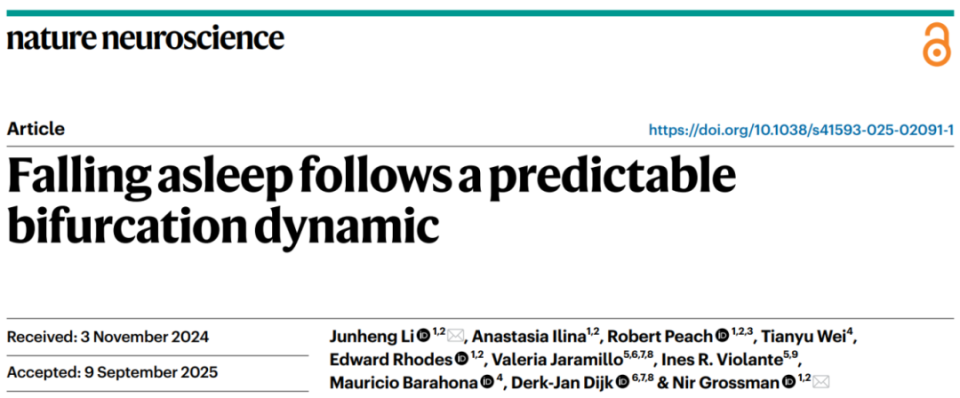
Scientists have for the first time identified a predictable “sleep threshold” in the brain, laying a scientific foundation for the diagnosis and treatment of sleep disorders as well as safety warning applications.
In November 2025, Junheng Li and Nir Grossman from Imperial College London's Department of Brain Sciences and the Imperial Centre for Dementia Research, in collaboration with the Sleep Research Centre at the University of Surrey and other institutions, published a paper titled “Falling asleep follows a predictable bifurcation dynamic” in Nature Neuroscience. The study provides the first experimental evidence that the brain's sleep onset process follows bifurcation dynamics. The team developed a novel computational framework representing EEG activity changes as trajectories in feature space.
They validated the bifurcation characteristics of falling asleep across two independent datasets involving over 1,000 participants, identifying the wake-sleep transition point and observing critical deceleration phenomena. Using this computational framework, the study achieved real-time prediction of falling asleep with sub-second resolution and an accuracy exceeding 0.95. This research offers a novel dynamical perspective on sleep onset mechanisms, laying a scientific foundation for sleep disorder diagnosis and treatment as well as safety alert applications.
3. Cell:Sleep-dependent neuroendocrine circuit for growth hormone release

On September 4, 2025, a research team from the University of California, Berkeley published a groundbreaking study titled “Neuroendocrine circuit for sleep-dependent growth hormone release” in the journal Cell. This work systematically revealed for the first time the specific neural circuitry in the brain that regulates growth hormone release during sleep, along with its feedback mechanisms, unraveling the neurobiological mystery behind how deep sleep promotes growth hormone secretion.
The researchers focused on GHRH neurons that secrete growth hormone-releasing hormone and SST neurons that secrete somatostatin in the hypothalamus. They discovered that during rapid eye movement (REM) sleep, GHRH and SST neurons synchronously activate, jointly driving pulsatile growth hormone release. In contrast, during non-rapid eye movement (NREM) sleep, the regulatory pattern becomes more refined: SST neuron activity decreases, releasing inhibition on GHRH neurons. This allows GHRH neurons to moderately activate, thereby promoting growth hormone secretion.
4. Nature:Changes in Pupil Size During Sleep Reveal Mechanisms of Temporal Segregation in Memory Consolidation
On January 1, 2025, a research team from Cornell University and other institutions published a study titled “Sleep microstructure organizes memory replay” in the journal Nature. The study revealed for the first time that microscopic fluctuations in pupil size during non-rapid eye movement (NREM) sleep precisely correspond to the consolidation processes of different memory types, providing a new mechanism for addressing the critical question of how memories avoid interfering with each other during sleep. The study demonstrates that the hippocampus replays recent experiences during sleep to consolidate memories. However, simultaneous activation of new and old memories may lead to interference or forgetting. Previous theories speculated that memories might be replayed randomly or regulated by specific sleep sub-states.
5. Cell Reports:The metabolome of the gut microbiota reveals a new mechanism linking sleep quality to frailty in older adults.

Zheng Yan, Wang Xiaofeng from Fudan University, Yuan Changzheng from Zhejiang University, and Liu Zhaoqian from Zhongnan University published a research article in the online edition of the journal Cell Reports entitled “Gut metagenome and plasma metabolome profiles in older adults suggest pyruvate metabolism as a link between sleep quality and frailty.” (Gut metagenome and plasma metabolome profiles in older adults suggest pyruvate metabolism as a link between sleep quality and frailty). The study is based on data from a large population group and highlights the important role of the gut flora and its metabolites in sleep quality and frailty. It thus provides potential new starting points and valuable resources for future longitudinal studies and clinical intervention studies.
The research team drew on the Rugao longitudinal age cohort and included 1,225 older adults aged 62 to 95, whose gut microbiota underwent metagenome sequencing and whose plasma samples underwent metabolomic analysis. Sleep quality was assessed using the Pittsburgh Sleep Quality Index. The results showed that probiotic bacteria such as Faecalibacterium prausnitzii were significantly reduced in older adults with poor sleep quality, while potentially harmful bacteria such as Erysipelatoclostridium ramosum were relatively more abundant.
6. Sleep:Phase III Clinical Data for New Insomnia Drug Daridorexant-Dalirex Released in China

In December, 2025, a research team from Xuanwu Hospital of Capital Medical University and other institutions (totally 33 centers) published a study in the journal Sleep titled “Efficacy and Safety of Daridorexant in Chinese Patients with Insomnia: A Multicenter, Randomized, Double-Blind, Placebo-Controlled Phase III Clinical Trial.” The study demonstrated that Daridorexant significantly improved sleep onset, maintenance, and total sleep time compared to placebo without altering sleep pattern. The drug is a novel dual orexin receptor antagonist (DORA) that acts on both orexin 1 and orexin 2 receptors, and it is well-tolerated with no evidence of dependency, rebound insomnia, withdrawal symptoms, or drug abuse. The study was conducted in collaboration with Simcere Pharmaceutical Group Limited and Idorsia Pharmaceutials Ltd.
7. Journal of Sleep Research:An In-Depth Exploration of Children's Sleep: Sleep Health and Sleep Behavior Disorders in Children and Adolescents

Adequate sleep is essential for healthy development and significantly contributes to physical and mental well-being. Despite expanding research on children's sleep, many mysteries remain. This narrative review outlines our current understanding of pediatric sleep health, identifies gaps in the literature, and considers factors such as age, gender, cultural differences, and the interactions between sleep, physical activity, nutrition, and mental health. It also addresses sleep health in more specific populations of children with neurodevelopmental disorders.
Published in the 2025 Journal of Sleep Research, the review “A Closer Look at Pediatric Sleep: Sleep Health and Sleep Behavioral Disorders in Children and Adolescents” frames pediatric sleep health as a multidimensional construct. It discusses age-specific issues, including factors affecting satisfaction, daytime alertness, sleep timing, efficiency, duration, and sleep-related behaviors. Few studies have explored childhood gender differences or variations in parental attitudes toward sleep between boys and girls. The impact of culture on sleep health, particularly during adolescence, remains unclear. Further research is needed to understand the interactions between sleep, nutrition, and physical health across developmental stages. Additionally, this review highlights sleep's protective role in adolescent mental health and in managing emotional and behavioral issues among children with neurodevelopmental disorders. It identifies key areas for future research to deepen our understanding of pediatric sleep health and develop more effective, tailored interventions and prevention programs.









Post comments