




































byAmerican Heart Association
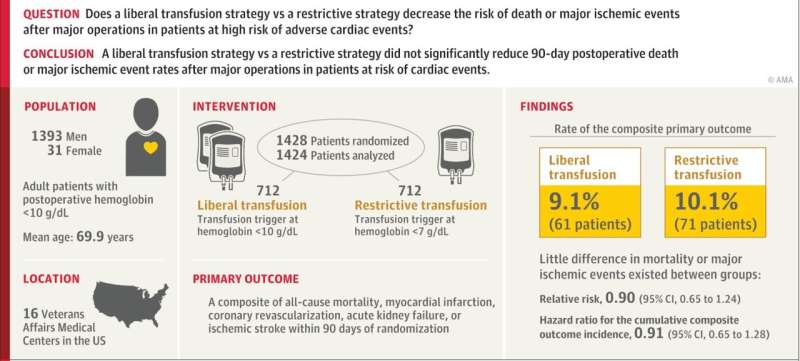
Credit:JAMA(2025). DOI: 10.1001/jama.2025.20841
An earlier blood transfusion—done when hemoglobin levels were higher—after major general or vascular surgery among people with heart disease was associated with a lower risk of some complications but not the most severe ones, according to a preliminary late-breaking science presentation Saturday at the American Heart Association'sScientific Sessions 2025. The paper was simultaneouslypublishedinJAMA.
The Transfusion Trigger after Operations in High Cardiac Risk Patients (TOP) trial investigated whether transfusing blood earlier, when hemoglobin levels drop below 10 g/dL after major surgery, may prevent complications among heart patients better than a strategy that calls for transfusions when hemoglobin levels drop below 7 g/dL. Hemoglobin is a vital component of red blood cells that transports oxygen throughout the body.
In this study of more than 1,400 military veterans having major general orvascular surgery, hemoglobin levels were assessed after surgery and reassessed after each transfusion to determine if additional transfusions were warranted until discharge or 30 days, whichever came first.
The trial compared the combined frequency of major complications, such as death, heart attack, kidney failure, need for a heart procedure or stroke to less severe but still serious complications like pneumonia, sepsis, wound infections, new irregular heartbeat, cardiac arrest or heart failure, for the two strategies 90 days after surgery.
"When excessive blood loss or anemia occurs during or after surgery, a blood transfusion may be needed. For people withheart disease, the risk of complications due to the strain of blood loss means that the timing of a blood transfusion is critical," explained lead author Panos Kougias, M.D., M.Sc., chair of the department of surgery at SUNY Downstate Health Sciences University in Brooklyn, New York. "The current standard of care for most patients is to wait until hemoglobin levels are low before transfusing blood."
"Our findings suggest that persistent blood loss in patients with serious underlying heart issues does not increase the risk of serious complications, such as death, heart attack, kidney failure, need for a heart procedure or stroke. However, it might place a greater strain on the heart than the volume from a transfusion, leading to problems like heart failure and irregular heartbeat," Kougias said. "The earlier blood transfusion strategy may protect the heart from the effects of blood loss. It's like keeping a car's fuel tank above half full, while the transfusion-later strategy is like adding fuel only when the low-fuel light comes on."
The analysis found:
"We were surprised that the restrictive transfusion strategy—giving less blood by only transfusing once patients' hemoglobin levels were below 7 g/dL—was associated with a higher rate of heart failure," Kougias said. "The traditional thinking has been that giving more blood may potentially overload the heart and worsen failure. Our finding suggests that in high-riskheart patients, persistent anemia might place a greater strain on the heart than the volume from a transfusion, leading to complications such asheart failureand arrhythmia. As this was a secondary outcome in our study, further research will be needed to confirm this finding.
"These results suggest that a one-size-fits-all transfusion strategy may not be best," he said. "For some patients, waiting to transfuse remains safe and appropriate. However, for patients with serious underlying heart disease undergoingmajor surgery, our findings show that an earlierblood transfusioncould help prevent serious heart complications, other than aheart attack."
The study's limitations include that most participants were men, so the results may not apply to women. In addition,health care professionalsknew which patients received which transfusion strategy, which may have affectedpatient care. In addition, the number of severe complications was fewer than expected, which means that small differences may have gone undetected.
Study details, background and design:
More information: Panos Kougias et al, Liberal or Restrictive Postoperative Transfusion in Patients at High Cardiac Risk, JAMA (2025). DOI: 10.1001/jama.2025.20841 Journal information: Journal of the American Medical Association
Provided by American Heart Association









Post comments