




































by Courtney Karayannis,Monash University
Credit: Monash University
Despite making up half of the 64 million people living with heart failure, patients with this common form have no access to heart pump treatments and are left with only medication or palliative care.
New research suggests that a reimagined heart pump could offer hope for patients suffering fromheart failurewith preservedejection fraction(HFpEF), a form of heart failure that has historically been difficult to treat. Unlike the more commonly known heart failure with reduced ejection fraction (HFrEF), HFpEF occurs when theheart musclebecomes stiff, making it harder for the heart to fill with blood between beats, despite maintaining a normal pumping function.
A Monash University study proposes an innovative heart pump design could address the unique challenges of this condition by improving blood flow and alleviating the strain on the heart.
The study,publishedin theAnnals of Biomedical Engineering, shows that a heart pump designed specifically for HFpEF could provide a bridge to transplant to keep patients alive while they wait for a donor heart, or even serve as a long-term solution for those without other options.
As part of her Ph.D. program inmechanical engineeringat Monash, study lead author Nina Langer investigated how existing heart pumps could be adapted for HFpEF patients, helping drive innovation in next-generation devices andpatient care.
"This major heart failure condition, known as HFpEF, has no dedicated mechanical circulatory support, leaving over half of all heart failure patients without a mechanical support option," Ms. Langer said. "Most of these patients have a heart that's stiff, with thickened walls and a smaller ventricle. This means standard ventricular assist devices don't fit well—and can even cause harm."
Credit: Monash University
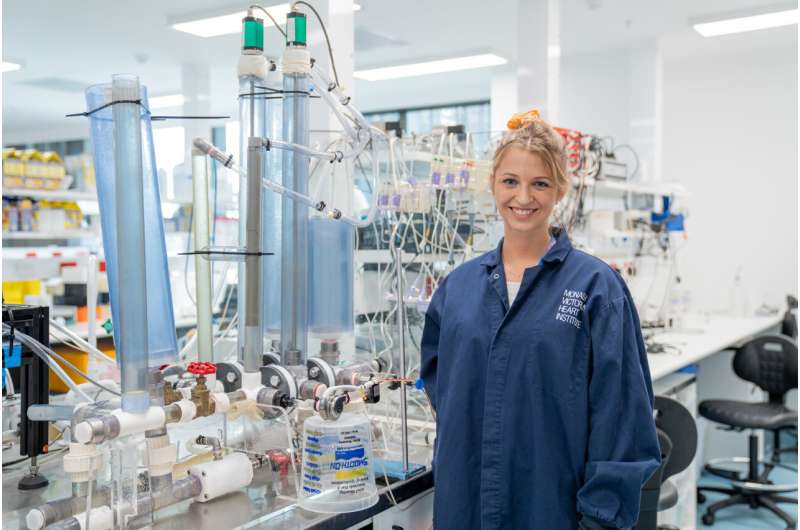
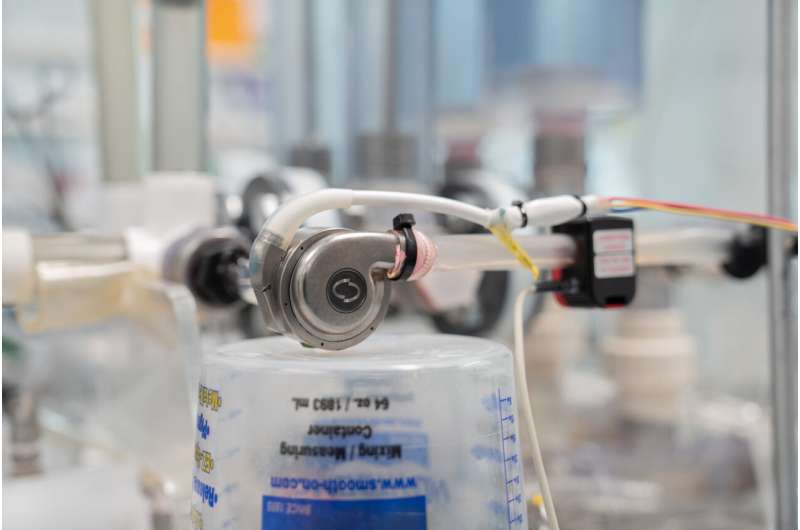
During her research, Ms. Langer got hands-on with a purpose-built test rig, and designed a high-tech plumbing system with pipes, pumps and valves. This allowed her to simulatecardiovascular conditions, testing modifications to existing devices and making real-time adjustments.
These findings are contributing to the development of the first mechanical circulatory support device for HFpEF patients, which is now being developed by the Monash-led Artificial Heart Frontiers Program (AHFP), the largest cardiovascular device program in the country.
Ms. Langer said the study highlighted a critical gap in heart failure treatment.
"The results underscore the need for dedicated heart pumps designed for this patient group, rather than repurposing devices developed for other types of heart failure. A dedicated pump could transform care for millions, offering a new lease on life for those currently left with few options."
In addition to the cardiovascular simulator, Ms. Langer developed a cutting-edgecomputational modelthat was experimentally validated in collaboration with MIT (Massachusetts Institute of Technology), to further explore the adaptations of existing heart pumps and to help engineers and clinicians push the limits of innovation in the field.
Prof. Shaun Gregory, one of Ms. Langer's Ph.D. supervisors and the Co-Director of the AHFP, said, "Nina's high-quality and translational research captures the unmet need for novel, targeted mechanical circulatory support for the largest cohort of patients with heart failure—over half of patients fall into the HFpEF category. While we've known of this unmet need for some time, this new study points to a clearer device development pathway."
More information: Nina Langer et al, HeartMate 3 for Heart Failure with Preserved Ejection Fraction: In Vitro Hemodynamic Evaluation and Anatomical Fitting, Annals of Biomedical Engineering (2024). DOI: 10.1007/s10439-024-03585-y Journal information: Annals of Biomedical Engineering
Provided by Monash University










Post comments