




































byWalter and Eliza Hall Institute of Medical Research
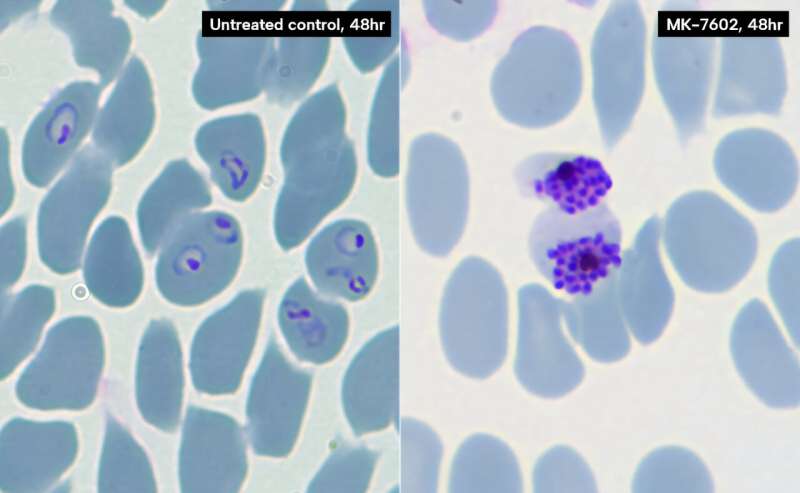
These images show the malaria parasites before and after treatment. Without MK-7602, parasites (purple) invade red blood cells (blue) after two days. With MK-7602, they are trapped inside cells, halting the malaria cycle and blocking transmission. Credit:eBioMedicine(2026). DOI: 10.1016/j.ebiom.2025.106061
Researchers have developed a new antimalarial drug candidate designed to address the growing challenge of drug resistance and potentially reduce malaria transmission.
The first-in-class clinical candidate, MK-7602, has been developed through a longstanding collaboration between WEHI and global biopharmaceutical company MSD (tradename of Merck & Co., Inc., Rahway, N.J., U.S.).
Pre-clinical research nowpublishedineBiomedicineshows the novel drug candidate targets the malaria parasite at multiple stages of its life cycle, with potential applications for both treating infections and reducing disease spread.
Since the completion of this preclinical research, results from early stage clinical trials continue to provide evidence for the potential of MK-7602 for the treatment of malaria.
The emergence of drug-resistant parasites has complicated efforts to control and eliminate malaria, which remains a leading cause of preventable illness and death globally, killing an estimated 600,000 people a year. Children under 5 are the most vulnerable—it is estimated that a child dies of malaria every minute.
The new drug candidate MK-7602 targets the most prevalent malaria parasites in humans, Plasmodium falciparum and Plasmodium vivax, and blocks two essential parasite enzymes, providing a unique dual-action strategy with the potential to reduce the risk of resistance.
Professor Alan Cowman AC, lead investigator from WEHI, said new and better treatments for malaria were urgently needed, to drive forward global efforts towards eradication.
"The evaluation of MK-7602 represents an important step in our fight against malaria," he said. "Its ability to target multiple stages of the parasite life cycle, combined with its high barrier to resistance, supports our ongoing efforts to find new ways to combat this devastating disease for patients who need the hope of new treatments."
MSD scientist and Discovery lead Dr. David Olsen said, "The development of MK-7602 exemplifies our commitment to addressing critical global health challenges through innovative research. We are encouraged by these results and look forward to further investigating this candidate as a potential new tool in malaria control and elimination efforts."
The close research collaboration between WEHI and MSD, spanning almost a decade, used the advanced screening technologies at WEHI's National Drug Discovery Center, which were instrumental in identifying and optimizing the compound.
The new study combinedmouse modelsand laboratory tests using human blood cells to evaluate the activity of MK-7602 against malaria parasites at multiple life stages, including the blood, liver and transmission stages.
Its mechanism targets two essential parasite enzymes,Plasmepsin IXand X, with the goal of creating a high barrier to the development of resistance.
MK-7602 has since completed Phase 1 safety and tolerability studies. Results of aPhase 1b clinical trialevaluating the activity of MK-7602 against P. falciparum blood stage infection in healthy adult participants (NCT06294912) were recently presented at the American Society of Tropical Medicine & Hygiene (ASTMH 2025) meeting held in Toronto Nov. 9–13.
Further studies are needed to fully assess the efficacy and safety of MK-7602 in diverse patient populations and real-world settings.
More information Paola Favuzza et al, MK-7602: a potent multi-stage dual-targeting antimalarial, eBioMedicine (2026). DOI: 10.1016/j.ebiom.2025.106061 Journal information: EBioMedicine











Post comments