






























by Sujith Ramachandran, Adam Pate,The Conversation
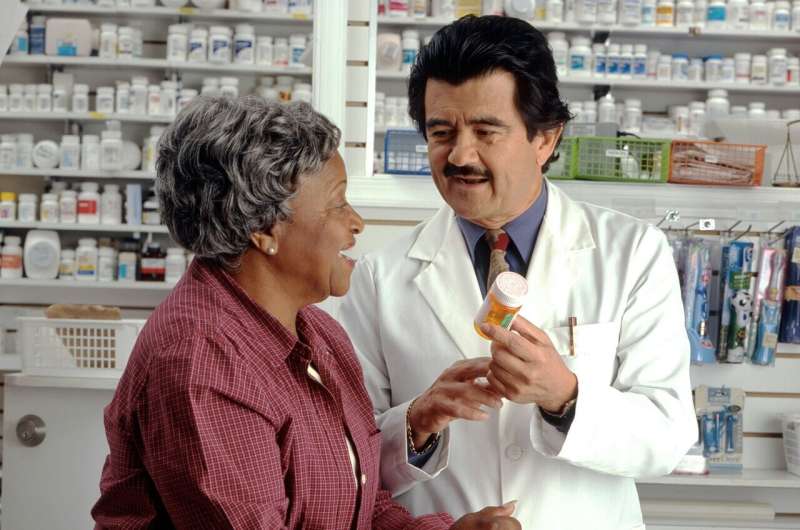
Credit: Unsplash/CC0 Public Domain
Even when Americans have health insurance, they can have a hard timeaffording the drugs they've been prescribed.
About 1 in 5 U.S. adults skip filling a prescription due to its cost at least once a year,according to KFF, a health research organization. And 1 in 3 take steps to cut their prescription drug costs, such as splitting pills when it's not medically necessary or switching to an over-the-counter drug instead of the one that their medical provider prescribed.
Aspharmacy professorswhoresearch prescription drug access, we think it's important for Americans to know that it is possible to get prescriptions filled more affordably, as long as you know how before you go to the pharmacy.
When you have health insurance and have to pay for a prescription drug at the pharmacy, you're usuallycovering the cost of your copay. This is the amount patients or their caregivers are expected to pay after insurance covers the rest of the tab.
If you get yourhealth insurance through Medicaid, the government program that covers low-income Americans and people with disabilities, you should not have to pay anything at all to obtain prescription drugs. If there is a copay, it should be low—probably less than US$5.
And if you'reinsured through Medicare, the government program that mainly covers people who are 65 and older, or get your coverage through a private health insurance company, it's important to understand what to expect when you visit a pharmacy.
Mostprivate insurance companies charge US$5 to $50for prescription drug copays. The copays are tiered based on what the drug costs. Brand-name and specialty medications have higher copays; older generics have lower copays.
Some generic drugs and vaccines may even require no copay at all. While a copay is a flat fee, it can change over the course of the year based on whether or not you have met your deductible. The deductible is the amount of money you have to pay out of pocket before your insurance starts covering your prescriptions. Before your deductible is fully paid, you may be responsible for the full cost of your medications. After you've met your deductible for the year, you will only be required to pay the copay.
As newer, more expensive drugs enter the market,cost-sharingat the pharmacy has increasinglyshifted from a copay to coinsurance.
In contrast with a flat copay, coinsurance means your insurance company willcover a certain percentageof the drug's cost, and you'll pay the rest. Since the patient's share is based on a percentage of the medication's price, coinsurance often results inhigher out-of-pocket costs than copays do.
Two newgovernment programscould help make prescription drugs more affordable for millions of older Americans.
Starting in 2026, people who are insured through Medicarewill pay no more than $2,100out of pocket on prescription drugs over the year. That cap may be much lower than $2,100 due to a quirk in Medicare's rules. Prescriptions filled after someone has paid the maximum allowable amount will cost them nothing at all.
In addition, the government launched theMedicare Prescription Payment Planin 2025. This program, which is available to people over 65, helps spread what patients spend out of pocket on prescription drugs throughout the year, making that expense more predictable and easier to budget for.
Early data indicates thatvery few Americans are enrolledin the Medicare Prescription Payment Plan. Patients insured through private companies do not have similar opportunities.
What if you can't afford a copay for your prescription drug?
Before giving up on ever getting it, ask the pharmacist about your options.
It may be worth trying to use a free online tool,such as RxAssist, sponsored by the Robert Wood Johnson Foundation, or adiscount card from GoodRx, which is a publicly traded company.
GoodRx cards are free. They help people compare local pharmacy prices and to locate coupons thatmake prescriptions more affordable.
GoodRx works by searching for the lowest available price for the prescription at various pharmacies. Other copay coupons provided by the drug manufacturer may also work similarly by lowering the cost of the medication. On some occasions, the cash price at the pharmacy may actually be cheaper than the copay, and the pharmacist should be able to help you navigate these options.
Here's what you should know before giving GoodRx a try:
You should weigh the caveats closely depending on your circumstance.
Prescription assistance programsprovide another cost-saving tool for Americans.
Drugmakers, nonprofits and government agencies sponsor those programs, which help patients who are uninsured or underinsured—even if they are on Medicare—fill prescriptions either at a discount or for free.
These programs include manufacturer-specific programs as well ascharitable pharmacieslikeDispensary of Hope,NOVA Scripts Centraland thePatient Advocate Foundation. Qualifying criteria vary for these programs, but typically you must have a low income and be a citizen or a legal U.S. resident.
ThePatient Access Network FoundationandRxAssist, two nonprofits that help Americans pay their medical bills, also offer helpful tools to identify programs that could work for you.
Assistance from these programs could cut your copay or even provide a prescription drug at no cost.
Separately, the Trump administration announced in November 2025 that a new White House prescription drug pricing program will soon begin to connect consumers to companies that have agreed to sell certain prescription drugs at a big discount.
Many experts don't expect the program,known as TrumpRx, to help people who havehealth insurance. Instead, it could be most likely tohelp those with no insurance at all. The new government program is slated to begin to roll out in 2026.
Beyond coupons and assistance programs, a more radical shift is in the works:direct-to-consumer platformsand cash-payment models.
In 2025, several manufacturers offered to sell medications directly to patients on websites and patient portals at cash prices. For example, thedrug manufacturer Eli Lilly is offeringits popular weight-loss medication, Zepbound,on its website.
These websites have out-of-pocket costs that can run upward of$300 a month, making them too high for many, if not most, Americans to afford. And insurance companies have so far refused to cover them.
To be sure, the systems underlying these programs are still being built. We believe that the Trump administration would need to make a bigger effort to make it easier for millions of Americans to be able to afford filling their prescriptions.
This article is republished fromThe Conversationunder a Creative Commons license. Read theoriginal article.
Key medical concepts Prescription Drugs Vaccines Tirzepatide










Post comments