




































byGriffith University
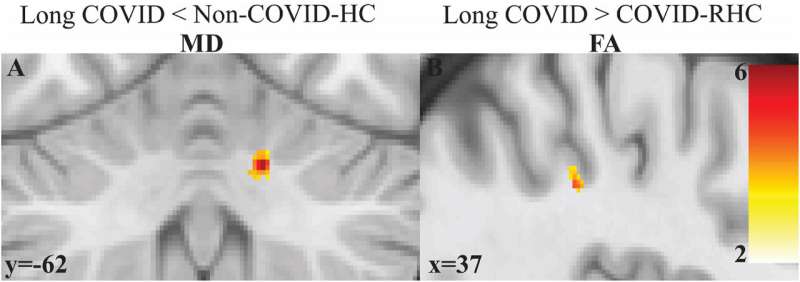
Clusters with significant differences in mean diffusivity and fractional anisotropy. Credit:Brain, Behavior, & Immunity - Health(2025). DOI: 10.1016/j.bbih.2025.101142
COVID-19 does not just affect the respiratory system, but also significantly alters the brain in people who have fully recovered from the infectious disease, highlighting the long-term neurological impact of the virus.
Researchers from Griffith University's National Center for Neuroimmunology and Emerging Disease (NCNED) used advanced MRI techniques to ascertain the neurological implications of COVID-19 compared with those who had never been infected.
The paper ispublishedin the journalBrain, Behavior, & Immunity - Health.
The research provided compelling evidence that even in the absence of ongoing symptoms, prior infection with the virus could leave a measurable imprint on the brain.
Lead author, Dr. Kiran Thapaliya, said, "We usedmultimodal MRItechniques to examine both gray and white matter brain regions critical for memory, cognition and overall brain health and found clear differences across all participant groups."
"The unique MRI approach identified significant alterations inbrain neurochemicals, brain signal intensity, and tissue structure not only in individuals with Long COVID but also in those who considered themselves fully recovered," he said.
"The research also reported that altered brain tissue was associated with symptom severity in individuals with Long COVID, suggesting the virus may leave a silent, lasting effect on brain health."
These findings offer vital insights into how COVID-19 affects the central nervous system and may help explain the cognitive problems, such as memory and concentration, reported both shortly after infection and months or even years later.
NCNED Director, Professor Sonya Marshall-Gradisnik, said, "The NCNED brings together a critical mass of talented researchers and clinicians committed to improving the lives of the patients."
"We are privileged to access state-of-the-art technologies which drive transformative scientific discoveries."
More information Kiran Thapaliya et al, Altered brain tissue microstructure and neurochemical profiles in long COVID and recovered COVID-19 individuals: A multimodal MRI study, Brain, Behavior, & Immunity - Health (2025). DOI: 10.1016/j.bbih.2025.101142
Provided by Griffith University








Post comments