




































by JooHyeon Heo,Ulsan National Institute of Science and Technology
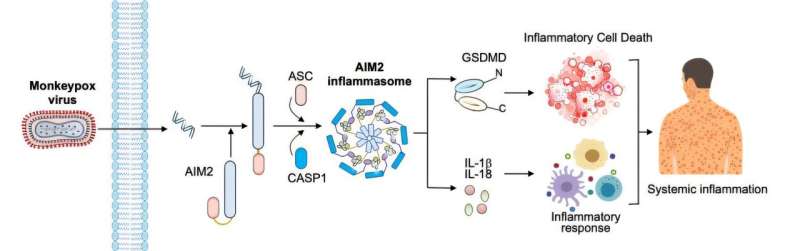
Schematic image illustrating the overall study. Credit: Ulsan National Institute of Science and Technology
A team of researchers, affiliated with UNIST, has identified a protein sensor that plays a key role in triggering severe inflammatory responses during mpox virus (MPXV) infection. The study reveals that this protein, known as AIM2, detects the viral DNA of MPXV within the body, leading to a potent inflammatory response that can contribute to disease severity.
Led by Professor SangJoon Lee of the Department of Biological Sciences at UNIST, in collaboration with Yujin Kim at the National Institute of Health (NIH) and Professor Daesik Kim at Sungkyunkwan University, the research team demonstrated that AIM2 functions as a critical immune sensor responsible for excessive inflammation during MPXV infection. The study ispublishedin the journalCellular & Molecular Immunology.
Although the reported fatality rate of mpox is relatively low at around 3%, severe cases can arise when the immune system mounts an excessive inflammatory response. While inflammation is essential for eliminating viruses, uncontrolled activation can damage healthy tissues and worsen clinical outcomes. Similar immune overreactions, often described as inflammatory cytokine storms, have been linked to severe complications and deaths in viral infections such as influenza and COVID-19.
The findings indicate thatAIM2recognizes MPXV DNA within infected cells and assembles a molecular complex known as the inflammasome. This complex activates caspase-1, an enzyme that induces inflammatory cell death and promotes the release of potent inflammatory cytokines, including IL-1β and IL-18.
Notably, the researchers found that AIM2-driven inflammation extends beyond cells directly infected by the virus. Infected cells primarily underwentpyroptosis, a highly inflammatory form of cell death, while neighboring uninfected cells activated alternative pathways, such as apoptosis and necroptosis. This coordinated but widespread response contributes to tissue damage and the progression of severe disease.
First author Jueun Oh explained, "This is the first experimental evidence demonstrating how AIM2 triggers inflammatory responses specifically during MPXV infection."
Furthermore, the team discovered thatIRF1, a transcription factor, serves as an upstream regulator of AIM2, controlling its expression by binding to specific DNA regions involved in AIM2 synthesis.
To explore therapeutic potential, the researchers tested whether inhibiting AIM2 could mitigate severe inflammation. InMPXV-infected mouse models, treatment with an AIM2 inhibitor significantly reduced inflammation and cell death in lung tissue and improved survival compared with untreated groups.
"Our findings suggest that AIM2 could be a promising therapeutic target for reducing harmful inflammation in severe viral infections," said Professor Lee. "However, because AIM2 plays an essential role in alerting the immune system to pathogens, careful consideration is necessary to prevent compromising immune defense."
More information Jueun Oh et al, AIM2 drives inflammatory cell death and monkeypox pathogenesis, Cellular & Molecular Immunology (2025). DOI: 10.1038/s41423-025-01367-7











Post comments