




































by Rachel Nelligan,University of Melbourne
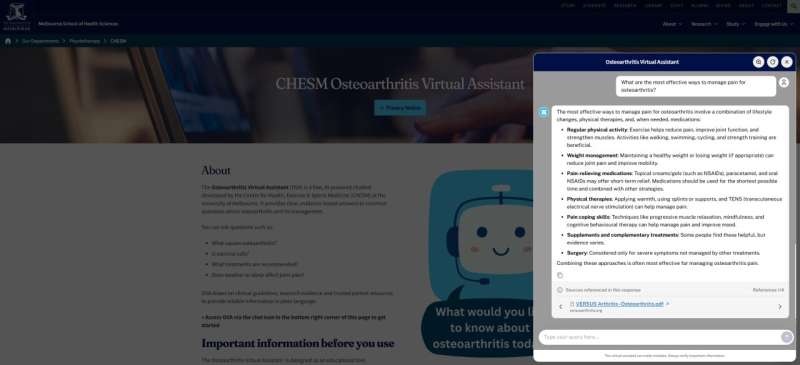
The Osteoarthritis Virtual Assistant (OVA) is a free online chatbot that draws from real research to answer common osteoarthritis questions. Credit: University of Melbourne
People living with osteoarthritis often have questions about their condition, but they do not always have easy access to clear and reliable answers. What causes osteoarthritis? Is exercise safe? What treatments are recommended? When should surgery be considered? And do things like weather changes or poor sleep affect joint pain? These questions often arise after a clinic visit, or before someone has spoken to a health professional at all.
Many turn to the internet for information, but what they find can be a confusing mix of helpful advice, outdated explanations and unsupported claims.
In recent years, artificial intelligence (AI) tools have increasingly become a go-to for people looking for answers. These conversational systems may make information easier to access, but ensuring that information is accurate and trustworthy is absolutely essential—and using existing tools, this is not always guaranteed.
Which is why we developed theOsteoarthritis Virtual Assistant (OVA).
OVA is a free online chatbot, developed by our team at the University'sCenter for Health, Exercise and Sports Medicine (CHESM), that aims to provide answers to common questions about osteoarthritis using only trusted, evidence-based sources.
Why reliable information matters
Osteoarthritis is one of the most common causes of joint pain and disability. In Australia, around1 in 5 people over the age of 45 lives with the condition.
Although there is currently no cure, there is strong evidence about how osteoarthritis should be managed.
Clinical guidelinesconsistently recommend education,exercise therapyand general physical activity like walking as the foundation of care.
However, some online sources still present outdated explanations of osteoarthritis, while others promote treatments that are not supported by evidence.
Many sources still describe osteoarthritis as simple "wear and tear" or "bone-on-bone" damage—phrases that are easy to understand, but no longer reflecthow the condition is understood by researchers and clinicians.
This matters because the way a condition is described shapes how people think about their options and what they choose to do next.
A conversational way to access evidence
OVA is designed to make evidence-based information easier to access.
Instead of searching across multiple websites, you can type a question into the chatbot in plain language, much like you would ask a clinician or use a search engine.
You might ask practical questions: "Is exercise safe for osteoarthritis?" or "When should I consider surgery?"
In the design of OVA, we collected hundreds of questions from clinicians, researchers and people living with osteoarthritis to better understand the types of questions users might ask—chances are, if you can think of it, OVA can answer it.
Using an AI approach calledretrieval-augmented generation(RAG), OVA then responds by drawing solely on trusted sources like clinical practice guidelines, open access peer-reviewed research and patient education materials from organizations includingArthritis Australia,MSK Australiaand CHESMs ownevidence-based patient resources.
This design element is integral, because it ensures answers remain aligned with clinical guidance and research evidence rather than drawing from unfiltered internet content.
OVA may also be useful for clinicians.
Health professionals can recommend it to patients who want to revisit information discussed in a consultation or explore topics in more detail.
It may also help clinicians quickly access evidence-based explanations for topics that fall outside their usual expertise—like the role of sleep, diet or other lifestyle factors in osteoarthritis symptoms.
OVA does not replace existing evidence-based resources but provides a conversational way to access reliable information that already exists—for patients and clinicians alike.
Importantly, the information underpinning OVA is reviewed and updated over time as research evolves and clinical guidelines change.
Staying within clear boundaries
While conversational AI tools are becoming more common, we designed OVA to operate within a clearly defined educational role.
The chatbot does not diagnose osteoarthritis, provide personalized medical advice or replace professional care.
If users ask questions that move into areas like diagnosis or individual treatment decisions, OVA provides general information and encourages them to seek advice from a health care professional.
These boundaries are important because conversational AI systems can sometimes blur the line between providing general health information and offering clinical advice.
OVA was tested extensively internally before it was piloted by people living with osteoarthritis and practicing physiotherapists to help refine responses and usability before its public release.
Let's talk
By grounding responses in clinical guidelines and research evidence, OVA is a great example of how AI can be used responsibly in health communication.
Ensuring our chatbot is trustworthy and the results provided are evidence-based was the most important factor to us in designing and launching the platform.
For people living with osteoarthritis, the benefit is straightforward: you can now find clear, reliable answers about the condition in one place. At any time of day,OVAis ready to help.
This article was first published on Pursuit. Read the original articlehere.
Key medical concepts Osteoarthritis Exercise Therapy Physical Therapists











Post comments