




































byUniversity of California, San Francisco
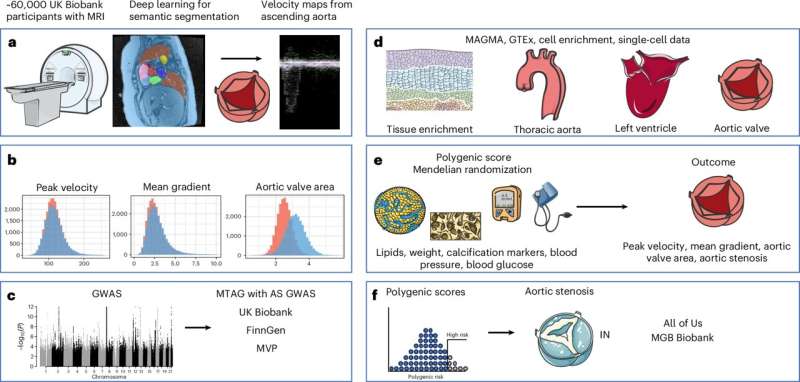
Study overview. Credit:Nature Genetics(2025). DOI: 10.1038/s41588-025-02397-7
Aortic stenosis is a narrowing of the aortic valve, which connects the heart to the rest of the body. It affects millions of people and can be fatal if left untreated. At present, there are no effective medical therapies to prevent or slow its progression. The only effective treatments are surgery or percutaneous valve replacement when the valve has become severely narrowed.
Recently, common genetic variants have been linked to the clinical diagnosis of aortic stenosis in population genetic studies.
To gain insight into the genetic underpinnings that lead to the initial development of aortic stenosis, a team of researchers from UC San Francisco and the Broad Institute of MIT and Harvard conducted a study analyzing genetic associations with aortic valve measurements in a healthy population. Theirresearchis published inNature Genetics.
Since severe aortic stenosis on a population level is rare, the researchers usedcontinuous measurementsof aortic valve function to find genetic signals. For this, they conducted a large-scale genetic analysis of three deep learning-derived measurements of aortic valve function in almost 60,000 healthy participants from the UK Biobank.
The measurements included peak velocity, mean gradient, andaortic valve area(AVA) from MRIs and genome-wide association studies (GWAS). They used these three deep learning-derived measurements of aortic valve function from MRI to identify 61 distinct genetic loci associated with these traits.
They additionally conducted a meta-analysis of aortic stenosis diagnoses in more than 40,000 cases and 1.5 million controls from multiple biobanks, identifying 91 loci. Finally, they conducted a multi-trait analysis incorporating both continuous aortic valve measures in the healthy population and the disease-based GWAS, identifying 166 genetic loci (134 for aortic valve function and 134 for aortic stenosis).
"In this study, we analyzed aortic valve function and disease diagnoses to comprehensively evaluate the common genetic basis for aortic stenosis," said study senior author James Pirruccello, MD, a cardiologist and assistant professor of Medicine in the UCSF Division of Cardiology. "Our findings suggest that risk for aortic stenosis is conferred at least in part through the same genetic mechanisms that drive normal variation in aortic valve function in the healthy population."
The genetic correlation between these measures in healthy people and the aortic stenosis GWAS meta-analysis was substantial: on a scale of 0–1 (0 being no relationship and 1 being in perfect agreement), the correlation with aortic stenosis was 0.64 for the gradient-based measures and 0.50 for AVA.
"Using deep learning to measure normal variation in aortic valve function helped us to identify 134 loci associated with aortic stenosis risk and 166 with aortic valve stenosis or function," said Shinwan Kany, MD, visiting scientist at the Broad Institute of MIT and Harvard. "We observed strong associations between aortic stenosis risk and coronary artery disease, lipoprotein biology, and phosphate handling, suggesting future avenues for research to prevent the development or progression of aortic stenosis."
The authors—which include collaborators at Mass General Brigham, Institute for Molecular Medicine Finland, and Beth Israel Deaconess Medical Center—note that clinical validation is needed before any implementation of programs to manipulate cholesterol or phosphate levels for aortic stenosis prevention.
Still, Pirruccello adds, "These findings demonstrate the power of jointly analyzing cardiovascular structure and function and their downstream disease outcomes."
More information Shinwan Kany et al, Multitrait analyses identify genetic variants associated with aortic valve function and aortic stenosis risk, Nature Genetics (2025). DOI: 10.1038/s41588-025-02397-7 Journal information: Nature Genetics










Post comments