




































byUniversity of Southern California
Credit: Pixabay/CC0 Public Domain
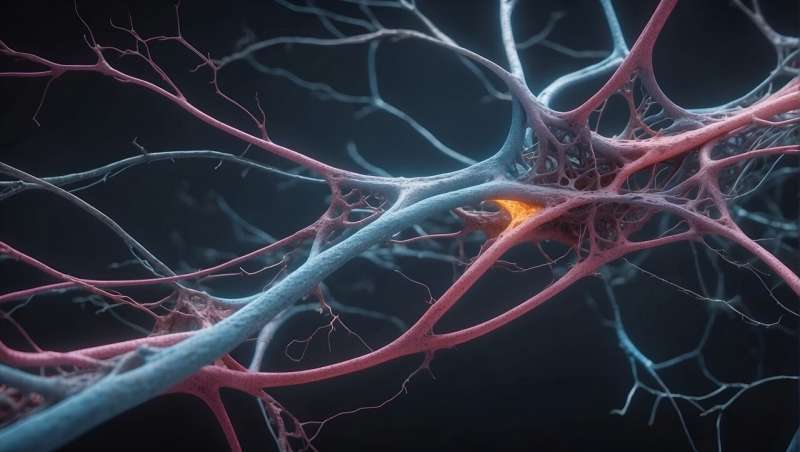
Every movement you make and every memory you form depends on precise communication between neurons. When that communication is disrupted, the brain must rapidly rebalance its internal signaling to keep circuits functioning properly. New research from the USC Dornsife College of Letters, Arts and Sciences shows that neurons can stabilize their signaling using a fast, physical mechanism—not the electrical activity scientists long assumed was required.
The discovery,publishedrecently inProceedings of the National Academy of Sciences, reveals a system that doesn't depend on the flow of charged particles to maintain signaling when part of a synapse—the junction between neurons—suddenly stops working.
Maintaining this balance between neurons is essential for muscle control, learning and overall brain health. Failure to maintain this "homeostasis" has been linked to neurological conditions such as epilepsy and autism.
USC Dornsife researchers led by Dion Dickman, professor of biological sciences, set out to understand how neurons compensate when communication between them falters. Specifically, they wanted to know how the receiving side of a synapse detects a sudden loss of function and signals the sending neuron to increase its output to restore homeostasis.
Working with fruit flies, a standard model for studying the nervous system, the team blocked glutamate receptors on the receiving side of the synapse with a chemical known to shut them down, then used electrical recordings and high-resolution microscopy to observe how the synapse responded. To identify the molecules responsible for triggering the response, the researchers used CRISPR gene-editing tools to remove specific structural proteins one by one and observe what changed in the cells.
This process of elimination revealed that the key trigger for the rapid adjustment is not the loss of electrical activity but the physical reorganization of a specific type of receptor. When these receptors were blocked, they rearranged themselves within the synapse, which set off a signaling process that instructed the sending neuron to release more neurotransmitters, helping maintain steady communication.
A scaffold protein called DLG proved essential for this response. When DLG was removed using CRISPR, the rapid compensation failed.
The researchers also showed that this fast signaling process continues even when all electrical synapse activity is silenced, indicating that the system relies on structural cues rather than electrical signals.
Understanding how synapses quickly adapt could help guide future research into treatments that strengthen neural resilience and ward off neurological diseases.
More information Chengjie Qiu et al, Nonionic signaling rapidly remodels postsynaptic DLG to induce retrograde homeostatic plasticity, Proceedings of the National Academy of Sciences (2025). DOI: 10.1073/pnas.2502997122 Journal information: Proceedings of the National Academy of Sciences







Post comments