




































byUtrecht University
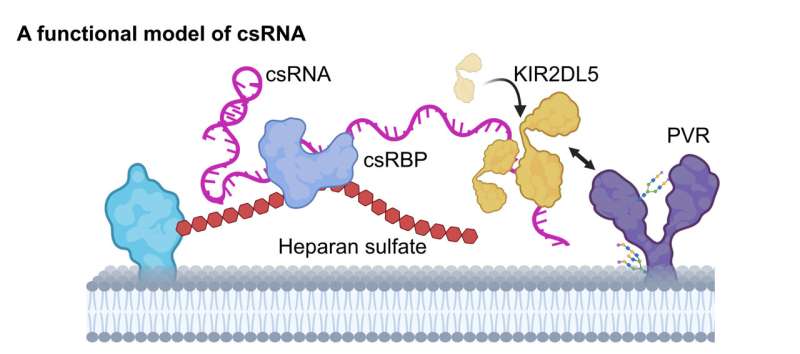
Schematic model showing how cell-surface RNA (csRNA) is anchored to the cell membrane via heparan sulfate and RNA-binding proteins, and how it can help bring immune receptors (such as KIR2DL5) together with their binding partners (PVR). This is a conceptual model based on the study's findings. Credit: Utrecht University
RNA is usually portrayed as a molecule that works deep inside the cell, helping to turn genetic information into proteins. But new research led by Utrecht University scientist Jack Li shows that RNA also plays an active role on the outside of cells. There, it appears to help immune cells recognize their targets. These results may open new perspectives for understanding, and eventually steering immune responses in diseases such as cancer.
For decades, biology textbooks have taught that RNA works inside the cell. Here they translate genetic information into proteins or regulate processes deep within the cell's interior. But new research led by chemical biologist Jack Li shows that RNA also plays an unexpected role on the outside of cells, where it can influence how immune cells recognize their targets.
The discovery was the result of a close collaboration between researchers from Utrecht University, Delft University of Technology, Leiden University Medical Center.
The study, published in the journalMolecular Cell, uncovers how RNA molecules can survive on the cell surface and what they are doing there. "Conventionally biologists think RNA must be within the cells," Li says. "But recently there are views showing these molecules can also make their way to the surface and perhaps do some regulation outside of the cell."
That simple observation raised a series of fundamental questions. How does RNA remain attached to the outside of a living cell, where enzymes that destroy RNA are abundant? And if it is there, is it just debris from deceased cells, or does it actually do something meaningful?
Li and his collaborators set out to answer those questions by developing a newmolecular tool. This tool can detect RNA on the surface of living cells without damaging them. Using this tool together with large-scale genetic screening and advanced protein analysis, the team pieced together a detailed molecular picture.
They found that cell-surface RNA is anchored by long sugar molecules called heparan sulfate. These are common components of the cell membrane and help organize molecules at the cell's outer surface. RNA-binding proteins then connect the RNA to these sugar chains, forming a stable molecular assembly. "The sugar provides the support, and the proteins act as a bridge to fix the RNA onto the cell surface," says Li.
The researchers then asked why this surface-bound RNA is actually there and if it has any specific tasks. One assumption was that the RNA affects how cells interact with other molecules. Immune cells constantly scan the body for infected or cancerous cells, and small changes in how receptors bind can determine whether a cell is attacked or ignored.
Li's team showed thatcell-surface RNAcan help bring together an immune receptor on natural killer cells with its partner on a target cell. When the RNA was removed, this binding can become much less efficient.
In other words, RNA can act as a kind of molecular matchmaker at the cell surface, subtly tuning how immune cells recognize other cells. Until now, scientists thought this kind of communication was handled mainly by proteins and sugars. RNA simply wasn't part of the picture.
In the long run, implications could be far-reaching, especially in cancer and immunology. Many cancer cells express immune checkpoint molecules that tell immune cells to stand down. If cell-surface RNA helps regulate these interactions, it could one day become a new target for therapies.
"We're adding a whole new layer to this crosstalk between cancer cells and immune cells," Li says. "RNA may be playing a role here that we didn't notice before."
Li is careful not to overstate the medical implications of this work. The study primarily focuses on fundamental mechanisms, not immediate medical applications.
One of the biggest open questions remains how RNA gets to the cell surface in the first place. "It is still unknown whether the RNA comes from inside the cell or whether it is captured from the outside, for example from surrounding cell debris," says Li.
Understanding this step will be crucial for determining when and where cell-surface RNA plays a role in the body and how it might be manipulated in the future.
That mystery is now one of the main directions for Li's future research, alongside exploring how widespread and important cell-surface RNA regulation might be. "This must be a tip of the iceberg," Li says. "We currently don't know how many cell-surface proteins are regulated by RNA and how many are not."
More information Zeshi Li et al, Cell-surface RNA forms ternary complex with RNA-binding proteins and heparan sulfate to recruit immune receptors, Molecular Cell (2025). DOI: 10.1016/j.molcel.2025.11.020 Journal information: Molecular Cell







Post comments