




































by Lisa Howard,UC Davis
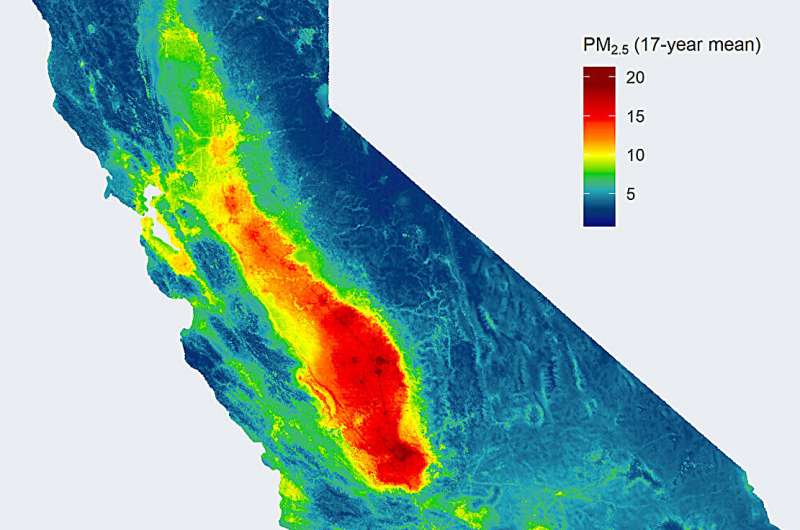
Distribution of long-term exposure to fine particulate matter < 2.5 µm in diameter for 17-year average from 2000 to 2016 across California. Credit:Alzheimer's & Dementia: Behavior & Socioeconomics of Aging(2026). DOI: 10.1002/bsa3.70074
A new study by researchers at UC Davis Health and Kaiser Permanente found that higher exposure to very small air pollution particles (PM2.5) over a 17-year span was associated with lower semantic memory. Semantic memory acts like the brain's "encyclopedia" for things like facts, words and long-term general knowledge.
"Semantic memory is essential for communication, comprehension and navigating everyday life," said senior author Kathryn Conlon, an associate professor in the UC Davis Department of Public Health Sciences. "Our findings suggest that long-term exposure to air pollution doesn't just affect physical health—it may also shape how the brain ages, particularly in ways that matter for independence and quality of life."
Two other measures of cognitive function—executive function and verbal episodic memory—did not show an impact related to the pollution.
The findings werepublishedinAlzheimer's & Dementia: Behavior & Socioeconomics of Aging.
Reducing air pollution may reduce dementia burden
The data for the research comes from the Kaiser PermanenteStudy of Healthy Aging in African Americans(STAR). Launched in 2017, the ongoing study aims to identify factors that impact healthy brain aging among Black adults.
Black adults in the United States experience 1.5 to 2 times higher rates of Alzheimer's disease and other dementias compared with non-Hispanic White adults.
In the new study, the researchers focused on particulate matter (PM), a mixture of solid particles and liquid droplets found in the air.Particles less than 2.5 micrometersin diameter (about 1/30th of a human hair) are referred to as PM2.5, or fine particulates.
Previous research has linked PM2.5tocardiovascular diseaseandmortality; however, a growing area of study is focused on the role offine particulate exposurein the progression of Alzheimer's disease.
Methods and findings
The researchers analyzed data from 740 adults, aged 53 to 94, who were participants in the STAR study. Individual-level long-term average PM2.5exposures were computed by averaging daily estimates of PM2.5levels at the participants' residential addresses.
Cognitive performance was assessed for semantic memory, verbal episodic memory and executive function. They evaluated associations with 5-, 10-, and 17-year average PM2.5exposure.
The researchers found:
Lowering air pollution could lower Alzheimer's burden
Long-term exposure to air pollution has been shown to causegreater harmto under-resourced communities. In addition,studies led by the U.S. Environmental Protection Agency(EPA) have found that people who are Black, Latino or Asian are more likely to live in areas with higher levels of particulate air pollution.
"Understanding environmental contributors to cognitive decline is critical for addressing disparities in dementia risk," said Rachel Whitmer, co-author of the study and the co-director of the Alzheimer's Disease Research Center at UC Davis Health. "Air pollutionis a modifiable exposure. That makes it a powerful target for prevention—both at the individual level and through public policy."
How individuals can reduce exposure to air pollution
While air pollution is largely a community-level issue, there are many ways individuals can reduce their exposure to air pollution:
Publication details Stacey E. Alexeeff et al, Particulate air pollution and domain‐specific cognition among Black adults, Alzheimer's & Dementia: Behavior & Socioeconomics of Aging (2026). DOI: 10.1002/bsa3.70074 Journal information: Alzheimer's & Dementia











Post comments