




































by Wendy Davidson,University of Aberdeen
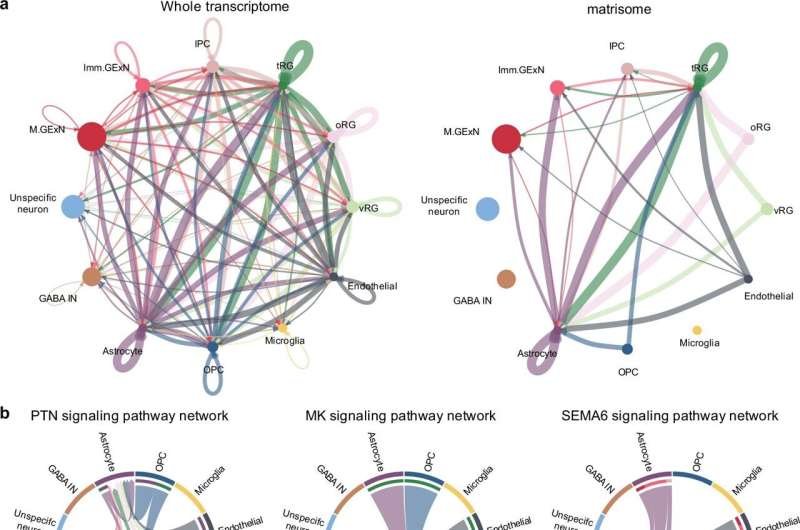
Cell-cell communication mediated by matrisome. Credit:Nature Communications(2025). DOI: 10.1038/s41467-025-64381-3
A team of researchers from the University of Aberdeen has uncovered, for the first time, how genes linked to autism and intellectual disability may influence early brain development.
Their work helps with understanding how differences in early brain development contribute to neurodevelopmental disorders and could help identify more targeted therapies for these conditions. Published inNature Communications, thestudylooked at an often-overlooked system in the brain, known as the extracellular matrix (ECM). The ECM guides how the brain grows and controls the "framework" of tissue by delivering signals, via genes, throughout the early stages of brain development.
Using datasets from multiple studies, the researchers investigated how genetic changes in the ECM can affect brain development. In doing so, they created the first comprehensive map of howECM-related genes, known as the "matrisome," behave in specific brain cell types and developmental stages. They found that many of these genes are linked to neurodevelopmental conditions such as ADHD, autism and intellectual disability and that their activity changes dynamically as the brain matures.
The study highlights how different brain cell types, includingneural stem cells, neurons, and blood vessel cells, use the ECM to communicate and coordinate their growth during brain development. Although previous studies have examined individual components of the brain's ECM, none have produced a detailed, cell-by-cell map of how it develops during early brain formation.
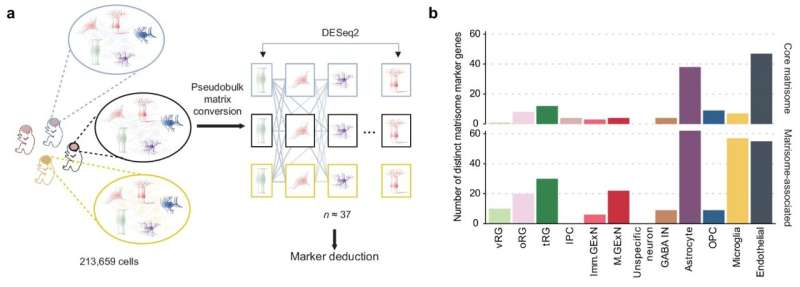
Cell type-specific matrisome signature during cortical development. Credit:Nature Communications(2025). DOI: 10.1038/s41467-025-64381-3
This study is the first to combine largesingle-cell datasetsto show how different brain cells build and modify the brain's support structure over time, revealing coordinated changes in gene expression and their links to neurodevelopmental conditions. It offers a new layer of understanding of how the brain's structural environment emerges and functions during development.
Dr. Eunchai Kang, group leader at the Institute of Medical Sciences at the University of Aberdeen, who led the research, explains, "Human brain development is an incredibly complex process. Stem cells need to know what to become and where to go, and many different cell types have to coordinate their behavior. This coordination happens within thedynamic environmentof the ECM, which guides and supports these developing cells.
"While we know the ECM plays a crucial role in guiding these processes, its specific contributions and how changes in these pathways may relate to neurodevelopmental conditions remain underexplored.
"By pooling together data from different studies on the ECM, we have been able to create a detailed map of its activity and see how it changes over time, helping us understand what these changes may mean for the developing brain."
Dr. Daniel Berg, group leader at the Institute of Medical Sciences at the University of Aberdeen, and co-lead of the study, adds, "Knowing whichgenes are activein specific cell types at different stages of early development gives us a clearer picture of how the brain is built. This will guide future experiments and help researchers study gene function in the right biological context.
"This knowledge provides an important foundation for understanding the pathways involved in developmental brain conditions. In the long term, it may also support efforts to develop more precise and targeted therapeutic approaches."
More information Do Hyeon Gim et al, Deciphering cell-type-and temporally specific matrisome expression signatures in human cortical development and neurodevelopmental disorders via scRNA-seq meta-analysis, Nature Communications (2025). DOI: 10.1038/s41467-025-64381-3 Journal information: Nature Communications







Post comments