




































by Nicole Rideout,Oregon Health & Science University
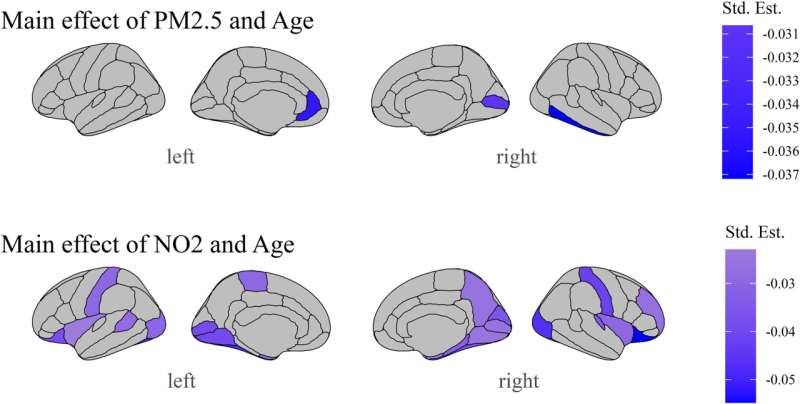
Persistent effects of air pollutants (main effects) from a multi-pollutant model. Standardized effects of all pollutant exposures (estimated from a single model) on cortical gray matter thickness are depicted on the cortical surface for all significant regions of interest (FDR-corrected p < 0.05). Credit:Environmental Research(2026). DOI: 10.1016/j.envres.2025.123333
Physician-scientists at Oregon Health & Science University warn that exposure to air pollution may have serious implications for a child's developing brain.
In a recentstudypublished in the journalEnvironmental Research, researchers in OHSU's Developmental Brain Imaging Lab found that air pollution is associated with structural changes in the adolescent brain, specifically in thefrontal and temporal regions—the areas responsible for executive function, language, mood regulation and socioemotional processing.
Air pollution causes harmful contaminants, such as particulate matter, nitrogen dioxide and ozone, to circulate in the environment. It has been exacerbated over the past two centuries byindustrialization, vehicle emissions, and, more recently, wildfires.
While research has established that pollution contributes to various physical health issues like respiratory disorders, cardiovascular diseases and metabolic dysfunction, its effects on neurocognitive health aren't as well understood.
OHSU researchers leveraged the ABCD Study—the largest longitudinal study of adolescent brain development in the United States—to better understand how exposure to specific air pollutants might affect adolescents, who are undergoing critical periods of brain development and may be especially vulnerable to exposures.
This was one of the first studies to examine air pollution's impact on structural changes in the adolescent brain over time.
"What's perhaps most concerning is that this study didn't look at rare toxins; it looked at everyday, common pollutants that all of us are exposed to walking around and breathing in the air outside," said Calvin Jara, M.D., resident in otolaryngology/head and neck surgeries in the OHSU School of Medicine and lead author of the study.
"What we discovered was a slow and subtle effect happening on the brain, and while it might not be causing symptoms immediately, it could be shifting developmental trajectories and outcomes over time."
In an analysis of nearly 11,000 children in the ABCD study dataset, researchers found that baseline exposure to specific air pollutants in the early phase of adolescence, or the onset of puberty, generally ages 9 to 10, was associated with both persistent and developmental changes in cortical thickness, a measurement of the structural maturation of the outer layer of the brain. Atypical cortical thinning, especially thinning that is accelerated, can be an indication of an underlying neurological disruption and result in associated cognitive impairment.
While the issue is more severe in urban areas, researchers note that they're seeing these changes even in children exposed to pollution at levels below what the Environmental Protection Agency marks as "safe."
"These data show this is not just about a single child," Jara said. "It's about what's happening to millions of children around the world who are exposed to low levels of air pollution for years on end."
Researchers warn that these structural changes in the brain could have impacts on a child's overall health, well-being and life trajectory. Alterations in the development of these critical brain regions could impair attention, memory and emotional regulation, potentially leading to academic difficulties and behavioral concerns. Future research should continue to examine these broader long-term consequences, researchers said.
Combating widespread pollution requires collaborative efforts outside of clinic spaces, researchers note. While individual clinicians can't directly change air quality, they can educate and advocate for system-level change. Policy efforts aimed at reducing air pollution, including those focused oncleaner transportationand infrastructure, improved access to green spaces and stricter air quality standards, will be critical for promoting healthy brain development, Jara said.
Additionally, clinicians must continually consider the growing role environmental health factors play in their patients' treatment and care.
"Environmental factors have a huge impact on how healthy children can be, and ultimately how healthy they'll be over their lifetime," said Bonnie Nagel, Ph.D., OHSU's Interim Chief Research Officer, executive vice president and the study's co-author.
"This work adds to the growing body of evidence that pollution is not just an environmental issue; it's a significant and growing health issue, especially for our youngest and most vulnerable."
More information Calvin A. Jara et al, Longitudinal associations between air pollution and adolescent gray matter development: Insights from the ABCD study, Environmental Research (2026). DOI: 10.1016/j.envres.2025.123333 Journal information: Environmental Research











Post comments