




































by Sean Barton,University of Sheffield
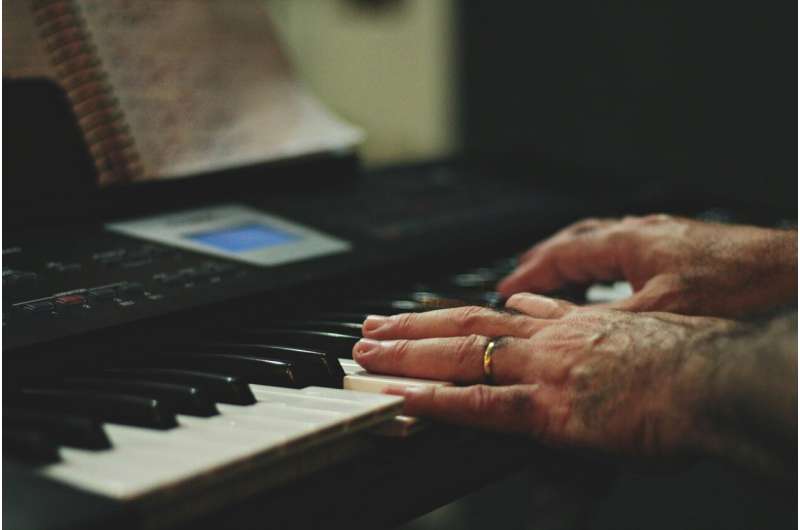
Credit: Unsplash/CC0 Public Domain
Improvising music could help to improve older people's cognitive skills, such as learning and memory, according to research from the University of Sheffield and Western Sydney University.
The study, led by Dr. Jennifer MacRitchie from the University of Sheffield's School of Languages, Arts and Societies, is the first to compare how different ways of making music—improvisation versus replication—can affect people's learning and cognitive abilities.
Improvisation tasks people with creating a new melody on the spot, whereas replication asks people to repeatedly play a given melody. Findings show both methods can improve older people's brain functions, but learning by improvisation brings enhanced benefits.
Published in the journalRoyal Society of Open Science, theresearchcould change the way music is taught as a brain training exercise and help music teachers tailor their programs so that individuals can be supported to develop skills to the best of their ability.
Previous studies have suggested that musicians have better cognitive and motor skills later in life compared to people who have had no musical training, such as being able to correctly hear what someone is saying to them in a noisy environment—known as thecocktail party effect.
However, previous research also argues that the link between music and cognitive training is weak, with the academics in those studies arguing that pre-existing factors such as socioeconomic status, inherent music aptitude or even personality traits are the main drivers of cognitive change rather than the music training itself.
The new study led by Dr. Jennifer MacRitchie, in collaboration with colleagues at Western Sydney University, challenges this argument as it followed complete novices for 12 months while they undertook different types of musical training. Most studies have only followed participants for between three to six months. The Sheffield-led study is the first to thoroughly examine both the musical skills that adults build up over the year as well as the cognitive and motor benefits.
Dr. Jennifer MacRitchie, Senior Research Fellow in Music at the University of Sheffield, said, "We've known for a long time that music provides a whole range of benefits to people's overall health and well-being, but there has been a debate over whether learning to play music can improve people's cognitive and motor skills, particularly later in the life.
"Our research is one of the longest studies to look at this and adds to the evidence that learning to play a musical instrument when you are older—even if you have never played an instrument before—can improve your brain function.
"Significantly, we've established a relationship between how much someone'smusic skillsdevelop to the development of their more general cognitive skills. More research is needed, but it's certainly a promising finding that music teachers should consider when designing music and well-being programs."
On the different ways of learning to play music, Dr. MacRitchie said, "Most programs that teach older people how to play a musical instrument use an approach called replication, which asks people to repeatedly play a given melody. However, what we've found in our research is that improvisation, which asks people to create a new melody of their own, is better at improving people's cognitive and motor skills. Both ways are good for the brain, but our study suggests improvisation brings enhanced benefits.
"Furthermore, improvisation doesn't require remembering exact sequences, which means it can be a good opportunity for musical expression for people who struggle with memory and may not normally take up playing an instrument later in life."
The researchers also looked at whether playing a physical instrument, in this case a piano, or playing an instrument virtually such as through iPad Thumbjam, also affects older people's cognitive skills.
On the benefits of playing a real or virtual instrument, Professor MacRitchie added, "Apps like iPad Thumbjam could potentially make playing a musical instrument more accessible than ever before, so we wanted to see whether there are any differences in how they could affect people's learning and memory compared to playing a real instrument. Our research suggests there are no noticeable differences, which is promising for those who are looking to make use of digital technologies in their music teaching.
"The difference in impact we've seen is in the way music is taught, regardless of whether it's a real or virtual instrument."
More information Jennifer MacRitchie et al, Progressively learned musical ability predicts cognitive transfer in older adult novices: a 12-month musical instrument training programme, Royal Society Open Science (2025). DOI: 10.1098/rsos.251022 Journal information: Royal Society Open Science









Post comments