




































byConcordia University
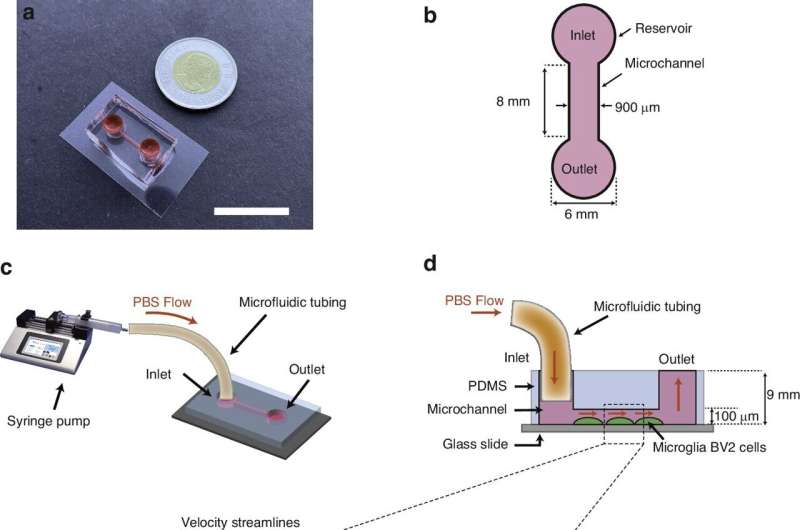
Schematic of microfluidic cell adhesion assay.aPhoto of the microfluidic device; the microchannel and reservoirs were filled with red dye (scale bar= 25 mm).bdimensions of the microchannel and reservoirs (top view).c3D Experimental setup anddside view of device when the PBS flow was pumped into the device to exert the flow shear stress on the cells.eMagnified shear stress on the cells, velocity streamlines, and velocity profile in the microchannel. Credit:Microsystems & Nanoengineering(2025). DOI: 10.1038/s41378-024-00862-7
A team of researchers from Concordia University and McGill University has developed a "lab-on-a-chip" device that models how Alzheimer's disease advances in the brain.
The microfluidic platform allows scientists to study how microglia—the brain'simmune cells—respond to small, toxic clusters of protein fragments known as amyloid beta oligomers (AβO). These fragments are considered a key marker of the disease.
Normally, microglia help clear AβO from the brain. But in Alzheimer's, they become over-activated when exposed to the harmful protein clusters, releasing inflammatory molecules that damage nearby neurons.
The chip works by flowing liquid overmicroglial cellsin a tiny channel, gently nudging them to test how well they stick to the surface. When exposed to higher levels of AβOs, or for longer periods of time, the immune cells lose their grip more quickly. That weakening is a physical sign that the disease is progressing.
The findings arepublishedinMicrosystems & Nanoengineering.
Traditional methods for tracking Alzheimer's often rely on "labels"—special dyes or antibodies that must be attached to cells or proteins so they can be detected. These approaches require extensive preparation, are expensive and usually provide only static snapshots.
By contrast, the new chip is label-free, inexpensive and can monitor cell behavior continuously. After 24 hours of exposure to high AβO concentrations, the immune cells lost all adhesion—indicating they were no longer viable.
This study demonstrates how a low-cost, portable system can capture subtle changes in the immune cell behavior that accompanies Alzheimer's disease, offering a valuable tool for both diagnostics anddrug development.
The paper was written by Ehsan Yazdanpanah Moghadam, Ph.D., Nahum Sonenberg, a professor in the Department of Biochemistry at McGill University, and Muthukumaran Packirisamy, a professor in the Department of Mechanical, Industrial and Aerospace Engineering at the Gina Cody School of Engineering and Computer Science.
More information: Ehsan Yazdanpanah Moghadam et al, Alzheimer model chip with microglia BV2 cells, Microsystems & Nanoengineering (2025). DOI: 10.1038/s41378-024-00862-7 Journal information: Microsystems and Nanoengineering
Provided by Concordia University











Post comments