




































byMurdoch University
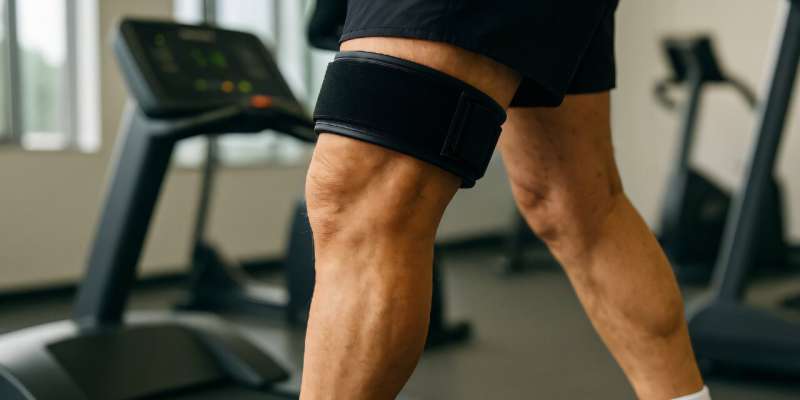
A blood flow restriction cuff. Credit: Murdoch University
New research from Murdoch University's School of Allied Health and Health Futures Institute has found that wearing blood flow restriction cuffs can change the way older people walk, potentially making them more unsteady during exercise.
Blood flow restriction (BFR) training is gaining popularity globally as a way to boost strength using light exercise, by placing inflated cuffs on the arms or legs to limit blood flow.
By partially blocking blood going in and out of the limb, BFR creates a low-oxygen environment which makes the muscles work harder, even under lighter loads.
Associate Professor Brendan Scott, from the Center for Healthy Aging at Murdoch University, saidrestricting blood flowto the legs while walking has been shown to increase muscle strength and size, but some caution is required with its use.
"Blood flow restriction training can be a powerful tool for improving strength and functional abilities in older adults, but our research shows that wearing these cuffs while walking changes how older adults walk, so exercise needs to be done in a safe environment," he said.
Ten healthy adults with an average age of 73 participated in the study by walking on a treadmill for 10 minutes at different speeds, with no cuffs, and then cuffs inflated to 40% and 60% of the pressure required to completely stop blood flow. A small motion sensor was taped to their lower backs to measure their balance as they walked.
The study, "Bilateral blood flow restriction of the legs worsens acute walking balance of older adults—a full factorial randomized experiment," waspublishedinGait & Posture.
Associate Professor Brook Galna, another author on the paper, explained the results: "We found that regardless of how fast people walked, wearing inflated BFR cuffs worsened their balance, and the more we inflated the cuffs, the worse their balance became."
Despite this, Associate Professor Scott said training with BFR could help improve elderly people's balance in the long term. "Blood flow restriction training can deliver real benefits, and it's possible that by challenging balance with BFR walking in a safe environment, older adults may adapt to actually enhance their balance," he said. "We've overseen hundreds of BFR walking sessions and have not had any trips or falls caused by the cuffs.
"It is important that if you're considering BFR, do it under professional supervision and start with low pressures in a safe environment."
More information Brook Galna et al, Bilateral blood flow restriction of the legs worsens acute walking balance of older adults – a full factorial randomised experiment, Gait & Posture (2026). DOI: 10.1016/j.gaitpost.2025.110022









Post comments