




































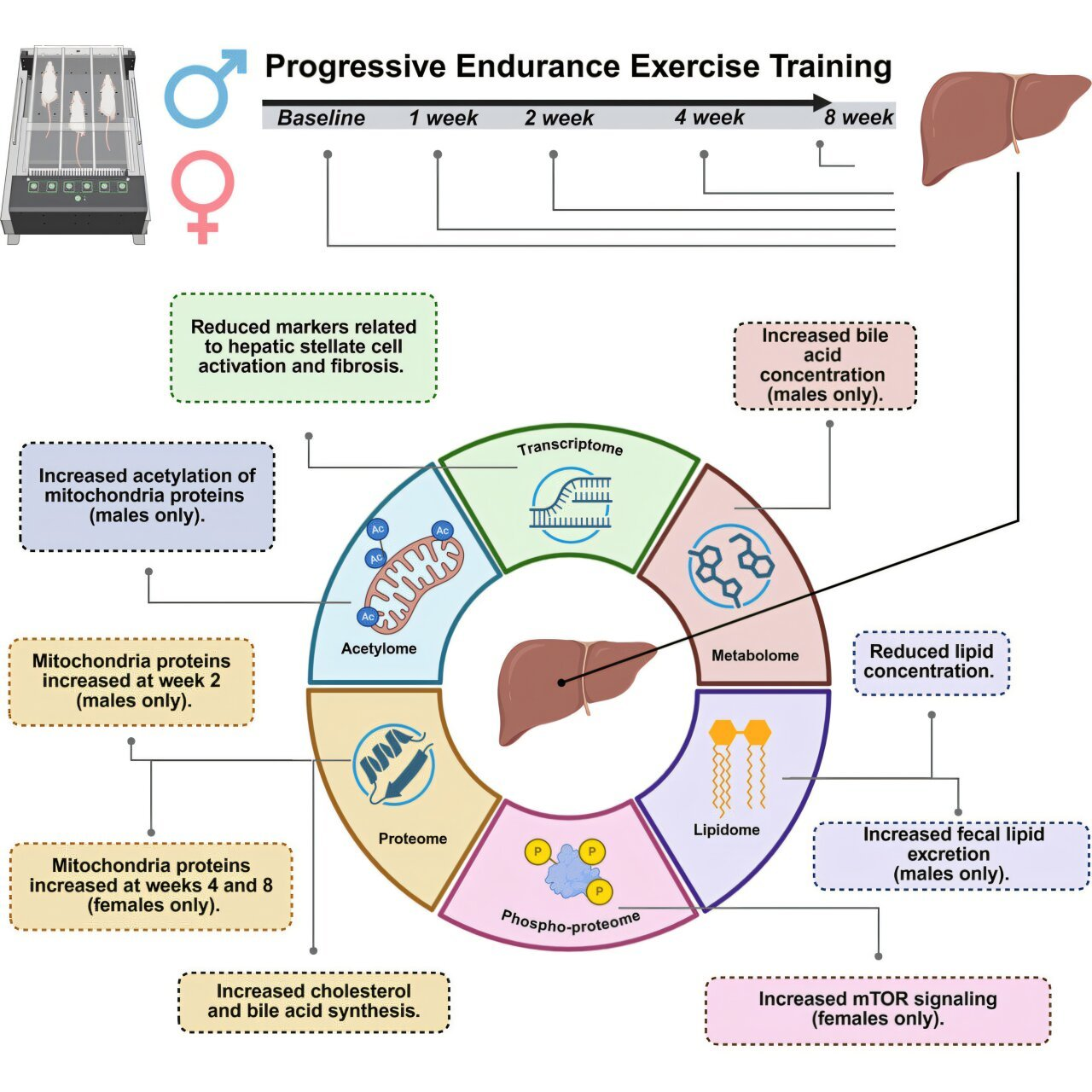
Graphical abstract. Credit: Cell Reports (2026). DOI: 10.1016/j.celrep.2026.117416
Exercise benefits nearly every part of the body, including the liver and metabolism. But new research from the University of Missouri School of Medicine suggests those benefits may not look the same in males and females. The findings are published in the journal Cell Reports.
Mizzou researchers found endurance exercise altered how liver cells created energy, a process known as the Krebs cycle that happens in the mitochondria within individual cells. Female rats had more proteins created with the energy cycle, whereas male rats had more proteins modified, or remodeled, by a chemical reaction that triggers the cycle.
"Male and female liver cells adapt to endurance exercise through distinct molecular pathways, which remodel the cellular structures responsible for producing energy. Think of it this way: Female rats generated more proteins, while male rats changed more of their existing proteins," lead author Scott Rector said. "These are subtle changes in the cellular energy process, and one sex doesn't necessarily have a 'better' modification."
Liver health improves in both sexes
Rector and his team found that exercise training improved liver health in both sexes—there was reduced liver fat, improved cholesterol use and disposal, and fewer markers of fibrosis, which is a buildup of scar tissue typically seen with liver injury or disease. Males specifically seemed to expel more cholesterol from the body than females.
"Why these different adaptations occur is still unclear, but we plan on investigating how these changes in the cell energy cycle might affect metabolism, which is how the body creates and uses energy," Rector said. "Our findings indicate that endurance and consistent exercise improve metabolic 'machinery.' What else we could discover may provide more precise and personalized interventions for people with metabolic dysfunction-associated steatotic liver disease, or MASLD."
MASLD, previously called nonalcoholic fatty liver disease, is the most common chronic liver disease, especially as the number of people diagnosed with obesity rises. The most severe forms can lead to cancer or cirrhosis, which can both be fatal.
More information: Taylor J. Kelty et al, Endurance exercise elicits temporal and sexual dimorphic multi-omics remodeling of liver metabolism revealed by MoTrPAC, Cell Reports (2026). DOI: 10.1016/j.celrep.2026.117416
Provided by University of Missouri
Source: MedicalXpress
Original article: https://medicalxpress.com/news/2026-10-rewires-liver-metabolism-differently-based.html








Post comments