




































byPublic Library of Science
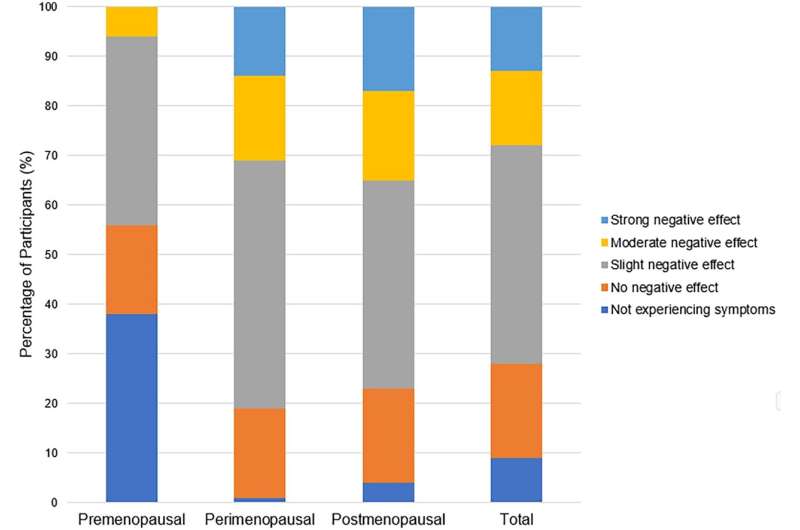
Perceived influence of menopausal symptoms on performance in pre-, peri-, and postmenopausal participants (n = 183). Credit: Hamilton et al., 2025,PLOS One, CC-BY 4.0 (creativecommons.org/licenses/by/4.0/)
A new study finds menopause symptoms to be very frequently reported by female endurance athletes, with many perceiving a negative effect on their training and performance. The findings are published inPLOS Oneby Heather Hamilton of Old Dominion University, U.S., and colleagues.
Physical activity has been reported to mitigate the negative effects of menopause, particularly when it comes to musculoskeletal changes and quality of life. However, at the same time, menopausal symptoms may interfere with participation in physical activity and sport.
In the new study, researchers surveyed 187 female runners, cyclists, swimmers, and triathletes aged 40–60 years who participated in their sport at least three days per week for at least three hours total per week. Participants completed the Menopausal Rating Scale (MRS), a validated measure for assessing menopausal symptoms, and reported how symptoms affected their training and performance.
The researchers found that the most common menopausal symptoms among the athletes were sleep problems (reported by 88% of women), physical and mental exhaustion (83%), sexual problems (74%), anxiety (72%), irritability (68%), depressive mood (67%), weight gain (67%), hot flushes (65%), and joint and muscular discomfort (63%).
The symptoms perceived to most negatively affect training and performance were joint and muscular discomfort, weight gain, sleep problems, and physical and mental exhaustion. 97% of women with joint and musculoskeletal discomfort reported a negative effect on training and 91% reported a negative effect on performance, for example.
Participants withmore severe menopausal symptomsreported greater perceived negative effects on training and performance, with about a third of all respondents reporting that menopausal symptoms had a moderate or strong negative effect on training and about a quarter reporting a negative effect on performance.
The study is limited by its cross-sectional design and the lack of demographic information, which makes it difficult to generalize to other populations. However, the authors conclude that the frequency of menopausal symptoms among female endurance athletes is high and the severity of menopausal symptoms is similar to that reported in the general population.
Despite high physical activity levels in this population, health care providers should address these symptoms to promote continued participation in physical activity, they say.
The authors add, "We hope this work brings attention to a growing, yetunderstudied populationthat is eager for guidance on how to navigate the menopausal transition while continuing to participate in sport and exercise."
More information Hamilton HM, et al. Frequency and perceived influence of menopausal symptoms on training and performance in female endurance athletes, PLOS One (2025). DOI: 10.1371/journal.pone.0335738 Journal information: PLoS ONE








Post comments