




































Provided by Pennsylvania State University
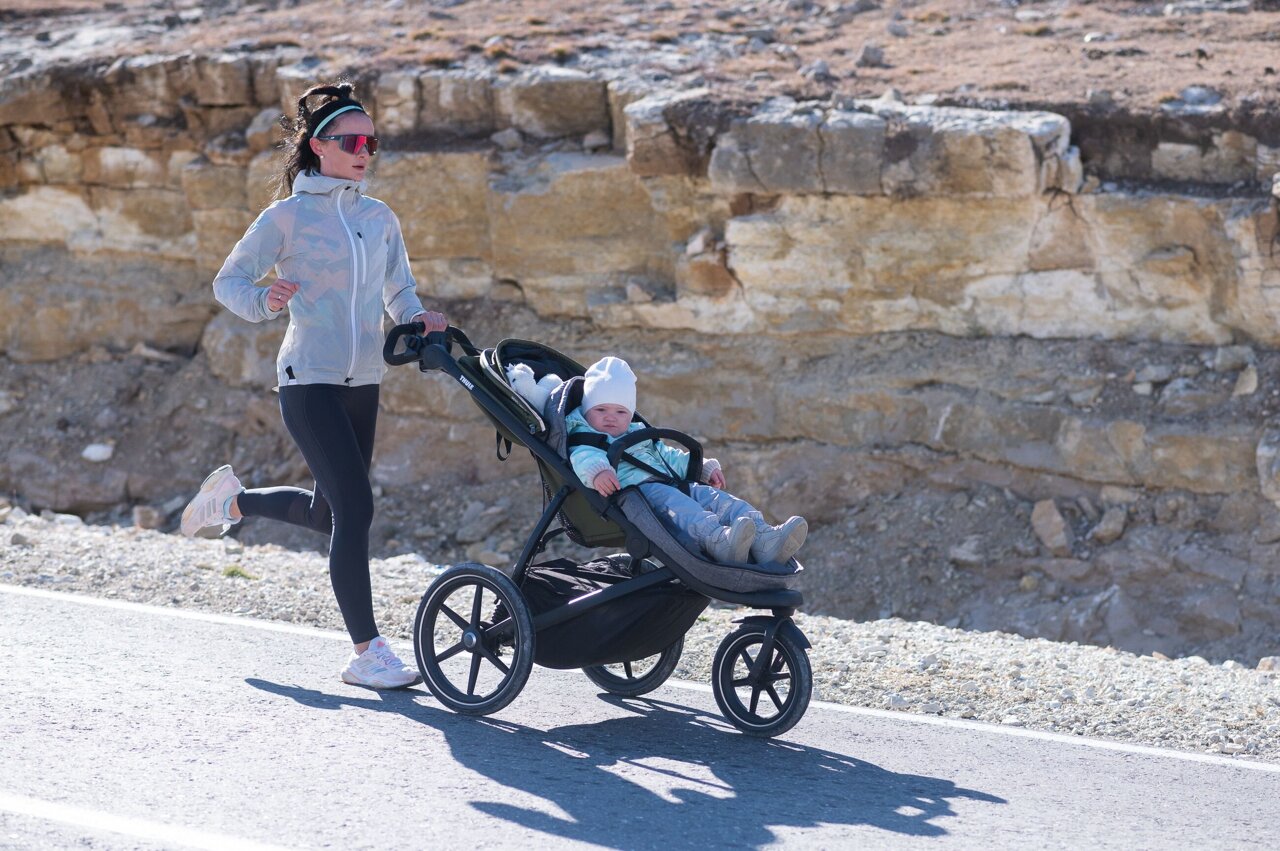
Credit: Dmitrii Eremin from Pexels
Anyone who has run while pushing a stroller knows stroller running can feel cumbersome and hard on the body. But does it increase the risk of injury? According to a new study from researchers at Penn State Berks, the answer appears to be no.
The study, published in the journal PLOS One, found that parents who ran with a stroller were less likely to sustain an overuse injury during the first three years after becoming a parent than those who ran without a stroller. For every 1,000 miles (1,600 kilometers) run, parents who ran with a stroller had a 55% lower injury rate than those who ran without a stroller.
"This study is among the first to look at injury patterns in parents who run," said senior author Allison Altman-Singles, associate professor of kinesiology and mechanical engineering at Penn State Berks. "We saw that running with a stroller is safe and can help sustain physical activity during early parenthood."
How the researchers compared runners
According to the researchers, previous studies have shown that running with a stroller alters the way a person runs. Stroller runners tend to have shorter strides, lean forward more, twist less through the torso and run slower. In this study, the researchers explored whether and how running with a stroller influenced running habits and injury risk compared with running without a stroller.
The researchers recruited participants who had been parents of children ages 0 to 3 within the past 20 years, ran more than five miles (8 kilometers) per week before becoming a parent and ran when their child was between 6 months and 3 years old. Using a web-based survey, participants reported their running mileage from the time their child was born until the child was age 10 and any injuries suffered during the first three years after becoming a parent.
The parents were then separated into two groups—those who ran
regularly with a stroller and those who didn't. The two groups were similar in age, height, weight, age when they had their first child and number of children. Most participants were female, particularly among the stroller-running group.
Lower injury rates with strollers
Among 196 stroller runners and 53 non-stroller runners included in the final data analysis, 30% of those who ran without a stroller reported an overuse injury, compared with 19% of those in the stroller-running group. The rate of injury for every 1,000 miles (1,600 kilometers) run was lower among stroller runners, too. Non-stroller runners were also more likely to experience multiple injuries during the first three years after becoming a parent.
"When you run with a stroller, you unweight the body a little bit, taking away some of the downward force by pressing on the handlebar, so you experience lower vertical loading," Singles said. "This change in biomechanics may relieve some of the stress on weight-bearing joints, which may explain why we see fewer injuries among stroller runners, particularly knee injuries, which are common among runners."
Prior research, led by Singles, found that running with a stroller decreases the force and impact of each step. The researchers explained that running with a stroller may also encourage parents to regulate their pace and run with a consistent cadence, or steps per minute—both of which are associated with lower injury risk, Singles said.
One injury showed up in both groups
Both groups did report a high incidence of plantar fasciitis, a condition in which the connective tissue along the bottom of the foot becomes inflamed, accounting for 15% of all reported injuries in the stroller-running group and 16% of all reported injuries in the non-stroller-running group. Given that most participants in both groups were women and were the birthing parent, Singles said the incidence of plantar fasciitis may be linked to physiological changes during pregnancy and the postpartum period, rather than the act of running with a stroller. For instance, factors like weight gain and hormonal shifts during pregnancy and the postpartum period, which can affect the elasticity of connective tissues, could increase injury risk.
When stroller use was highest
The study also tracked how running mileage changed based on a child's age. Between birth and 6 months, neither group ran much, but by 1 year, both groups were running similar mileage. Stroller use peaked when children were between 6 months and 3 years old before declining as the child grew older.
"The stroller also allowed people to run more when their child was between 6 and 12 months old," Singles said, with stroller runners logging 34% more miles than non-stroller runners. "The stroller can help runners get out and exercise."
Limits of the survey data
The research team noted several limitations to the study, including the relatively small study population for an injury study. The survey didn't tease out factors that could potentially contribute to injury risk, such as breastfeeding status and whether participants had additional children during the study period.
The research team plans to continue investigating issues related to
stroller running, such as the motivational factors that influence whether someone chooses to run with a stroller. They will also continue to investigate the biomechanical changes associated with running with a stroller.
First author Houn "Grace" Kim was an undergraduate student at Penn State Berks during the research and received her undergraduate degree in 2025. Andrew Friesen, associate professor of kinesiology at Penn State Berks, also contributed to this paper.
More information: Injury risk and running habits in parents: Does stroller use make a difference?, PLOS One (2026). DOI: 10.1371/journal.pone.0354371









Post comments