




































byPublic Library of Science
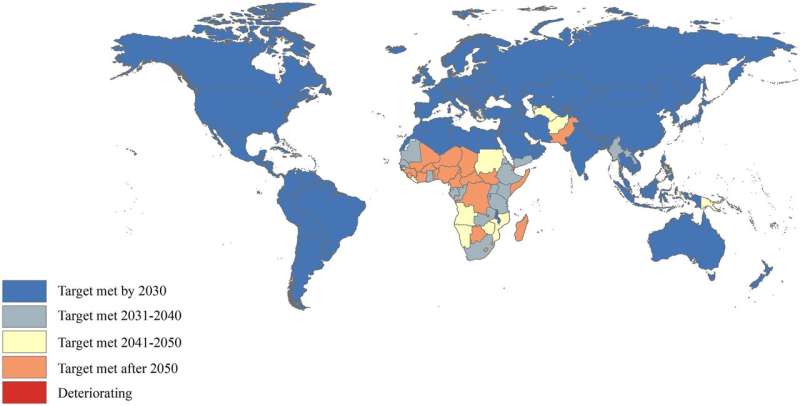
Years in which the U5MR reduction target is expected to be achieved. U5MR: under-5 mortality rate. Credit:PLOS One(2026). DOI: 10.1371/journal.pone.0343745
A new study tracking global progress on child mortality finds that the world will miss a key United Nations (UN) health target by at least five years at current rates, with the burden falling heavily on Sub-Saharan Africa. The UN's Sustainable Development Goal 3.2 calls for all countries to reduce the mortality rate for children under 5 to fewer than 25 deaths per 1,000 live births by 2030. As that deadline approaches, there has been no comprehensive assessment of where countries stand. The findings arepublishedinPLOS Oneby Min Liu of Peking University, Beijing, China, and colleagues.
In the new study, researchers used data from the UN to analyze annual under-five death counts and mortality rates from 1990 to 2023 across 200 countries and territories. They calculated the rate of change in mortality over time and used those trends to project when those countries still above the target threshold would be expected to reach it.
The researchers found that globally, under-five deaths fell by 63% over the study period—from nearly 13 million in 1990 to 4.78 million in 2023—and the mortality rate dropped by an average of 3.18% per year. However, the global rate still stands at36.72 deathsper 1,000 live births, well above the SDG target, and is not projected to reach the target until 2035.
In total, 133 countries have already met the target and nine more are on track to do so by 2030. However, 58 countries will miss the deadline, including 25 that are not projected to reach the target until after 2050, and Dominica, where under-five deaths have risen. More than four-fifths of all under-five deaths worldwide are concentrated in just two regions:Sub-Saharan Africa, where the mortality rate remains at 68.82 deaths per 1,000 live births and is not projected to meet the SDG target until 2055, and Central and Southern Asia.
The study is limited by the assumption that trends over the last two decades will continue unchanged. Data quality was also poor in some conflict-affected regions and low-income countries, the very places where child mortality is highest.
The authors conclude that to meet UN targets, policymakers must focus on scaling up proven interventions—includingskilled birth attendance, postnatal care, vaccination, improved nutrition, and treatment for common childhood illnesses—in every community, and especially in Sub-Saharan Africa.
Publication details Guiying Cao et al, Tracking under-five mortality from 1990 to 2023: Global, regional, and national trends, inequities, and projections toward achieving SDG Target 3.2 by 2030, PLOS One (2026). DOI: 10.1371/journal.pone.0343745 Journal information: PLoS ONE











Post comments