




































byUniversity of Strathclyde, Glasgow

Credit: William Fortunato from Pexels
New research suggests that babies take part in simple, story-like interactions with their parents long before they learn words, helping to build emotional connection and early social skills. The "Narrative Development in Infant–Mother Interaction" paper,publishedin theAnnals of the New York Academy of Sciences, shows that everyday exchanges between infants and their mothers follow a clear pattern that looks like a very short story, with a beginning, a build-up, a peak moment, and a natural ending.
Researchers from the University of Strathclyde closely observed interactions between mothers and babies at 4, 7, and 10 months old. Even though the babies could not speak, the interactions were not random. Instead, they became more organized over time, with both the baby and the parent responding to each other in a shared rhythm.
Positive emotion
As babies got older, these "mini stories" happened more often and became more complex. They were also linked to longer durations of positive emotion for both the baby and the mother, suggesting that these early narrative-like moments play a role in bonding and emotional well-being.
The researchers say the findings challenge the idea that dynamic and complex interaction begins with language. Instead, they suggest that the foundations of communication, meaning, and shared experience are laid much earlier, through facial expressions, sounds, movement, and timing.
Very early social engagement between parents and their babies is fundamental to health and learning. Understanding how babies make sense of the world in lived,co-created storiescan help the understanding of early differences in autism and neurodivergent development.
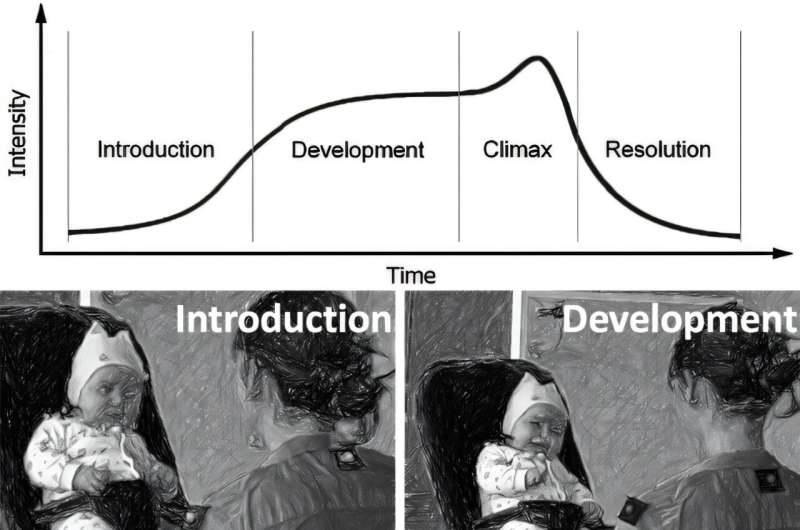
A narrative cycle between mother and infant (aged 4 months). Credit:Annals of the New York Academy of Sciences(2026). DOI: 10.1111/nyas.70192
Active agents
Lead author, Dr. Timothy McGowan, from Strathclyde, said, "Science is constantly pulling back the curtain on the infant mind. Babies are not passive observers of the world; they are active agents seeking engagement and meaning with the adults around them.
"Our findings further this perspective, helping us understand how the earliest interactions between parents and their babies are structured. This sheds light on early social development and provides a clearer look at the foundations upon which speech and language are built."
Social communication
The study adds to growing evidence that early social interaction is central to how humans learn to communicate. By recognizing these early patterns, the researchers say it may be possible to better understand how social communication develops, and why it can differ between children.
Jonathan Delafield-Butt, Professor of Child Neurodevelopment and Autism and the Director of the Laboratory for Innovation in Autism, at Strathclyde, said, "These tiny moments may look simple, but they are the active expressions of the baby's feelings and early thoughts, seeking engagement with another mind, their mother or father.
"This is important, as we're drawn as adults to reciprocate and engage. This shared emotion is at the heart of healthy human connection, and when made in active engagement, it co-creates stories to give a foundation for social belonging and a structure for learning.
"It is very satisfying, making a story together, and our data show this is true from the earliest beginnings of human life."
Everyday play
The researchers stress that parents do not need to do anything special to create these interactions. The study focused on ordinary, everyday play and engagement, showing that natural responses between parents and babies already support early development.
They hope the findings will be of interest to parents, early-years professionals, and anyone interested in how human communication begins.
More information Timothy McGowan et al, Narrative Development in Infant−Mother Interaction, Annals of the New York Academy of Sciences (2026). DOI: 10.1111/nyas.70192







Post comments