




































by Holly Ober

Researchers found more severe abuse correlated with more dramatic changes in the brain. Credit: Trym Nilsen/Unsplash
Childhood abuse leaves a scar on the brain, a new neuroimaging study led by UCLA psychologists has shown. The researchers found associations between the severity of different maltreatment exposures and cortical thickness, surface area and subcortical volume based on MRI images of individuals. The effect was more pronounced in young women than in men or in children. The study is the largest of its kind to examine the neurobiological legacy of childhood maltreatment across a diverse, global sample of people.
"We know that childhood maltreatment is a major risk factor for many stress-related disorders, including major depressive disorder and posttraumatic stress disorder, and we wanted to know if there was what amounted to a neurobiological scar associated with these adverse experiences," said UCLA psychology professor Tiffany Ho, the corresponding author of the study, which is published in the journal Biological Psychiatry.
Much of the neuroimaging research in this area has focused on the cumulative effects of multiple exposures in individuals exposed to childhood maltreatment. But during childhood, the brain is still developing many of its major neural networks and is especially sensitive to environmental inputs, a situation known as heightened plasticity. Contextual influences can therefore have an outsized effect on how the brain develops during these sensitive periods. The researchers therefore suspected that abuse might affect the physical structure of the brain in ways related to developmental timing.
Haley Wang, who is now a postdoctoral fellow at UCLA Psychiatry, collaborated with an international research collective called the ENIGMA Consortium to examine brain MRI images of 1,389 patients with posttraumatic stress disorder (PTSD) and major depressive disorder (MDD), along with 2,322 healthy controls. The images came from eight countries. The team measured different brain dimensions, such as the thickness of the outside layer of the brain, called the cortex, and the volume of the inner layers of the brain, called the subcortex, along with the overall surface area of the brain.
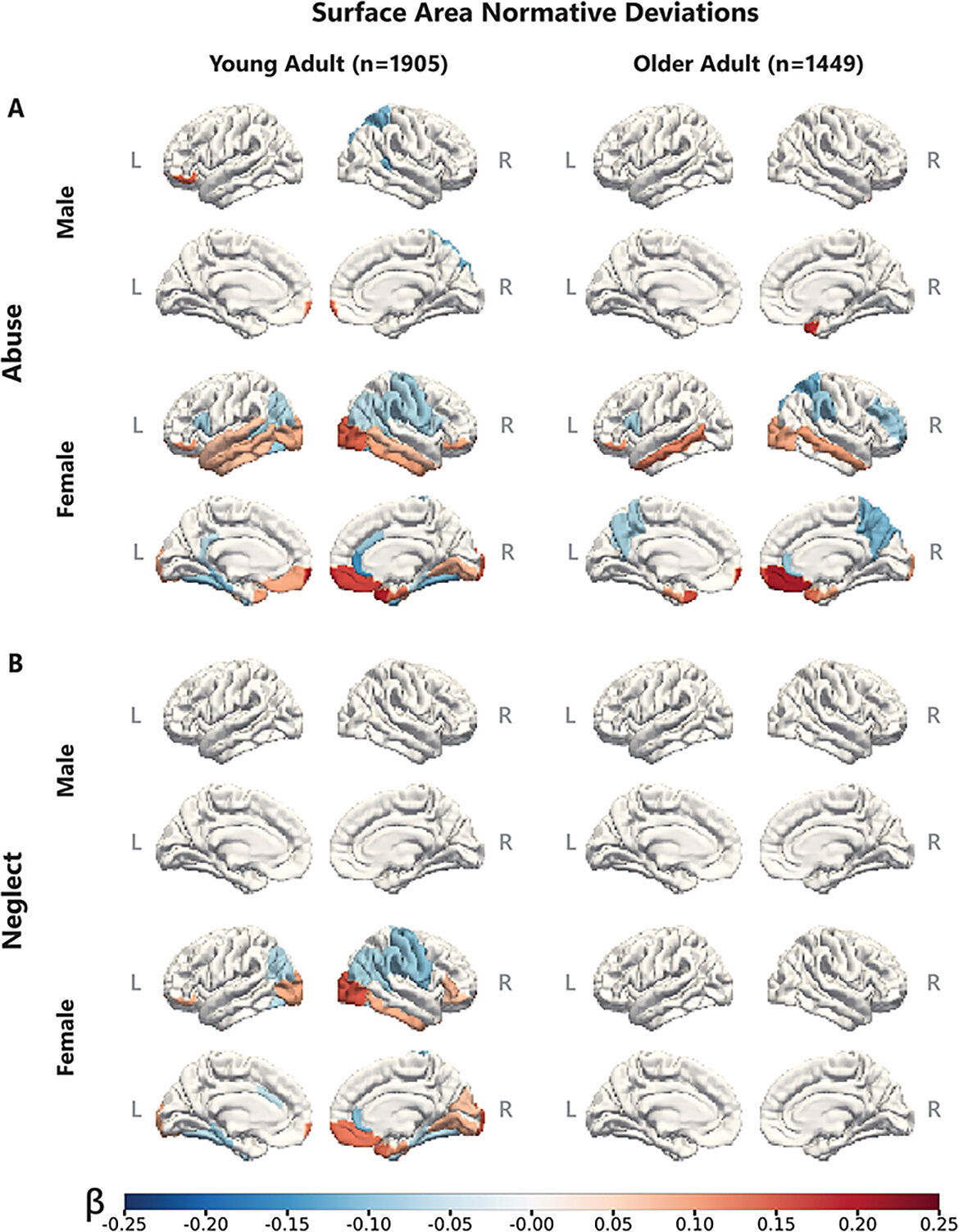
Comparison in surface area in the brains of people who had experienced childhood maltreatment vs. neglect. Credit: Wang et. al. 2026
Participants answered a standard questionnaire to retrospectively assess childhood physical abuse, emotional abuse, sexual abuse, physical neglect and emotional neglect. From this, the researchers devised two scores, one to reflect the total severity of childhood abuse and one to reflect the total severity of childhood neglect. Neglect had a separate score from abuse to distinguish its effects from those of trauma.
Using an index that researchers have gathered over the years about how the brain typically grows and develops—akin to a growth chart for the brain—the researchers found a distinct but nonuniform array of structural differences in the brains of individuals who scored high on childhood maltreatment. These differences suggest that the neurodevelopmental trajectories of these brain regions have been altered as a result of experiencing such adversity.
More severe abuse was associated with larger thalamus and pallidum volumes, smaller isthmus cingulate cortex regions and a larger surface area of the medial orbitofrontal cortex than expected for the participants' ages. More severe abuse was associated with more noticeable changes in these brain regions, particularly among young women. Many of these patterns seen in young women persisted in older women as well.
Wang and Ho said that the more severe effects in women may have to do with the higher incidence of sexual trauma among girls compared with boys during this sensitive period of development, or that their brains may respond to trauma more strongly. Clarification of these patterns will require more research.
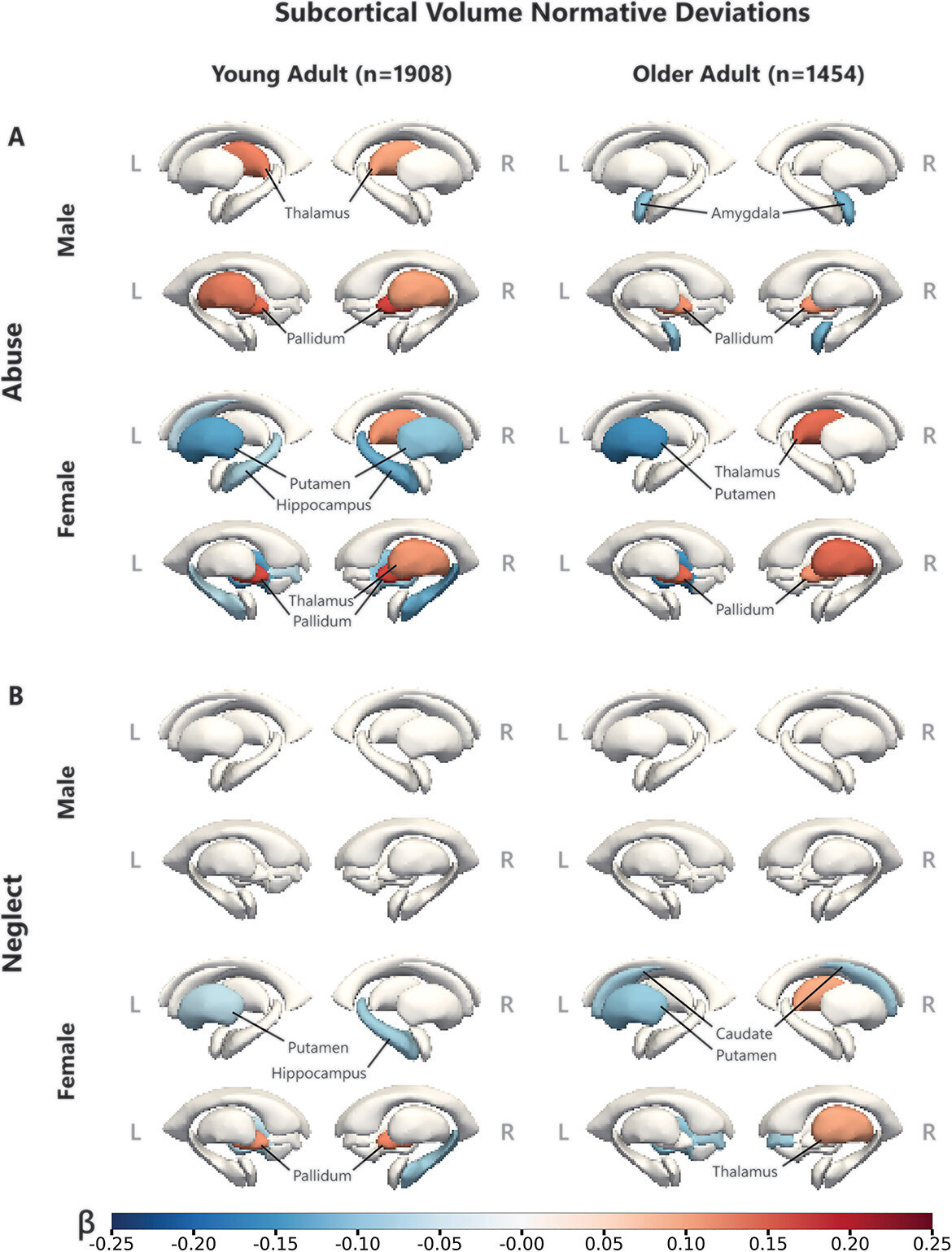
Comparison in subcortical volume and surface area in the brains of people who had experienced childhood maltreatment vs. neglect. Credit: Wang et. al. 2026
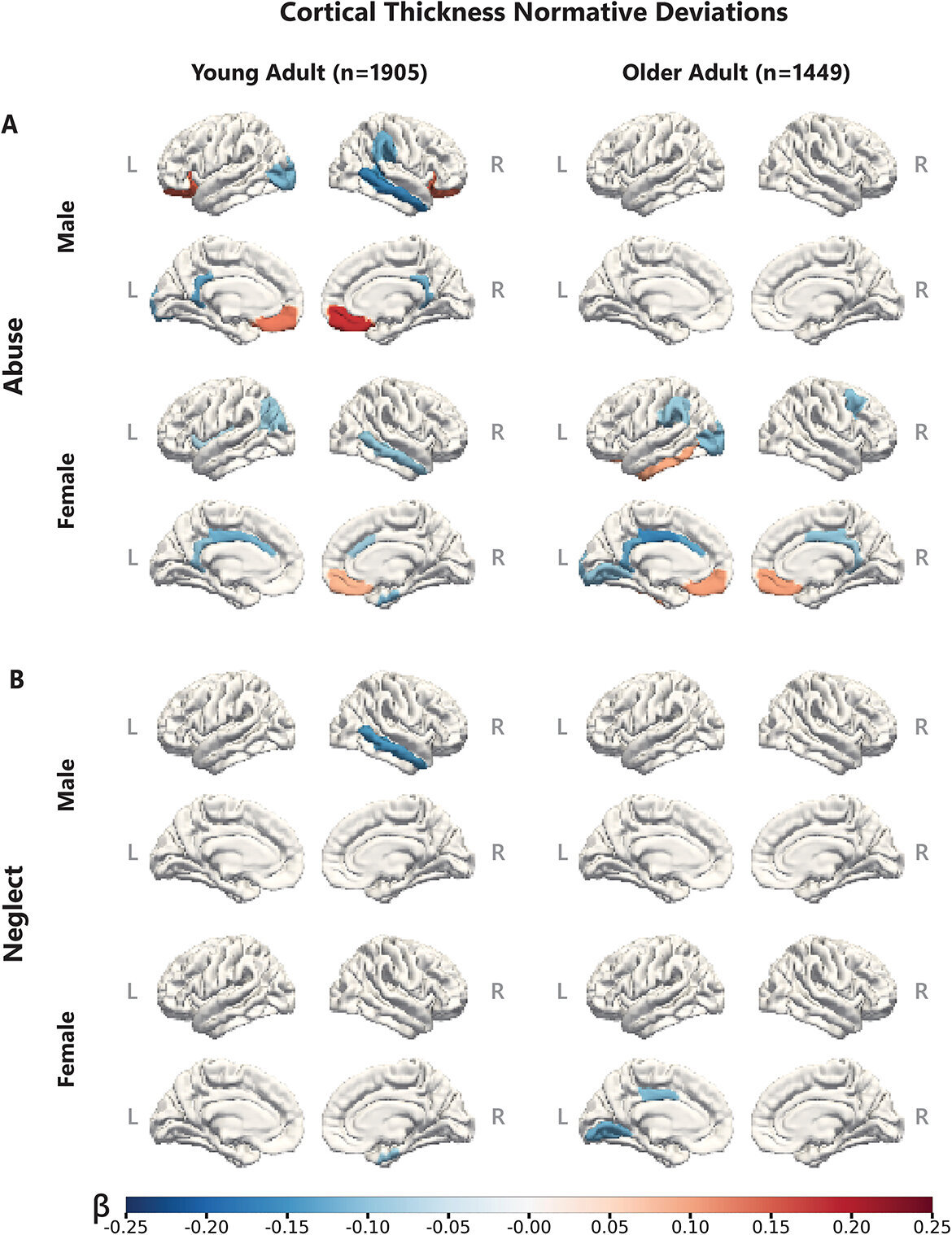
Comparison in cortical thickening in the brains of people who had experienced childhood maltreatment vs. neglect. Credit: Wang et. al. 2026
Neglect was associated with more circumscribed patterns of differences in brain structure. In young women, these differences were limited to surface area deviations primarily in the cingulate regions, located in the middle part of the brain close to the corpus callosum, while in young men, effects were restricted to a smaller right middle temporal cortex, which is located on the lower right side.
"The changes we measured for the cortex were parceled out over 70 different regions of the brain. But not every region followed the same pattern. We found a widespread pattern of volume changes, surface area changes and thickness changes in many regions that are involved in emotional and cognitive functioning. We saw thinning in some areas, but also, in some potentially complementary regions, we see thickening. Some regions are expanded, while others are shrunk," said Wang.
The findings challenge the notion that childhood trauma has a singular, static effect on the brain. Instead, distinct types of early-life adversity may be associated with a variety of changes in brain structure that depend on age and sex. And they reveal nothing about specific cognitive, emotional or developmental abilities of individuals with brain "scarring" due to abuse.
More information: Haley R. Wang et al, Childhood Maltreatment and Deviations From Normative Brain Structure: A Mega-Analysis of 3711 Individuals From the ENIGMA Major Depressive Disorder and ENIGMA Posttraumatic Stress Disorder Working Groups, Biological Psychiatry (2026). DOI: 10.1016/j.biopsych.2026.02.016
Provided by University of California, Los Angeles
Source: MedicalXpress
Original article: https://medicalxpress.com/news/2026-10-childhood-abuse-scar-brain.html










Post comments