
































byUniversity of Tsukuba
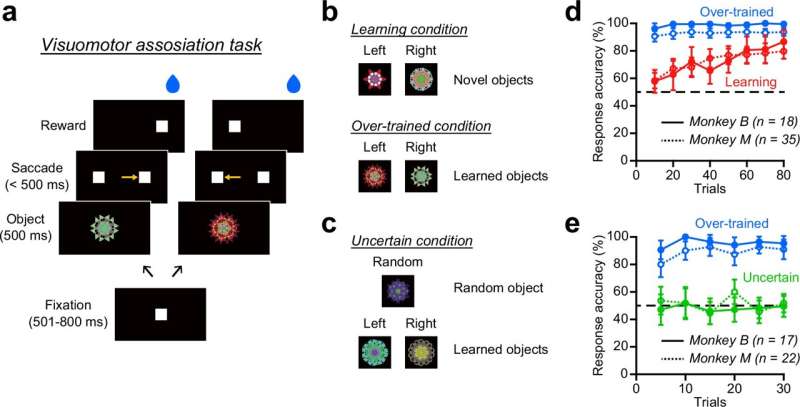
Visuomotor associative learning task. Credit:Communications Biology(2025). DOI: 10.1038/s42003-025-09068-7
The cerebellum facilitates associative learning—wherein visual information is linked to motor actions—by strengthening sustained visual responses. Researchers at the University of Tsukuba have discovered that this amplification enhances goal-related information, making it easier to match visual cues with the appropriate movements.
Everyday behaviors, such as braking at a red light or opening an app upon seeing a notification, are shaped by associative learning, wherein the brain links sensory cues to motor actions. Although recent studies have suggested that the cerebellum contributes to this process, the precise neural mechanism underlying its involvement has remained unclear.
In the newstudy, published inCommunications Biology, researchers recorded neuronal activity in the cerebellar dentate nucleus of Japanese monkeys performing a visuomotor association task. The monkeys learned to makeleftward or rightward eye movementsin response to two distinct images. The team discovered numerous neurons exhibiting sustained visual activity, particularly during the learning phase.
These responses varied according to the image, indicating that sustained activity encodes both the learning state and image-movement associations. Moreover,stronger responsesduring learning corresponded to greater differentiation between images. This finding suggests that cerebellar signals enhance visual discrimination in a learning-dependent manner, thereby facilitating the formation of precise visuomotor associations.
These findings uncover a previously unknown mechanism wherein cerebellar signals amplify goal-related information to support associative learning. Given the cerebellum's uniform circuitry, this mechanism could influence a wide range of cognitive functions beyond motor control.
More information Yusuke Akiyama et al, Sustained visual signals in the primate cerebellar dentate nucleus drive associative learning, Communications Biology (2025). DOI: 10.1038/s42003-025-09068-7 Journal information: Communications Biology







Post comments