




































Provided by Japan Advanced Institute of Science and Technology
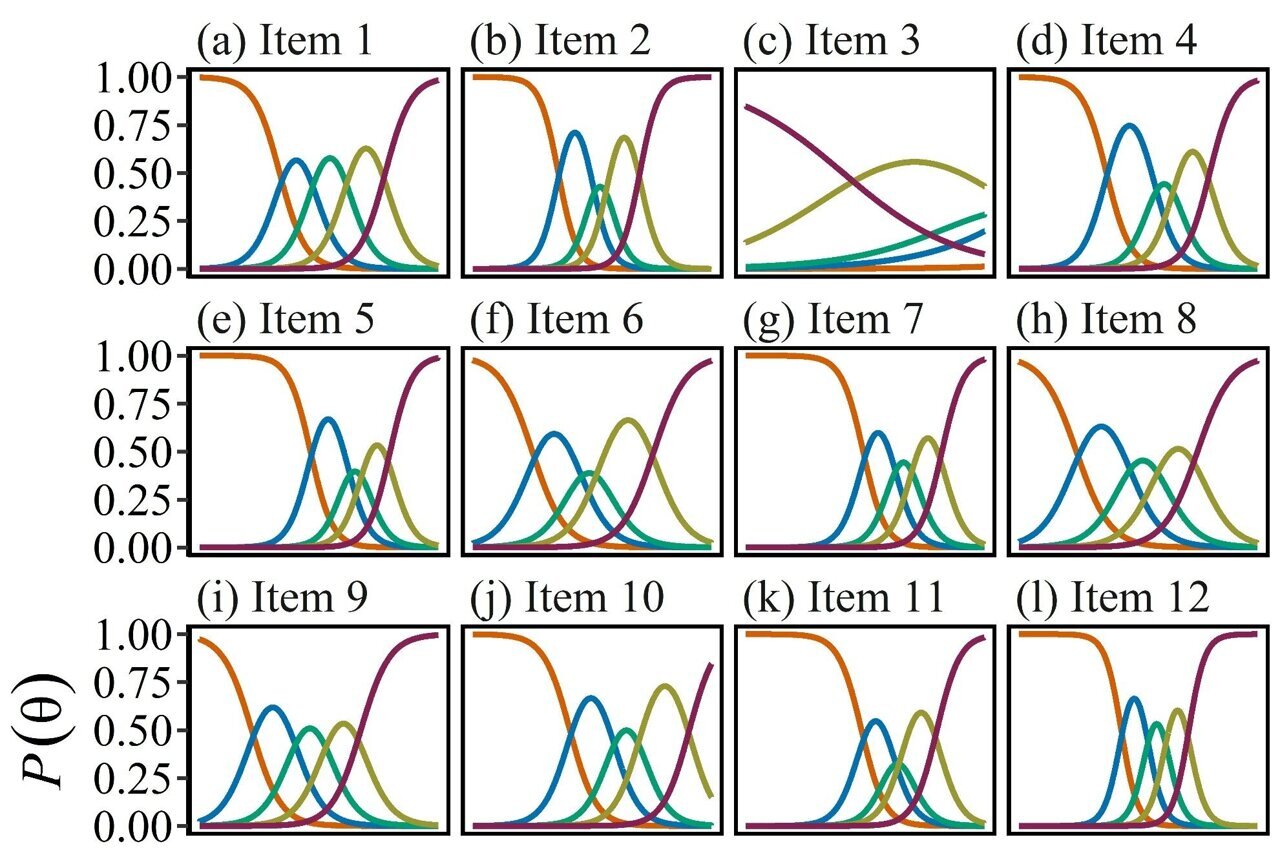
Questions (denoted as "Items" in the Figure) 1–20 correspond to the question numbers. For the response categories (Score 1: strongly disagree–Score 5: strongly agree), scores were reversed for questions with opposite response directions to ensure consistent evaluation across all questions. Most questions show a stepwise shift in the distribution of response categories as θ increases, and the curves overlap less. Conversely, Questions 3 and 13 do not follow this stepwise pattern, and the curves overlap greatly. Thus, researchers were able to quantitatively evaluate which questions performed well and which did not.
Credit: Dr. Masaki Mori from Japan Advanced Institute of Science and Technology (JAIST), Japan Image source link: https://link.springer.com/article/10.3758/s13428-026-03145-3
Recognizing a familiar face, whether it's greeting a colleague or spotting a friend in a crowd, plays an important role in social interactions. However, for people with lifelong difficulty processing familiar faces, these effortless tasks can be quite challenging.
These individuals have a condition called developmental prosopagnosia, in which they experience lifelong difficulty recognizing faces despite having normal vision and no brain injury.
Since the condition often goes undiagnosed, accurate and accessible screening tools are essential for identifying it.
Now, a study led by Associate Professor Masaki Mori from the Graduate School of Advanced Science and Technology, Japan Advanced Institute of Science and Technology (JAIST), Japan, along with former graduate student Midori Sugiyama from the Graduate School of Media and Governance, Keio University, Japan, provides the first comprehensive evaluation of the 20-item prosopagnosia index (PI20), a self-report questionnaire widely used to screen for developmental prosopagnosia.
The PI20 asks people to rate how strongly they agree with 20 statements about everyday face-recognition experiences, such as recognizing familiar people out of context or remembering faces after meeting someone.
The findings were published in the journal Behavior Research Methods on Aug. 12, 2026.
Testing how well PI20 works
To evaluate how well the questionnaire performs, the researchers used two complementary statistical approaches: classical test theory and item response theory. The first approach mainly examines whether the questionnaire consistently measures what it is intended to measure, while the second approach goes a step further by evaluating how well each question distinguishes between people with different levels of face-recognition difficulty.
Together, these analyses confirmed that the PI20 is an effective screening tool and identified specific questions that could be refined to improve its accuracy.
"We evaluated the measurement characteristics of the PI20, one of the most widely used screening questionnaires for developmental prosopagnosia, to facilitate its appropriate use and development," Mori says.
The researchers analyzed responses from 599 Japanese adults to the PI20 questionnaire. The analyses revealed that the PI20 has excellent reliability and validity, confirming its effectiveness as a screening tool. Several questions describing real-world situations were effective at distinguishing individuals with different levels of face-recognition difficulty.
Questions that fell short
Additionally, the study identified opportunities for improvement. Two questions contributed relatively little to measuring face recognition. One question focused on recognizing people with distinctive facial features. Since unusual or highly distinctive faces are easier for most people to remember, the question may not effectively capture the specific face-recognition difficulties associated with developmental prosopagnosia.
Another question was about recognizing one's own face in photographs, even though most people with developmental prosopagnosia may not experience much difficulty recognizing themselves.
Overall, the findings suggest that while most items adequately capture the characteristics of developmental prosopagnosia, certain items may not be suitable for screening for developmental prosopagnosia.
Open data for future revisions
Beyond evaluating the PI20, researchers have also made one of the largest PI20 datasets and the accompanying analysis code publicly available. This could prove valuable for future studies across different languages and cultures. By strengthening the scientific foundations of one of the field's most widely used questionnaires, the study brings researchers one step closer to identifying people with developmental prosopagnosia more accurately.
"Our study provides open materials and evidence to revise and further improve the PI20 for screening for developmental prosopagnosia," Mori concludes.
More information: Masaki Mori et al, Item analyses of the 20-item prosopagnosia index using classical test theory and item response theory, Behavior Research Methods (2026). DOI: 10.3758/s13428-026-03145-3









Post comments