




































byTohoku University
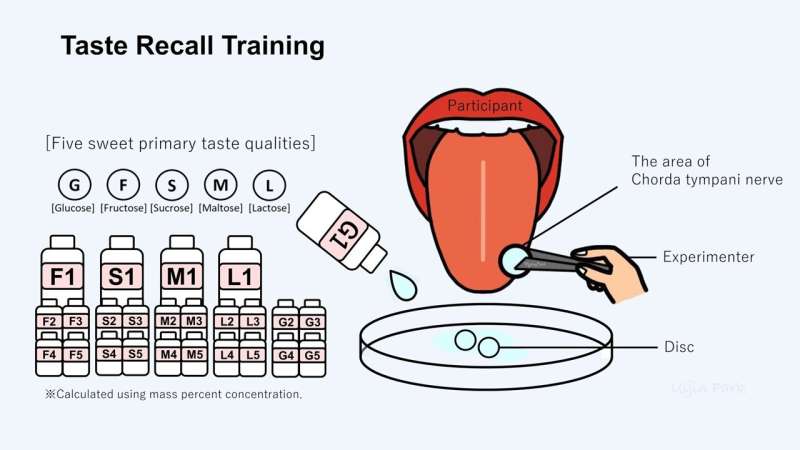
Procedure of sweet taste recall training. Credit: Uijin Park
Why are gourmets seemingly able to detect subtle nuances in taste that others miss? Researchers at Tohoku University have uncovered part of the answer by demonstrating that taste sensitivity can be enhanced through learning.
In a study led by Professor Satoru Ebihara and Ph.D. Candidate Uijin Park, a research team investigated how humans distinguish and remember fine differences within the same taste quality. Forty healthy adults participated in a novel "sweet taste recall training," designed to improve their ability to recognize and remember subtle variations in sweetness.
At the start of the study, the researchers measured each participant'staste threshold—the lowest concentration at which sweetness could be perceived—for five sweet substances: glucose, fructose, sucrose, maltose, and lactose. Participants were then repeatedly exposed to these sweeteners at concentrations slightly below their individual thresholds. Over three consecutive days, they tasted the samples and were asked to recall which sweet substance they were experiencing.
After just three days of training, participants showed a significant improvement in taste sensitivity for all five sweet substances. Their taste thresholds decreased, indicating a sharper perception of sweetness. These findings provide clear evidence that taste perception, like vision or hearing, is plastic and can be enhanced through learning.
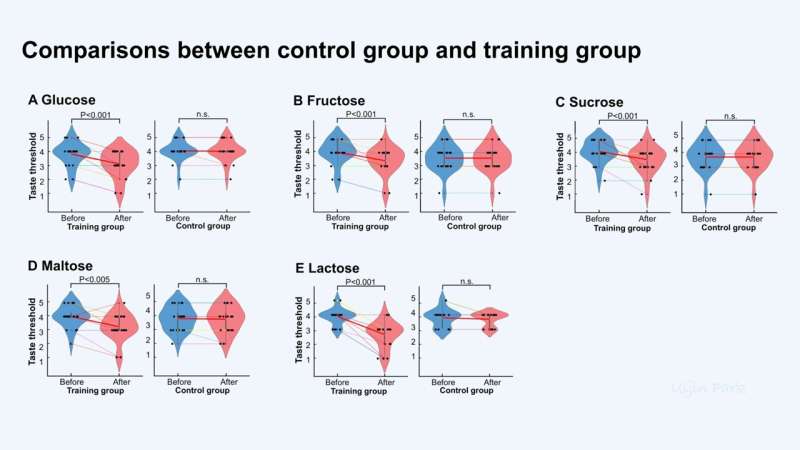
Comparison of taste thresholds change between training and control groups for each taste. Credit: Uijin Park
"Taste expertise has long been linked to experience rather than innate talent," explains Park. "For example, sommeliers are believed to develop refined palates not because they are born with special tastebuds, but because years of experience allow them to accumulate detailed 'taste memories' in the brain."
The training in this study was like a boot camp of rapidly accumulating these "taste memories" to allow participants to refine their palate. Previously, it was unclear if this was possible to do within the same taste modality, since all the sweeteners act upon the same family of receptors on the tongue.
Remarkably, learning and memory played a big role in perception, which points to promising clinical applications. Understanding how taste memory and sensory learning interact in the brain may lead to new rehabilitation strategies for taste disorders and age-related loss of appetite.
"We're excited to report thattaste recall-based rehabilitationis already being explored in clinical practice at Tohoku University Hospital," remarks Ebihara.
Published inChemical Senseson November 19, 2025, thisstudyis the first to demonstrate that training taste recall can enhance discrimination not only between different taste qualities, but also among subtle variations within the same taste.
More information Uijin Park et al, Effect of taste recall training using 5 sweet substances on sweet taste sensitivities, Chemical Senses (2025). DOI: 10.1093/chemse/bjaf057 Journal information: Chemical Senses







Post comments