


































byIngrid Fadelli, Medical Xpress
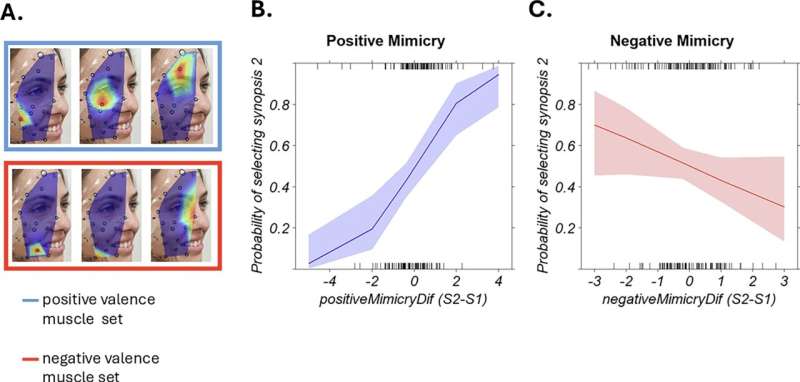
When study participants unconsciously mimicked positive facial expressions, for instance smiling more during one movie synopsis, they were significantly more likely to choose that movie. The face map (A) shows which muscle groups we tracked, and the graphs (B, C) demonstrate this predictive relationship across 106 participants. Credit: Amihai et al.
In social situations, humans often copy the facial expressions of others who they are interacting with. This phenomenon, known as facial mimicry, is widely reported and has been linked to social connection and an empathic understanding of how others are feeling at a given time.
Researchers at Tel Aviv University have carried out a study exploring the possibility that facial mimicry sometimes reveals people's preferences.
Their findings, published inCommunications Psychology, confirmed this hypothesis, suggesting that when people mimic another person's positive facial expressions more strongly, they are subsequently more likely to choose the option linked to that interaction.
"The inspiration for our study came from a very common experience," Liron Amihai, first author of the paper, told Medical Xpress.
"When I was younger, I'd go to the movies with friends, read them a few movie options, and ask what they wanted to see. That's essentially what we recreated in the lab—just with facial sensors attached!"
Past studies consistently showed that facial expressions are good predictors of what people will choose. Yet most earlier works focused on choices between very different options, such as a very boring and a very funny item.
"When options are more similar, expressions alone aren't as revealing," said Amihai.
"We had this hunch that facial mimicry—the way we unconsciously mirror each other's expressions during conversation—might be indexing agreement in these cases, perhaps even better than people's own expressions. Our objective was to test whether mimicry during a social interaction could predict which option someone would ultimately choose."
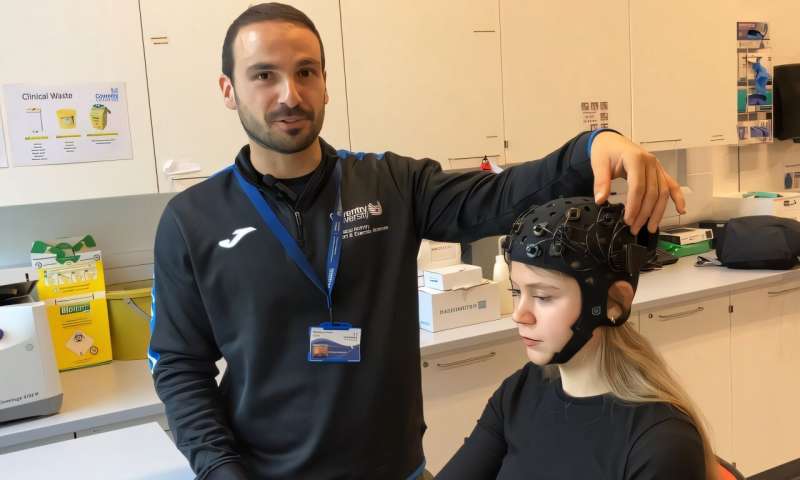
To explore the link between facial mimicry and people's choices, Amihai and his colleagues recruited 106 adults and split them into53 pairs. These pairs of strangers were asked to wear high-resolution facial EMG electrodes, sensing devices that can detect tiny facial muscle movements.
"The experiment had two parts," explained Amihai. "In the first part, participants took turns: one read aloud two movie synopses while the other listened and watched their faces. After hearing both options, each person privately chose which movie they'd prefer to watch. In the second part, both participants listened together to pre-recorded synopses read by an actress (audio only)."
As the study participants completed both parts of the experiment, the researchers continuously recorded the activity of their facial muscles. They then analyzed the data they collected to determine whether the activation of similar facial muscles in paired-up individuals predicted their choices.
"What we found was striking: when listeners mimicked more positive facial expressions—like smiling and eyebrow raises—during one synopsis compared to the other, they were significantly more likely to choose that synopsis," said Amihai.
"This pattern held even when they were just listening to the pre-recorded voice, showing it wasn't just about seeing the speaker's face."
The findings of this study suggest thatfacial mimicryis more than a mere act of social connection, as it can predict what people will prefer and choose between different available options. This was never demonstrated before and could have interesting implications for future research in a wide range of fields.
"Mimicry is fundamentally a social act, and when preferences are being formed during social interaction, it seems to capture something that individual expressions miss," said Amihai.
"What really stood out was that mimicry outperformed people's own facial expressions as a predictor of their choices. This suggests mimicry isn't just automatic copying—it's reflecting something deeper about how we evaluate options when interacting with others."
The team's observations could soon be validated in further studies and could lead to field-specific investigations. For instance, future research could explore the implications of the team's findings in juridical settings, where members of a jury might need to make decisions based on people's testimonies.
In addition, marketing experts or behavioral scientists could be inspired to utilize facial mimicry to improve the effectiveness of advertising campaigns or interventions aimed at prompting people to make more responsible choices.
"Our study opens a window into how social influence actually works at the moment it's happening," added Amihai. "We're now continuing to explore facial mimicry in other types of choices—for example, when people are labeling emotions or making other judgments.
"We're also really interested in working with clinical populations, particularlyautistic individuals, to understand how mimicry patterns might differ and what that tells us about social decision-making."
© 2025 Science X Network
More information Liron Amihai et al, Facial mimicry predicts preference, Communications Psychology (2025). DOI: 10.1038/s44271-025-00351-1 . Journal information: Communications Psychology









Post comments