




































By Andy Cain,Keele University
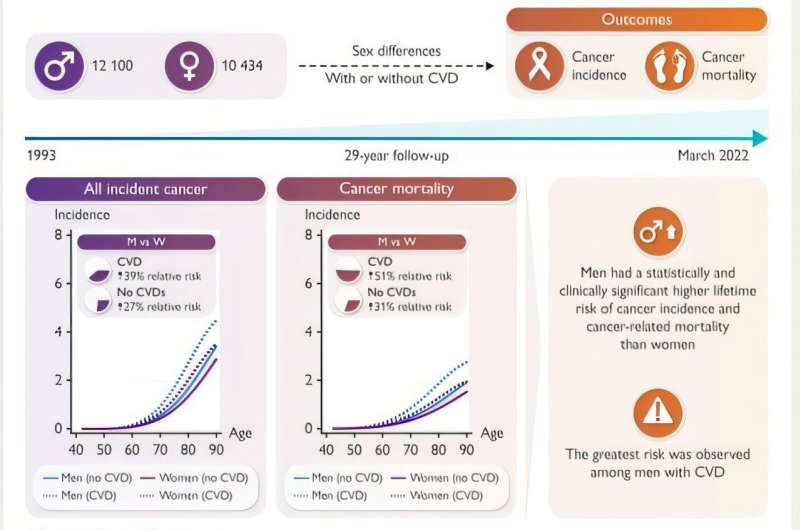
Structured Graphical Abstract. Credit:European Heart Journal(2026). DOI: 10.1093/eurheartj/ehag515
New research from Keele University and the University of Aberdeen has found that men with cardiovascular disease are at higher risk of cancer and death from cancer than women. The study found this pattern across all cancer subtypes, with lung cancer and colorectal cancers accounting for the highest risk.
Published in theEuropean Heart Journal, the team looked at data from more than 20,000 people over a 25-year period to identify gender differences in health outcomes among people living with cardiovascular disease.
Cardiovascular disease (CVD) is an umbrella term for a range of conditions affecting the heart and blood vessels. These can include diseases such as coronary heart disease, atrial fibrillation, heart failure, stroke and vascular dementia.
According to recent data from the British Heart Foundation, it is estimated that more than 8 million people are living with cardiovascular disease in the UK, and it causes around a quarter (26%) of all deaths in the UK. That's around 170,000 deaths a year, or 460 each day—one every three minutes.
While there is already a known link between cardiovascular disease and cancer, this relationship seemed to differ between the sexes, although evidence was very limited and sometimes contradictory.
This study is the first to identify how sex affects the relationship between CVD and cancer. This could now be used to inform public health strategies to try to achieve more equal health outcomes between men and women.
Professor Phyo Myint, chair in old age medicine at the University of Aberdeen, led the research. The team examined the health records of 22,534 people in the UK over a 25-year period using the EPIC-Norfolk database. The EPIC (European Prospective Investigation into Cancer) Norfolk study is a population-based study coordinated by a management team based at the IMS Epidemiology Unit, University of Cambridge.
Professor Mamas Mamas, professor of cardiology at Keele University, highlighted that while the future risk of cardiovascular disease in patients with cancer is well known, it is now becoming evident that patients with cardiovascular risk are at increased risk of cancer, with important sex differences in cancer types.
He said, "We need to better understand the driver of cancer development in these populations. Furthermore, whilecardio-oncology serviceshave focused mainly on preventing the development of cardiovascular diseases in cancer patients, we need better pathways that can identify and prevent cancer development in patients with cardiac conditions."
Dr. Tiberiu Pana, specialty registrar in cardiology at NHS Grampian and honorary early career clinical research fellow at the University of Aberdeen, said, "We examined how men and women differed in their risk of cancer incidence and death over more than 25 years.
"We found that cancer incidence and death were higher in people with cardiovascular disease than in those without—a relationship we already knew a bit about. However, by looking at this large patient group over a very long period, we were able to examine it more thoroughly.
"We have identified clear differences between men and women across a range of factors in those with cardiovascular disease and all types of cancer.
"We found that men had higher rates of both developing cancer and, sadly, dying from it, and this was particularly true among people with cardiovascular disease.
"Although the pattern was the same across all cancer subtypes, this was most pronounced in lung and esophageal cancers."
The team suggests that the association between cardiovascular disease and cancer is likely mediated by lifestyle risk factors, such as smoking, obesity and alcohol consumption. They say it is important to target these modifiable risk factors as early as possible to avoid the occurrence of either condition.
Myint proposes that early cardiovascular disease screening be incorporated as a cancer-preventive strategy, particularly in men, given the results of this study. He added, "More needs to be done to improve risk management, targeted screening and prevention to address this health inequality."











Post comments