




































byIngrid Fadelli, Medical Xpress
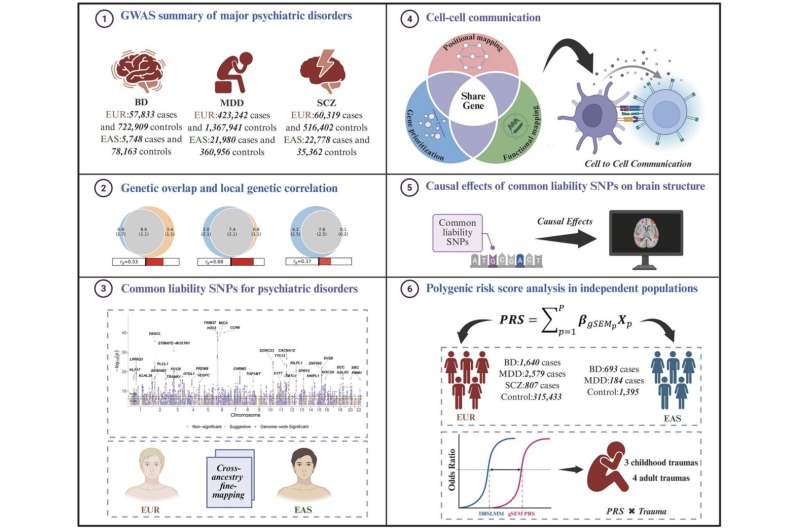
The study integrates multi-ancestry GWAS data for bipolar disorder (BD), major depressive disorder (MDD), and schizophrenia (panel 1), revealing extensive polygenic overlap and local genetic correlations across disorders (2). Multivariate GWAS using genomic structural equation modeling (gSEM) identified shared liability SNPs (3), which were functionally prioritized through integrative transcriptomic and cell-type analyses (4). Mendelian randomization established causal links between common liability variants and brain structure (5). Finally, polygenic risk scores (PRSs) derived from gSEM-enhanced loci were validated in independent EUR and EAS cohorts, revealing gene–environment interactions with trauma exposure (6). Credits: in BioRender by Yu, F. (2025) https://BioRender.com/jyfrwni.
Psychiatric disorders, such as bipolar disorder (BD), major depressive disorder (MDD), schizophrenia and anxiety disorders, adversely affect the daily functioning and well-being of millions of people worldwide. Understanding the neural and genetic underpinnings of these disorders can help medical and psychiatry researchers to devise more effective methods to predict the risk that they will emerge, as well as diagnosing and treating them.
While each psychiatric disorder is linked to a specific set of symptoms, past studies have found an overlap between some of their genetic features. For instance, they identified various genes that are linked to an increased risk of developing both BD and SCZ, two disorders with overall different symptoms that can prompt psychosis (i.e., a state of disconnection from reality).
Researchers at Zhejiang University School of Medicine and various other departments at Zhejiang University set out to further explore the genetics of psychiatric disorders, by analyzing a large pool of data collected from people living in Europe and East Asia.
Their findings,published inMolecular Psychiatry, identify new regions in the human genome that are linked to various psychiatric disorders, while also establishing connections between genetic factors and structural changes in the brain.
Analyzing European and East Asian genetic data
To explore the genetic and biological underpinnings of different psychiatric disorders, the researchers analyzed two large health datasets, one collected in Europe and the other in East Asia.
The first is the UK Biobank, a well-known database that includes biological samples and health records collected from hundreds of thousands of people living in the UK. The second is a dataset containing health-related data collected as part of an East Asian clinical study called CLASS-BD.
"We conducted across-ancestry multivariate genome-wide association study(GWAS) integrating European and East Asian populations to uncover shared genetic underpinnings," wrote Yu Feng, Ningning Jia and their colleagues in their paper.
The researchers combined the Biobank and CLASS-BD datasets and performed various analyses, looking for genetic variants that were shared across different psychiatric disorders. They then used the results of their analyses to calculate polygenic scores for each person included in the combined dataset. These are essentially values that estimate the risk that a person will develop a mental health disorder.
"Our analyses identified403 lociassociated with shared polygenic liability to psychiatric disorders, including 88 novel regions," wrote Feng, Jia and their colleagues.
"Cross-ancestry fine-mapping highlighted robust shared signals, notably at VRK2 (rs7596038), consistently significant across ancestries. Gene prioritization revealed 90 high-confidence candidate genes enriched in neurodevelopmental pathways. Single-nucleus RNA sequencing implicated excitatory neurons and astrocytes as key cellular contexts, emphasizing NCAM1–FGFR1 and NEGR1–NEGR1 signaling pathways."
The team's analyses ultimately allowed them to identify just over 400 specific locations of genes on a chromosome (i.e., genetic loci), that were associated with a risk of developing various psychiatric disorders. Notably, 88 of these loci are entirely new and had not been identified in previous studies.
The researchers also carried out additional analyses using a statistical technique known asMandelian randomization, which allowed them to explore the link between the genetic risk of developing psychiatric disorders and people's brain structure.
They found that the genetic variants they uncovered appeared to be linked to specific changes in the brain, particularly in the structure of regions associated with crucial mental functions and the processing of emotions.
"Mendelian randomization analyses provided causal evidence linking shared genetic liability to structural brain alterations, particularly in regions crucial for emotion and cognition," wrote the authors. "Polygenic risk scoresderived from shared genetic liability substantially enhanced predictive accuracy for BD and SCZ, demonstrating strong trans-ancestry validity."
Informing the prediction and treatment of psychiatric disorders
The findings of this recent study offer further evidence suggesting that major psychiatric disorders, particularly BD and SCZ, have a common genetic foundation. The collection and analysis of additional biological and genetic data could soon help to uncover an even broader range of genetic variants and biological features that are shared between most mental health disorders.
"These results advance understanding of shared genetic architecture in psychiatric disorders, highlighting potential therapeutic targets and emphasizing the critical importance of diverse ancestry studies in precision psychiatry," wrote the authors.
In the future, this recent work could help to develop new tools for predicting the vulnerability of specific individuals to mental health conditions. These tools could potentially help to diagnose disorders early and treat them before symptoms become severe or chronic.
© 2026 Science X Network
Publication details Yu Feng et al, Cross-ancestry genetic architecture reveals shared biological pathways of major psychiatric disorders, Molecular Psychiatry (2026). DOI: 10.1038/s41380-026-03541-3 . Journal information: Molecular Psychiatry










Post comments