




























143

Neurology
Focuses on brain health.
Sub Categories on Neurology
Latest Articles
Consistent gene changes in Alzheimer's disease across studies

Consistent gene changes in Alzheimer's disease across studies

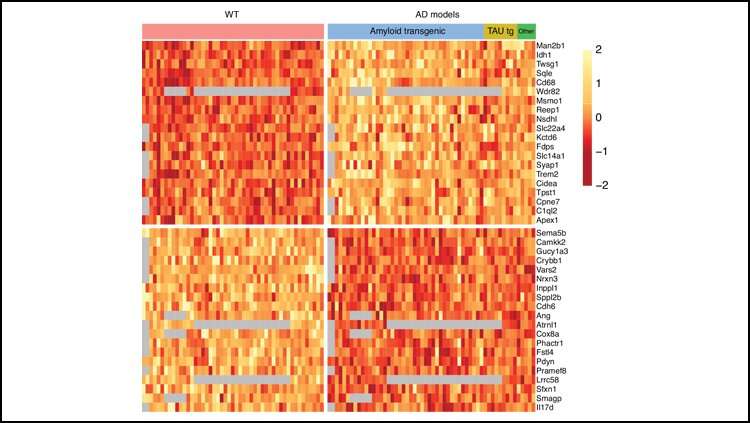
by Society for NeuroscienceTop 20 up and down-regulated genes for late phase Alzheimer's disease. Credit: Zhuang et al.,eNeuro2019A comparison of mouse Alzheimer's disease mod

Consistent gene changes in Alzheimer's disease across studies

by Society for NeuroscienceTop 20 up and down-regulated genes for late phase Alzheimer's disease. Credit: Zhuang et al.,eNeuro2019A comparison of mouse Alzheimer's disease mod
Uncovering the molecular mechanism behind synapse loss in Alzheimer's disease

Uncovering the molecular mechanism behind synapse loss in Alzheimer's disease

by Korea Brain Research InstituteCredit: Unsplash/CC0 Public DomainKorea Brain Research Institute (KBRI, Pann-Ghill Suh (President)) announced that Dr. Kea Joo Lee and Dr. You-Na Jang of the Neural Ci

Uncovering the molecular mechanism behind synapse loss in Alzheimer's disease

by Korea Brain Research InstituteCredit: Unsplash/CC0 Public DomainKorea Brain Research Institute (KBRI, Pann-Ghill Suh (President)) announced that Dr. Kea Joo Lee and Dr. You-Na Jang of the Neural Ci
Research links age-related inflammation, microglia and Alzheimer's disease

Research links age-related inflammation, microglia and Alzheimer's disease

by Nicholas Weiler,Stanford UniversityMyeloid TREM1 expression positively associates with increasing AD pathology. Credit:Nature Neuroscience(2024). DOI: 10.1038/s41593-024-01610-wSt

Research links age-related inflammation, microglia and Alzheimer's disease

by Nicholas Weiler,Stanford UniversityMyeloid TREM1 expression positively associates with increasing AD pathology. Credit:Nature Neuroscience(2024). DOI: 10.1038/s41593-024-01610-wSt
Using light to treat Alzheimer's disease

Using light to treat Alzheimer's disease

by The Korea Advanced Institute of Science and Technology (KAIST)Deposits of Beta-Amyloid in Fruit Flies Stopped by Using Porphyrin and Blue LED Lights. Credit: KAISTA Korean research team jointl

Using light to treat Alzheimer's disease

by The Korea Advanced Institute of Science and Technology (KAIST)Deposits of Beta-Amyloid in Fruit Flies Stopped by Using Porphyrin and Blue LED Lights. Credit: KAISTA Korean research team jointl
Oxytocin: The love hormone that holds the key to better memory

Oxytocin: The love hormone that holds the key to better memory

byTokyo University of ScienceResearchers discovered that activating a specific group of oxytocin neurons in the mouse brain improves performance in novel object recognition tasks. Credit: Akiyos

Oxytocin: The love hormone that holds the key to better memory

byTokyo University of ScienceResearchers discovered that activating a specific group of oxytocin neurons in the mouse brain improves performance in novel object recognition tasks. Credit: Akiyos
How the brain's immune system worsens epilepsy

How the brain's immune system worsens epilepsy

by Richard C. Lewis,University of IowaUniversity of Iowa biologists have definitively linked the brain's immune system to epilepsy. The caption shows the sequence of events that triggers wor

How the brain's immune system worsens epilepsy

by Richard C. Lewis,University of IowaUniversity of Iowa biologists have definitively linked the brain's immune system to epilepsy. The caption shows the sequence of events that triggers wor
Alzheimer's drug trial shows 'evidence of sustained improvement'

Alzheimer's drug trial shows 'evidence of sustained improvement'

by University of AberdeenRelationship between steady-state plasma levels of hydromethylthionine and decline on the ADAS-Cog11scale over 65 weeks in 566 participants receiving hydromethylthi

Alzheimer's drug trial shows 'evidence of sustained improvement'

by University of AberdeenRelationship between steady-state plasma levels of hydromethylthionine and decline on the ADAS-Cog11scale over 65 weeks in 566 participants receiving hydromethylthi
Different biological variants discovered in Alzheimer's disease

Different biological variants discovered in Alzheimer's disease

by Amsterdam University Medical CenterCredit: Pixabay/CC0 Public DomainDutch scientists have discovered five biological variants of Alzheimer's disease, which may require different treatments. As

Different biological variants discovered in Alzheimer's disease

by Amsterdam University Medical CenterCredit: Pixabay/CC0 Public DomainDutch scientists have discovered five biological variants of Alzheimer's disease, which may require different treatments. As
How does the brain know whether our actions actually make a difference?

How does the brain know whether our actions actually make a difference?

by Champalimaud Centre for the UnknownIn "controllable houses", the door's color determines which room it leads to. In contrast, in "uncontrollable houses" the sequence of room

How does the brain know whether our actions actually make a difference?

by Champalimaud Centre for the UnknownIn "controllable houses", the door's color determines which room it leads to. In contrast, in "uncontrollable houses" the sequence of room
Computational techniques explore 'the dark side of amyloid aggregation in the brain'

Computational techniques explore 'the dark side of amyloid aggregation in the brain'

by Jianhan Chen,University of Massachusetts AmherstPET scan of a human brain with Alzheimer's disease. Credit: public domainAs physicians and families know too well, though Alzheimer's d

Computational techniques explore 'the dark side of amyloid aggregation in the brain'

by Jianhan Chen,University of Massachusetts AmherstPET scan of a human brain with Alzheimer's disease. Credit: public domainAs physicians and families know too well, though Alzheimer's d
A new breakthrough in Alzheimer's disease research: Visualizing reactive astrocyte-neuron interaction

A new breakthrough in Alzheimer's disease research: Visualizing reactive astrocyte-neuron interaction

by Institute for Basic ScienceFig. 1. Augmentation of acetate uptake, mediated by MCT1, facilitates Aβ-induced GABA release in reactive astrocyte. A. Blockade effect of MCT1 inhibitor on 14C-acet

A new breakthrough in Alzheimer's disease research: Visualizing reactive astrocyte-neuron interaction

by Institute for Basic ScienceFig. 1. Augmentation of acetate uptake, mediated by MCT1, facilitates Aβ-induced GABA release in reactive astrocyte. A. Blockade effect of MCT1 inhibitor on 14C-acet
A century after the EEG was discovered, it remains a crucial tool for understanding the brain

A century after the EEG was discovered, it remains a crucial tool for understanding the brain

by Giridhar Kalamangalam,The ConversationCredit: Pixabay/CC0 Public DomainJena, Germany, 1924: Working in near-isolation and with painstaking tediousness, thepsychiatrist Hans Berger

A century after the EEG was discovered, it remains a crucial tool for understanding the brain

by Giridhar Kalamangalam,The ConversationCredit: Pixabay/CC0 Public DomainJena, Germany, 1924: Working in near-isolation and with painstaking tediousness, thepsychiatrist Hans Berger