




































byKing's College London
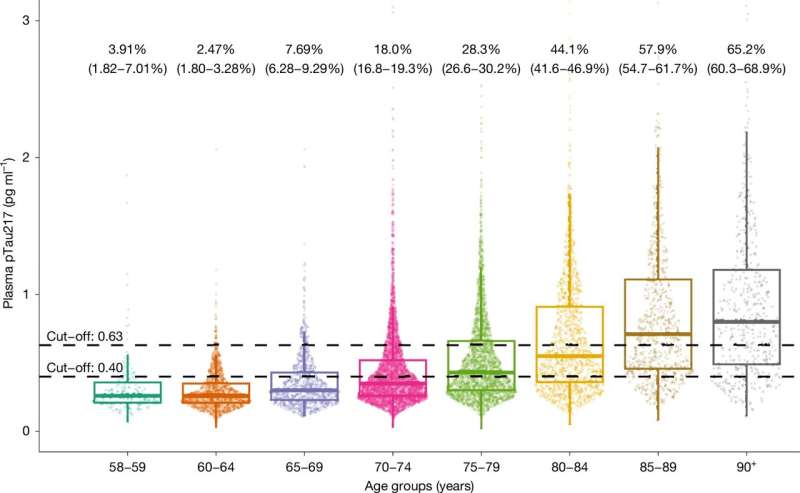
Plasma pTau217 concentrations in different age groups. Credit:Nature(2025). DOI: 10.1038/s41586-025-09841-y
New research, published inNature, has provided the first ever population-based data on the frequency of Alzheimer's disease neuropathological changes (ADNC)—a key causal factor behind the development of dementia—and found that it is more prevalent than previously thought in the oldest age groups (e.g., 85+) but lower in those under 75. These changes were less common in people with higher education levels.
The research, conducted by King's College London, Stavanger University Hospital, and University of Gothenburg, used a simplenon-invasive blood testto establish that more than 1 in 10 adults over 70 met the eligibility criteria for monoclonal antibody treatments that are capable of slowing cognitive decline.
ADNC are deposits of proteins in the brain that result in the death of neurons and synapses, particularly in the hippocampus, which is vital for memory. While they are anexcellent biomarkerand early sign for the potential development of Alzheimer's and other related diseases, testing for it in England on the NHS requires either a lumbar puncture to analyze cerebrospinal fluids, or a PET scan. As such, the true prevalence of ADNC has been difficult to establish.
In this study, researchers worked with members of TheTrøndelag Health Study(HUNT) in Norway to analyze 11,486 blood samples provided by participants over the age of 57 in the local population.
Their analysis of the data found that the prevalence of ADNC increased with age; just under 8% of participants aged 65 to 69 compared to 65% of the over 90s had clearly abnormal findings on the biomarker. Researchers suggest this shows evidence of a higher prevalence of Alzheimer's dementia in older individuals and a lower prevalence of preclinical Alzheimer's disease in younger groups than previously estimated.
"In an aging global population, the assessment and treatment of dementia presents a significant challenge. Our study used a simple blood test to establish changes that contribute to cognitive impairment in those with dementia," said Professor Dag Aarsland, a Professor of Old Age Psychiatry at King's IoPPN and the study's lead author.
Further analysis, however, revealed that among those participants over the age of 70, ADNC was present in 60% of people with dementia, and in 32.6% of those with mild cognitive impairment. These findings show that factors other than ADNC are important contributors to dementia.
The findings challenge previously held beliefs about the nature of dementia, including that it is a "female dominant" disease. Researchers were unable to find any significant differences in prevalence between the sexes at any age group.
Professor Aarsland, a Professor of Old Age Psychiatry at King's IoPPN and the study's lead author said, "We found that around 11% of participants over the age of 70 meet the eligibility criteria for monoclonal antibody treatments that can potentially slow the impact of cognitive decline in these individuals.
"If we are to meet this global challenge, it is vital that we are able to detect signs of dementia at the earliest possible stages. This blood test looks to be an effective means of providing that clarity at scale."
The blood test used in this study is not available on the NHS.
The researchers are now exploring how well theseblood-based biomarkerscan predict the development of dementia. They also want to work with GPs to find out how these tests can be used in primary care.
More information Dag Aarsland et al, Prevalence of Alzheimer's disease pathology in the community, Nature (2025). DOI: 10.1038/s41586-025-09841-y Journal information: Nature
Provided by King's College London










Post comments