




































by Melinda Krigel,University of California, San Francisco

Credit: Pixabay/CC0 Public Domain
Researchers at UC San Francisco have developed a new way to improve walking for patients with Parkinson's disease using deep brain stimulation and artificial intelligence.
Deep brain stimulation (DBS) uses an implanted device to send electrical signals to specific areas of the brain. With the help ofartificial intelligence(AI), researchers developed a first-of-its-kind measure ofgaitperformance and fine-tuned the electrical pulses to individual patient's needs that led to meaningful improvements in walking without worsening other symptoms.
Doris Wang, MD, Ph.D., a neurosurgeon and UCSF associate professor of Neurological Surgery, specializes inmovement disorders, including Parkinson's disease, and led the NIH-supported research team, along with Hamid Fekri Azgomi, Ph.D., a UCSF postdoctoral researcher. She explains the research and what it means for patients.
DBS uses an implanted device. This is done with a minimally invasive surgery. I drill two very small holes in the skull, and then insert really thin wires or electrodes, which are the size of angel hair spaghetti and very flexible. The wires run from the side of the head all the way down to the chest under the skin. In the chest, these wires are connected to an electrical pulse generator. You can think of it as a pacemaker for the brain.
In Parkinson's disease, the destruction of dopamine neurons in the brain's basal ganglia area causes a variety of motor issues, including "Parkinson's gait." People with the disease tend to shuffle when they walk and take many mini steps when they turn. They also have different step lengths between the left and right foot, and some patients freeze in place.
These symptoms often lead to falls. These walking problems are reflective a change in the pattern of their brain waves, making it harder for them to change their movements. DBS works by changing these patterns.
Among Parkinson's patients' major symptoms, gait has been quite difficult to treat. The most severe types of gait disorder are really challenging to treat with either medication or DBS. Although we use continuous high-frequency DBS to treat tremor and the slowness and stiffness of movement, it doesn't work well for gait.
That inspired me to think about different ways to stimulate the brain, by changing the timing and amount of energy delivered from the DBS simulation for gait specifically. That was the motivation for our study.
Our study looked at gait from two different perspectives—one is clinical and the other neurophysiological.
From the clinical perspective, we wanted to know how we quantify good gait, or effective gait, versus poor gait. And then, how we could tune different stimulation parameters to change patients' gait metrics.
From the neurophysiological perspective, we wanted to figure out what are the common effects of these gait-optimized stimulation parameters on brain activity.
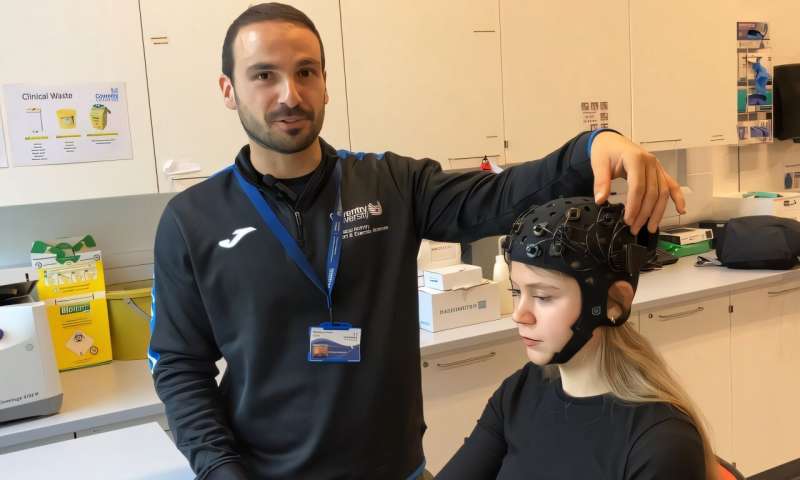
Using wearable motion sensors and brain stimulation electrodes, researchers record how a person with Parkinson's disease walks during a series of exercises. This video shows a reconstructed representation of the person walking. By analyzing features such as leg swing, arm movement, and walking speed, the team can characterize everyone's gait. The research team then uses AI algorithms to systematically identify person-specific DBS configurations, aiming to enhance their gait functions.
With each patient, we had to determine their baseline under their usual DBS settings and how we could make their gait better or worse by changing their DBS settings. Then we had them walk laps while we continuously streamed their neural data and gait mechanics.
We developed a Walking Performance Index, which is a comprehensive but also easily quantifiable set of measurements that indicates whether the person was actually walking better. We included four features that differentiate Parkinson's gait from healthy subjects, including arm swing amplitude, stride speed, stride length variability, and stride symmetry.
From these sessions, we gathered data and used machine learning to identify the DBS settings that improved each patient's gait. AI helped predict the settings that might be best for different patients. We found that for some patients, a really high frequency worked better for their gait. For others, a lower frequency worked best. So not everyone's gait-optimized settings are the same.
By studying how DBS influences the cerebral cortex's motor network, we identified brain waves associated with improved walking performance, which can further guide programming in the future.
The personalized settings for each patient led to meaningful improvements in walking, such as faster, more stable steps, without worsening other symptoms. We are actively working on an adaptive, or closed-loop, DBS algorithm where patients switch to this gait-optimized setting when walking but remain on their standard DBS at all other movement states. We hope that this can significantly improve gait symptoms for Parkinson's patients and ultimately improve their mobility and reduce falls.
Provided by University of California, San Francisco








Post comments