




































bySanjukta Mondal, Medical Xpress
Our date of birth doesn't always match the age of our brain. How old our brain really is depends on our biological age, shaped by the wear and tear our cells experience over time. Genetics, environmental factors, and lifestyle choices all play a role in shaping how young or old our body's components are. A biological age higher than your actual chronological age can signal an increased risk of age-related diseases and health problems.
Arecent sleep electroencephalography (EEG) studyinvolving 7,105 adults aged 18 and older, none of whom had dementia at the start, found something striking: for every 10-year increase inBrain Age Index(BAI), the risk of developing dementia rose by about 39%.
They found that brain age was a unique predictor that held true even after the researchers accounted for other major risk factors, such as actual age, sex, lifestyle, andapolipoprotein E ε4status—a known marker of genetic predisposition to Alzheimer's disease and dementia. The findings are published inJAMA Network Open.
Zooming in to sleepy brain signals with AI
With each passing year, the number of dementia and Alzheimer's diagnoses continues to rise, and with the global population aging, these numbers are only expected to increase. Alongside proper treatment, identifying the right biomarker for detecting and predicting neurodegenerative diseases has become a priority.
Many studies have recognizedsleep disturbanceas an early indicator and potential modifiable risk factor for dementia. Standard sleep measures like total sleep time and efficiency show only weak and inconsistent links to dementia risk, with pooled studies finding no clear association.
The researchers in this study examined a new sleep indicator: the EEG-based BAI. They set out to understand whether sleep-based BAI could help predict the risk of developing dementia in older adults living in the community.
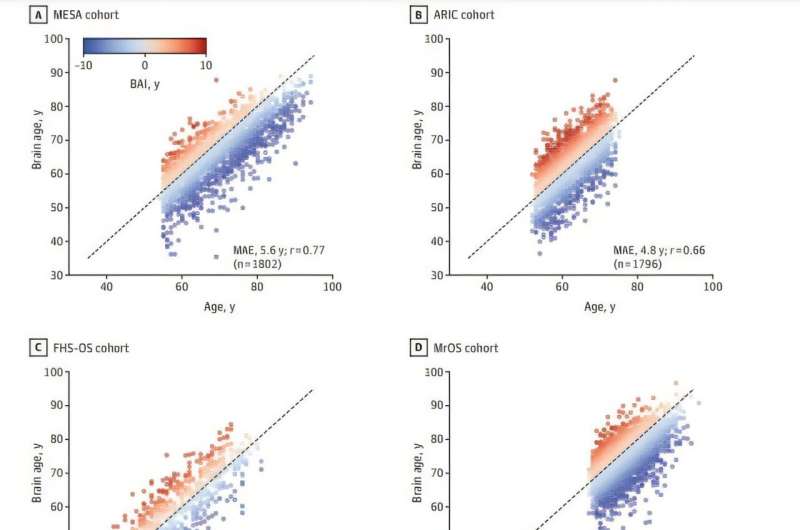
Scatter plots of chronological age vs. sleep electroencephalography (EEG)–based brain age in all cohorts. Credit:JAMA Network Open(2026). DOI: 10.1001/jamanetworkopen.2026.1494
Instead of using sleep EEG simply to measure sleep quality, the team repurposed the technology to examine microscopic details of brain waves, including their speed and structure across different stages of sleep. They gathered EEG data of adult participants who were part of five large, long-term community health studies.
This data was then fed into amachine learning modeldesigned to analyze patterns and estimate a person's age. The model was trained on EEG data from people without known brain conditions, so it could learn what healthy brain activity during sleep looks like across different ages and sleep stages.
Once trained, the system could predict a person's age based on their brain activity during sleep. The team defined BAI as the difference between EEG-predicted brain age and actual age. If the AI estimated an age older than the person's actual age, it indicated a higher BAI, suggesting faster brain aging than expected.
A higher BAI was linked to a greater risk of future dementia, and this relationship stayed strong across five large studies involving thousands of participants, applying equally to men and women and to those both below and above 70.
Participants across all five groups were followed for periods ranging from about three to nearly 17 years, allowing researchers to track who eventually developed dementia. They found 1,082 people developed dementia during the follow-up period—702 men and 380 women.
The findings show that theEEG-based BAI, built on interpretable brain wave patterns, could offer an accessible way to identify people at risk of dementia years before symptoms appear.
Before it can be used clinically, BAI must be further studied to establish its relevance as a dementia prediction biomarker across diverse populations and among individuals with competing risks such as psychiatric illnesses and comorbid conditions.
© 2026 Science X Network
Publication details Haoqi Sun et al, Machine Learning–Based Sleep Electroencephalographic Brain Age Index and Dementia Risk, JAMA Network Open (2026). DOI: 10.1001/jamanetworkopen.2026.1521 Omonigho M. Bubu, Sleep Electroencephalography Brain Age—A Window Into Incident Dementia Risk, JAMA Network Open (2026). DOI: 10.1001/jamanetworkopen.2026.1494 Journal information: JAMA Network Open








Post comments