




































byIngrid Fadelli, Medical Xpress
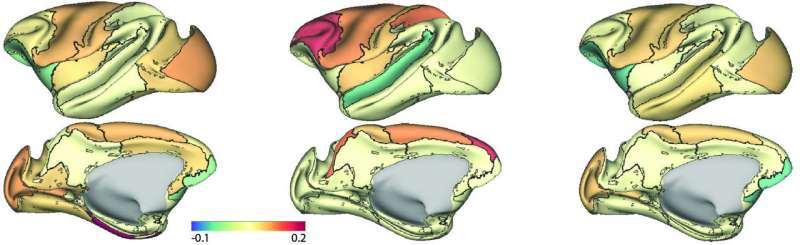
Changes of volume (first column), cortical thickness (second column) and surface area (third column) during adolescent development. Color represents proportional change from the earliest time point available. Credit: Zhu et al.
Adolescence, the life stage that marks the transition between childhood and adulthood, is known to be a vital period for the brain's development. During this critical phase, people's mental abilities, including their problem-solving and memory skills, rapidly improve.
Past neuroscience studies have tried to link these observed cognitive improvements during adolescence to changes in the structure of the brain and the connections between different brain regions. Nonetheless, the relationship between changes in the brain and specific aspects of cognitive performance has not been fully elucidated.
Researchers at Vanderbilt University, CNRS Université de Lyon, and Wake Forest School of Medicine recently carried out a study involving monkeys that was aimed at shedding new light into the underpinnings of mental maturation during adolescence. Their findings,publishedinNature Neuroscience, suggest that the cognitive development of adolescent monkeys is associated with a refined connectivity between brain regions, while changes in gray matter structure play a lesser role.
"It is well known that theprefrontal cortex, the part of the brain most responsible for higher cognitive functions, matures more slowly than other brain areas," Christos Constantinidis, senior author of the paper, told Medical Xpress.
"Parents of teenagers fault the immature prefrontal cortex for poor life choices and impulsive decisions. Much less is known about how the activity of neurons in the prefrontal cortex changes so as to effect of this cognitive maturation. Our study was designed to chart changes in neural activity and identify what structural changes in the brain are responsible for them."
As part of their study, the researchers studied juvenile monkeys for several years, periodically collecting recordings of their brain and testing their cognitive skills. To assess their cognitive skills, they employed versions of tasks that are widely used to test the mental capabilities of children.
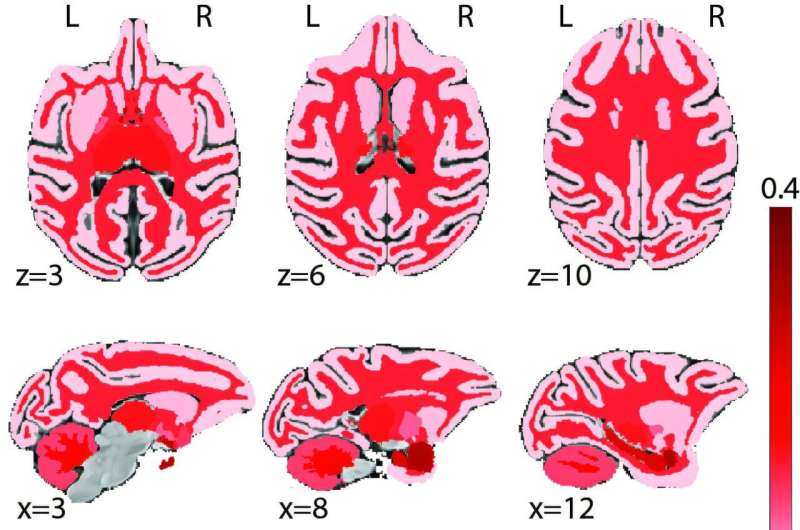
Map of volume changes across the brain during adolescent development. Credit: Zhu et al.
"We tested monkeys with behavioral tasks measuring working memory and ability to resist distraction," explained Constantinidis.
"We relied onmagnetic resonanceimaging (MRI) imaging methods to determine how the thickness and volume of the cerebral cortex and the myelination of white matter that connects different areas change as a function of age. Additionally, we were able to directly monitor the activity of neurons in the prefrontal cortex with microelectrode recordings."
Notably, most monkey species age 3 times faster than humans and their adolescence lasts around 2–3 years. Constantinidis and his colleagues tracked the development of young monkeys for this entire period, using both experimental tasks and MRI imaging.
When they analyzed the data they recorded, the researchers found that the cognitive performance and neuron firing rate of monkeys was best predicted by the maturation of white matter connecting the frontal lobe with other brain areas. This suggests that the connectivity between brain regions known to support mental functions plays a key role in the improvement of mental skills observed during adolescence.
"Cortical thickness, which is known to decrease during development as used synapses are pruned, was less predictive of cognitive maturation," said Constantinidis. "Our results begin to tie structural changes in the brain, which are more easily detectable with imaging methods in humans, to changes in the activity of neurons, which are more difficult to assess."
This recent study suggests that the growth of white matter in the primate brain is a signature of healthy brain maturation. In the future, Constantinidis and his colleagues plan to extend their research to include other brain areas beyond the prefrontal cortex.
"In these experiments, it was only possible to monitor neural activity from the prefrontal cortex," he added. "We plan to extend our approach to find out howneural activitymatures across the brain.
"So far, we have only used a few working-memory based tasks, but we would like to also expand the range of cognitive tasks we use and determine which brain areas are responsible for execution of more complex cognitive functions as development progresses. In parallel we aim to refine our techniques and reveal how activity patterns emerge across layers of the cerebral cortex."
© 2025 Science X Network
More information: Junda Zhu et al, Longitudinal measures of monkey brain structure and activity through adolescence predict cognitive maturation, Nature Neuroscience (2025). DOI: 10.1038/s41593-025-02076-0 . Journal information: Nature Neuroscience







Post comments