




































byDaegu Gyeongbuk Institute of Science and Technology
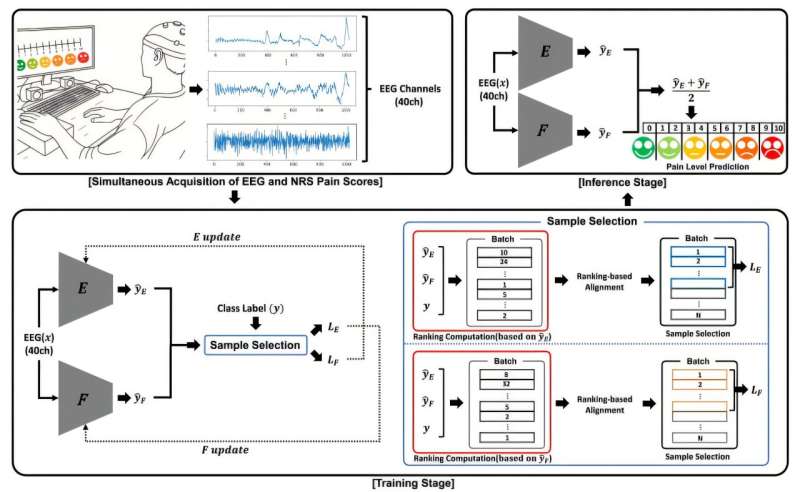
Overall process of the proposed EEG-based pain level classification method. Credit:IEEE Transactions on Neural Systems and Rehabilitation Engineering(2026). DOI: 10.1109/tnsre.2026.3692232
A research team has developed technology that uses artificial intelligence to analyze electroencephalogram signals triggered by thermal stimuli and objectively classify pain intensity. The study ispublishedinIEEE Transactions on Neural Systems and Rehabilitation Engineering.
The team was led by Principal Researcher An Jinung at the DGIST Industrial AX Innovation Institute, who also serves as an adjunct professor in interdisciplinary engineering, in collaboration with Professor Jeon Seong-chan's team at Gwangju Institute of Science and Technology.
Because pain perception varies from person to person, previous methods relied heavily on theVisual Analog Scale, a subjective scale reported by patients. This resulted in inconsistent evaluations, even for the same stimulus, and posed significant limitations in accurately assessing pain in patients who have difficulty communicating, such as those with impaired consciousness, children and older adults.
An's team developed a technology that uses AI to analyze EEGs generated during various thermal stimuli to classifypain intensity. Rather than relying on conventional methods that simply learned from patients' subjective pain scores, the team implemented an algorithm in whichtwo AI modelscompare their prediction results and selectively learn only from highly reliable data. This effectively reduced the bias in pain expression, which varies from person to person.
In tests using EEG data from 41 participants, the model demonstrated significant performance improvements compared with conventional models and maintained stable predictions in new stimulus environments where the model had not yet been trained. The researchers also found that delta wave activity in the left and right anterior temporal lobes, F7 and F8, is closely associated with pain intensity, establishing a neurophysiological basis for developing brain-based digital biomarkers.
"This study directly addresses the bias in subjective self-reported labels, which was the chronic limitation of EEG-based pain analysis," An said. "We intend to develop this into a universal pain AI platform that can be utilized in actual clinical settings by integrating various bio-signals."
First author Jeong Ui-jin, a postdoctoral researcher, said, "We hope this technology will be widely used for pain monitoring before and after surgeries, chronic pain tracking, and objective pain assessment in intensive care units." Jeong added, "Moving forward, we will devote ourselves to research so that it can be expanded into a brain-computer interface-based real-time monitoring system."
More information Euijin Jung et al, EEG-Based Pain Classification via Sample Selection to Mitigate Subjective Label Bias, IEEE Transactions on Neural Systems and Rehabilitation Engineering (2026). DOI: 10.1109/tnsre.2026.3692232









Post comments